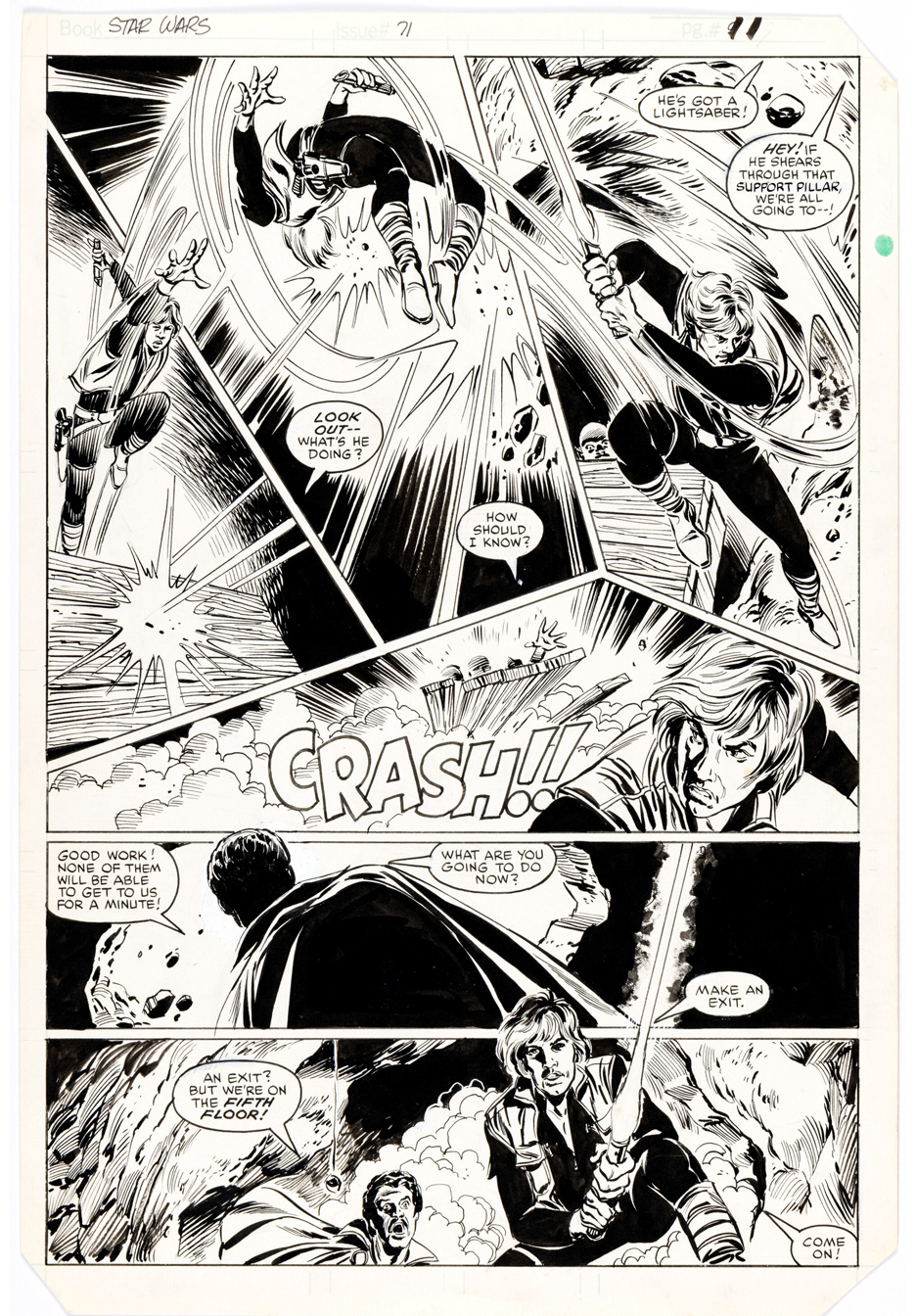
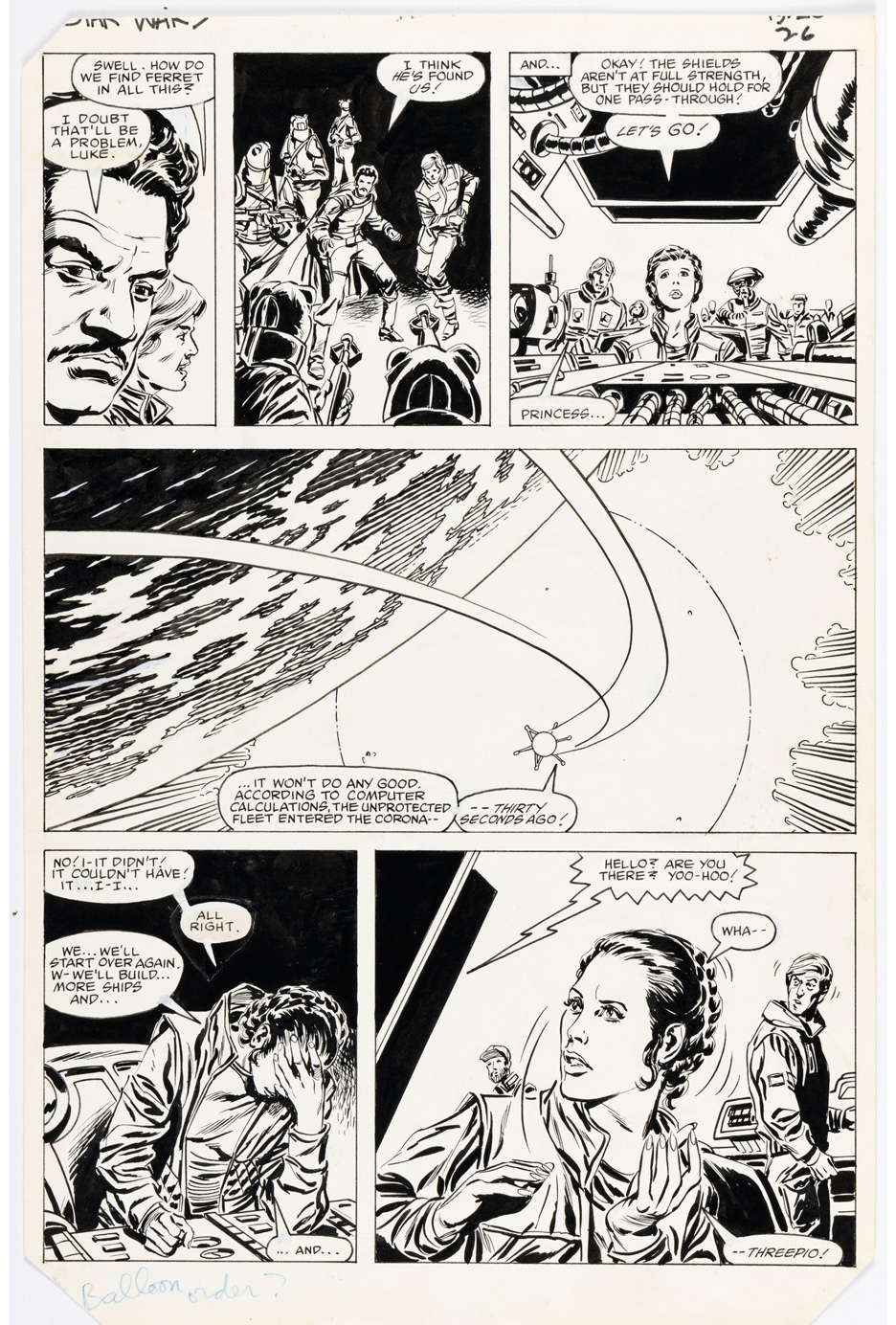
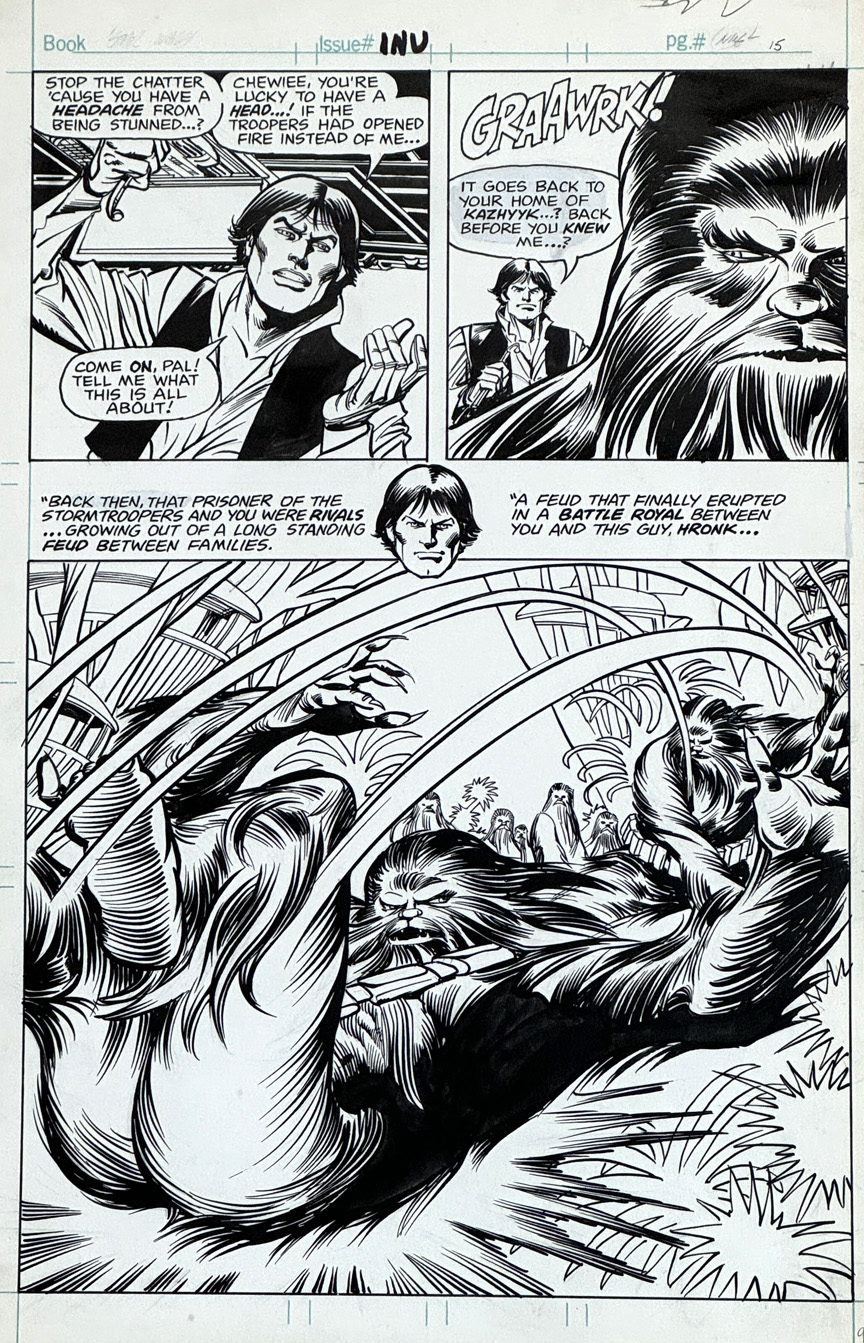
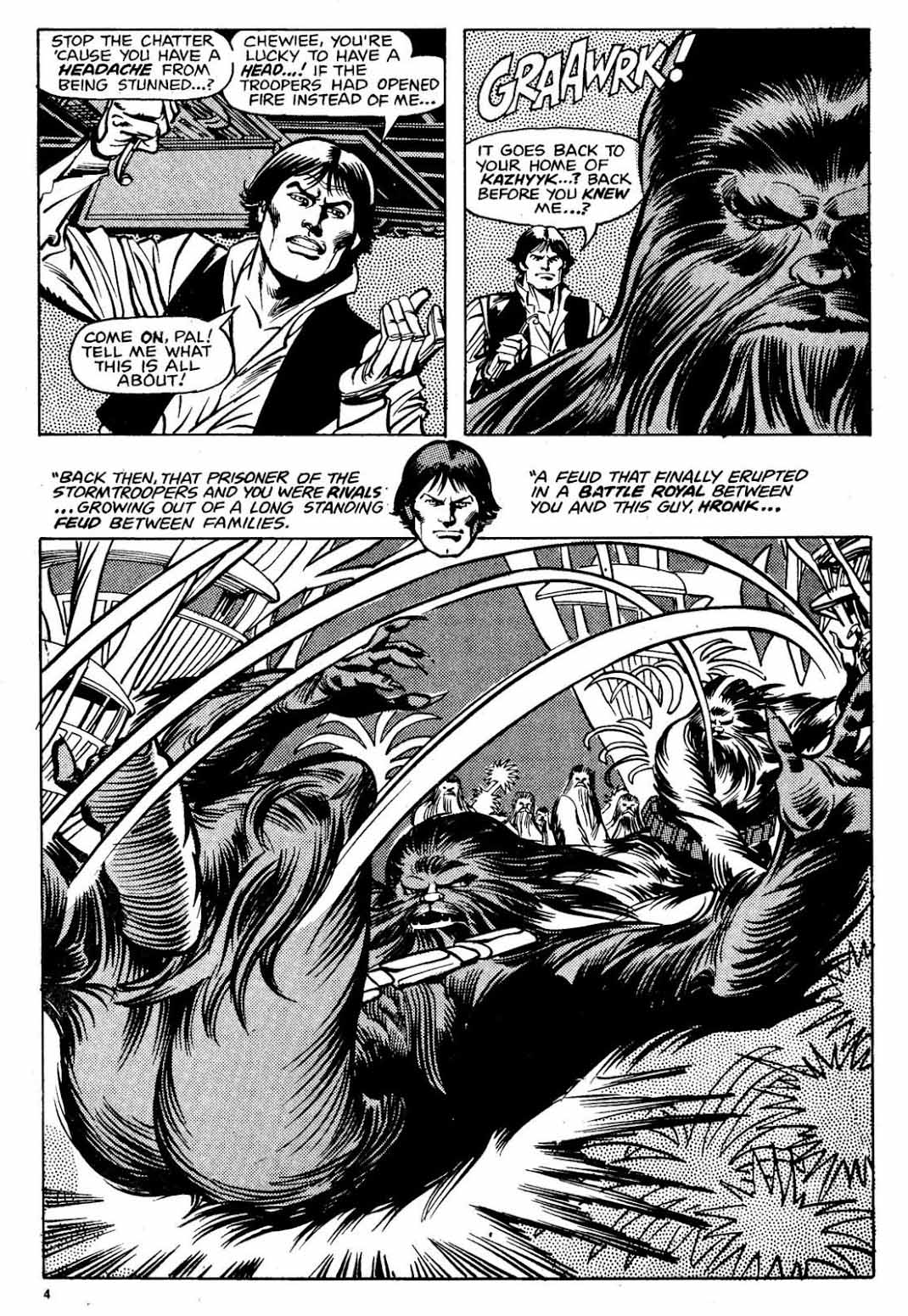
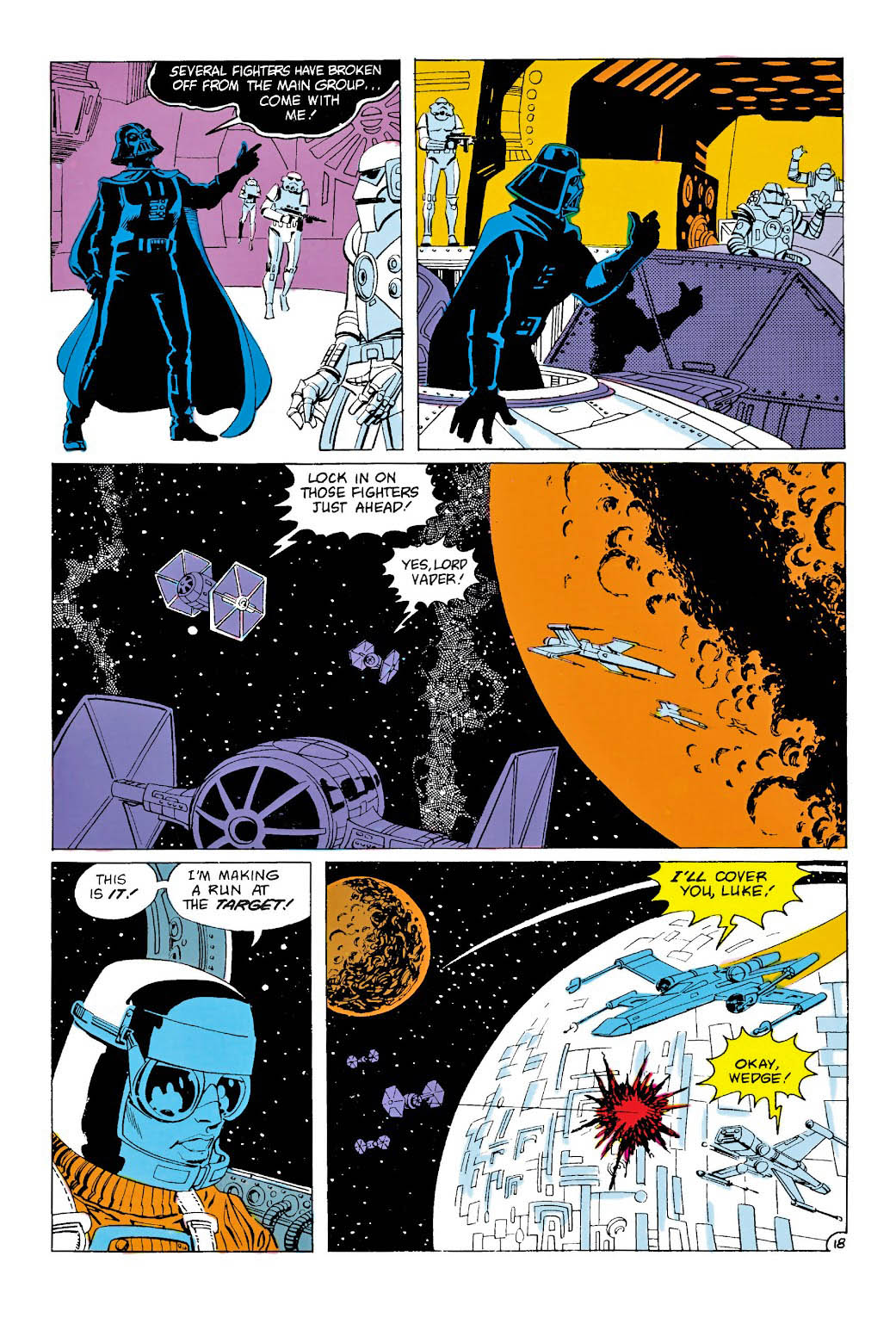
Here is a very dynamic page from a very dynamic art duo (sorry, couldn’t resist) of Ron Frenz and Tom Plamer. Following the terrific run by Walter Simonson and a few fill-in issues from Gene Day, Frenz took over as regular penciller; Palmer stayed on as inker, once again providing a smooth consistency to the art.
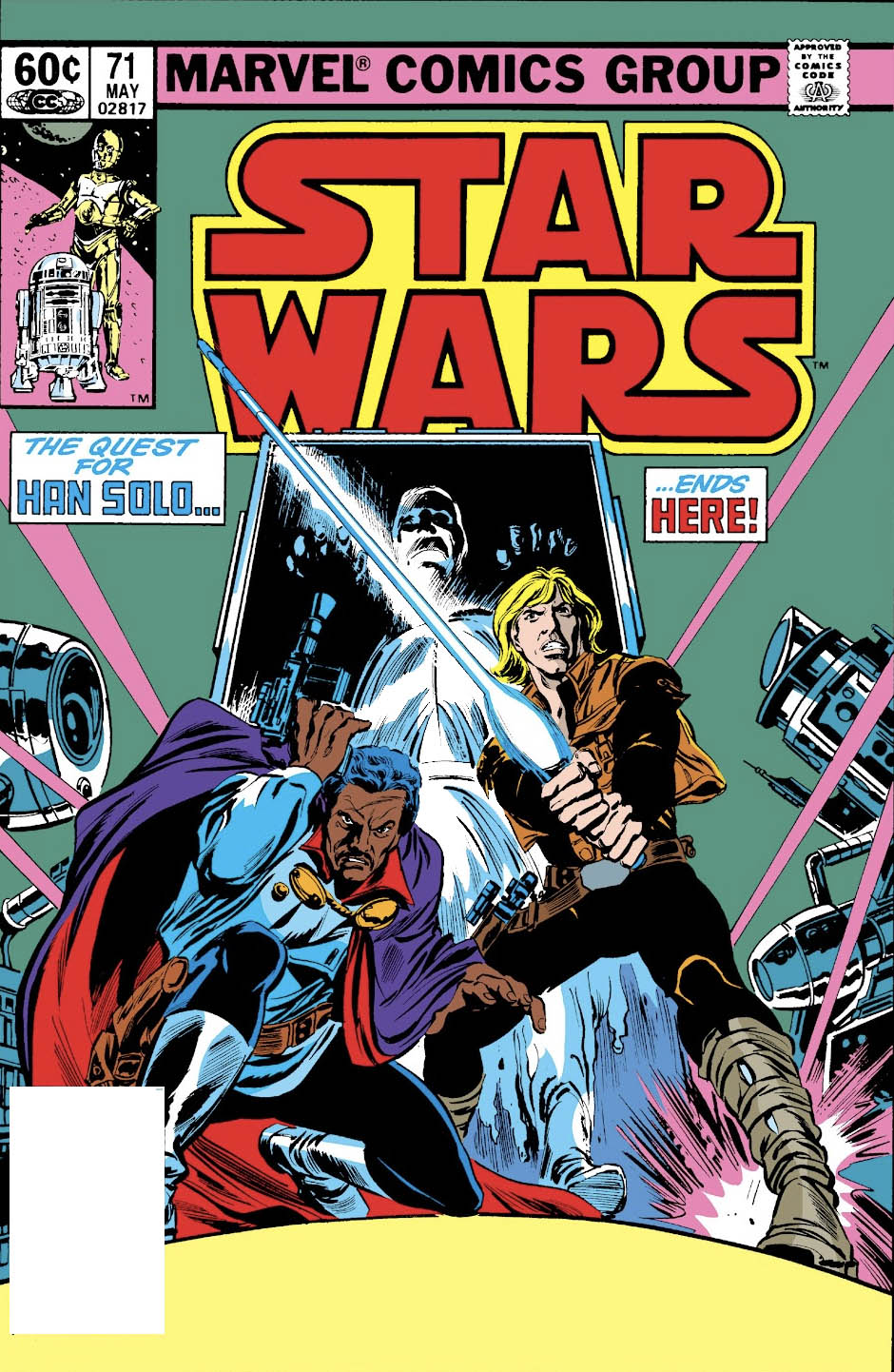
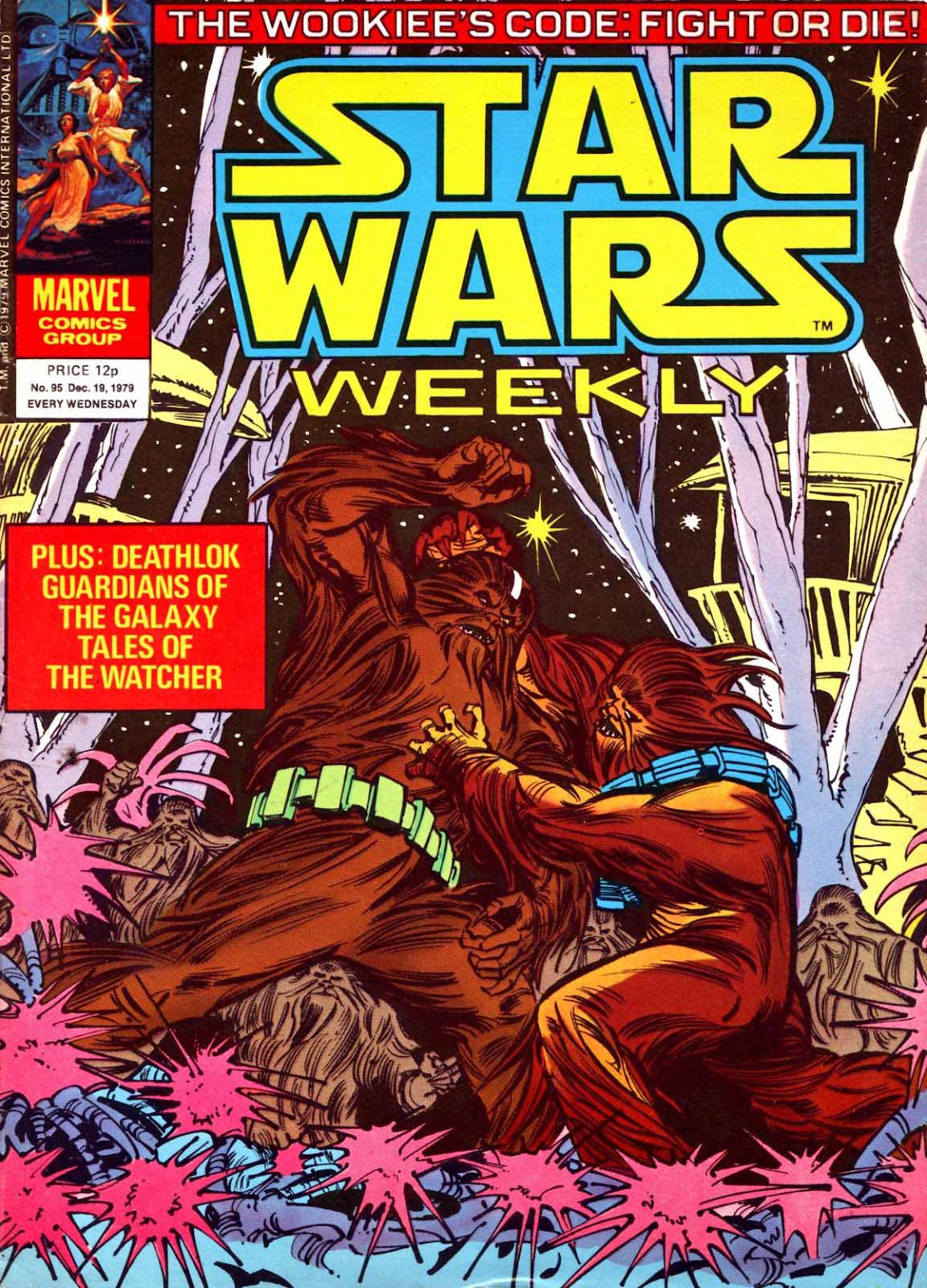
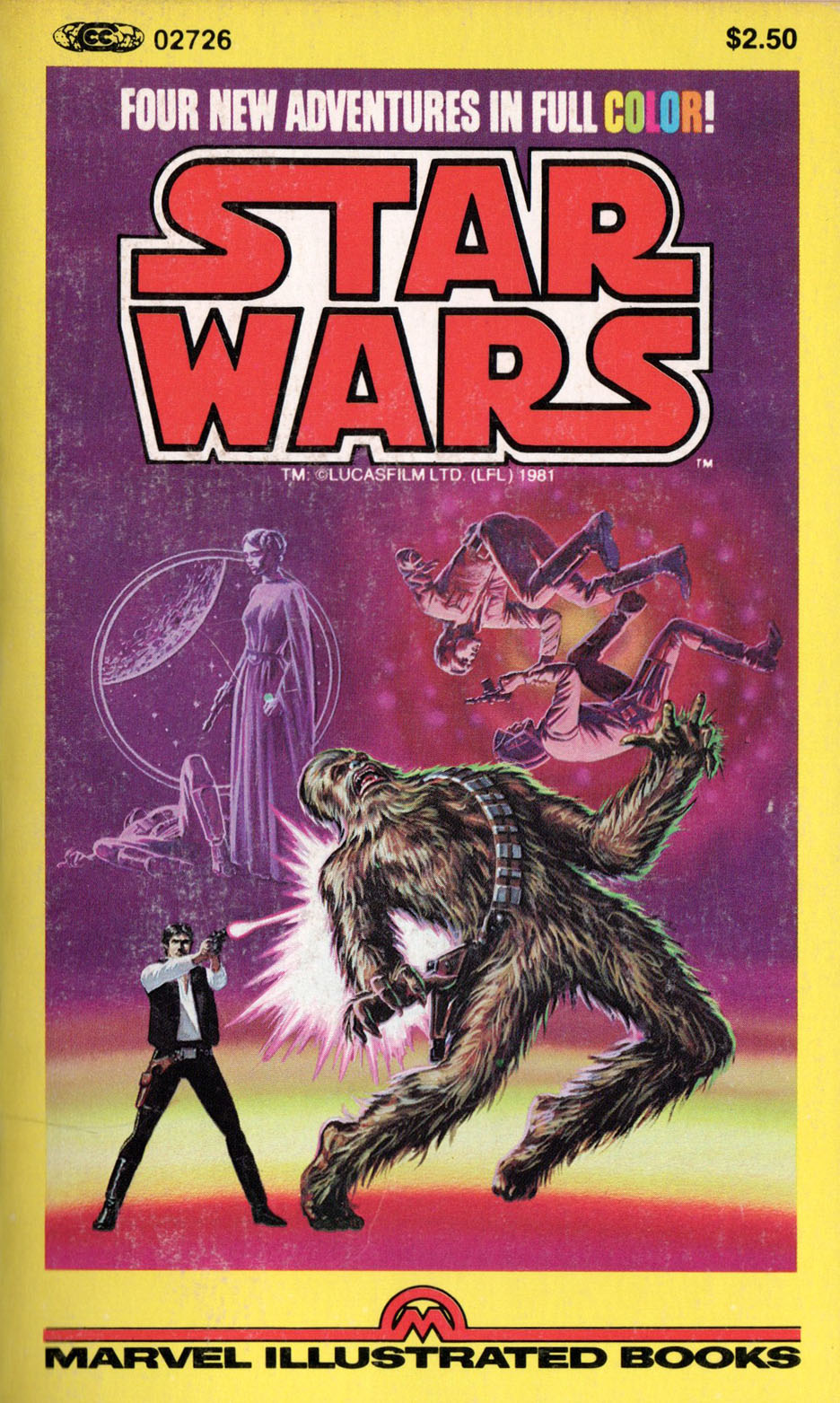
As for the story? Don’t let the cover blurb fool you. The quest For Han Solo most definitely did not end here; he wasn’t able to return to Marvel’s Star Wars series until a few months after the release of Return of The Jedi. (Issue #81, to be precise.) And again, Marvel’s creative team did a heckuva job with the little information they had ahead of ROTJ.
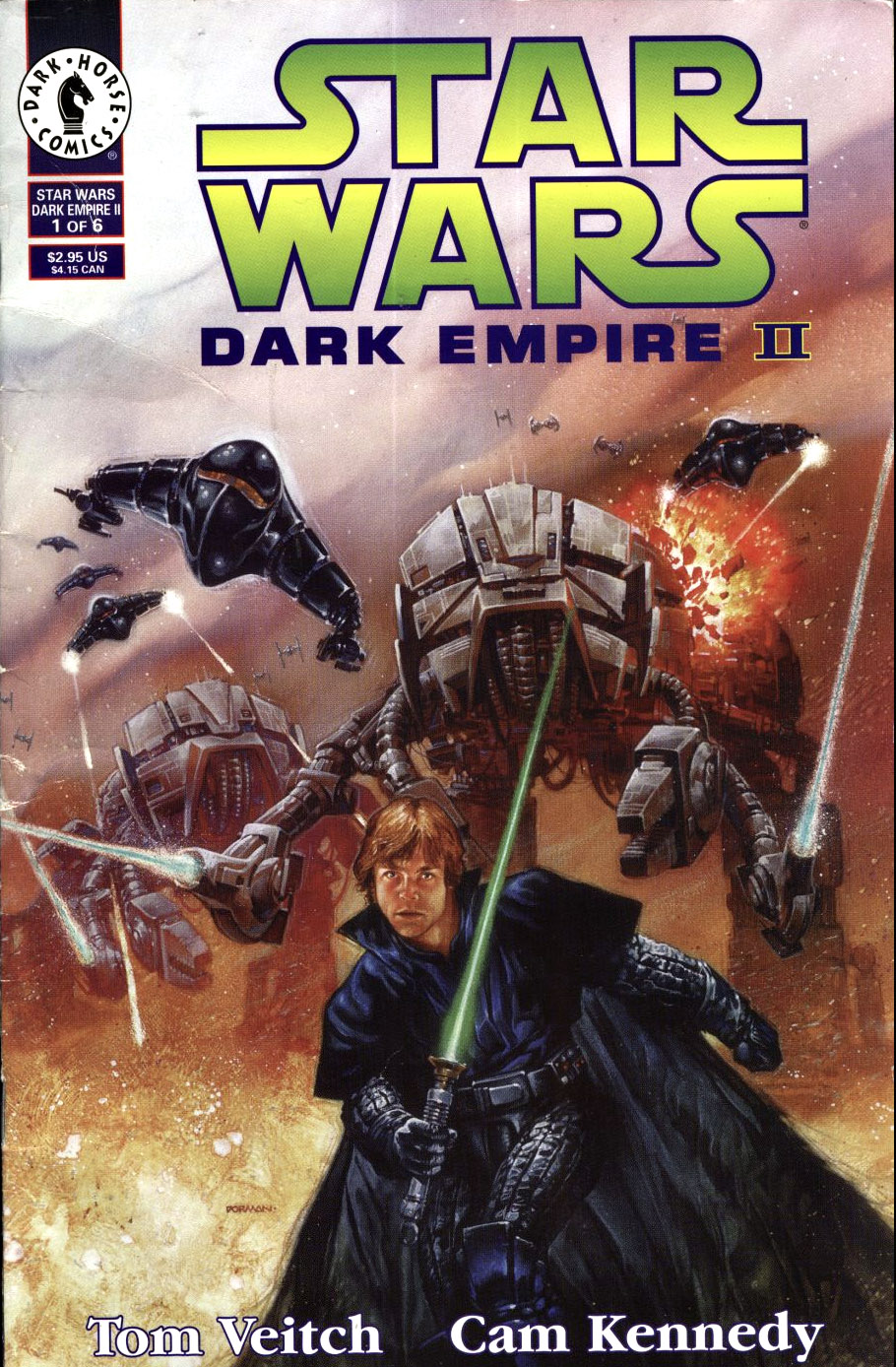
Hey Disney — if you had simply adapted and updated material from the Thrawn Trilogy (“Heir to The Empire.”) by Timothy Zahn, and the Dark Empire Trilogy (Tom Vetch) you would have had a sequel film series that people would still be talking about — favorably.
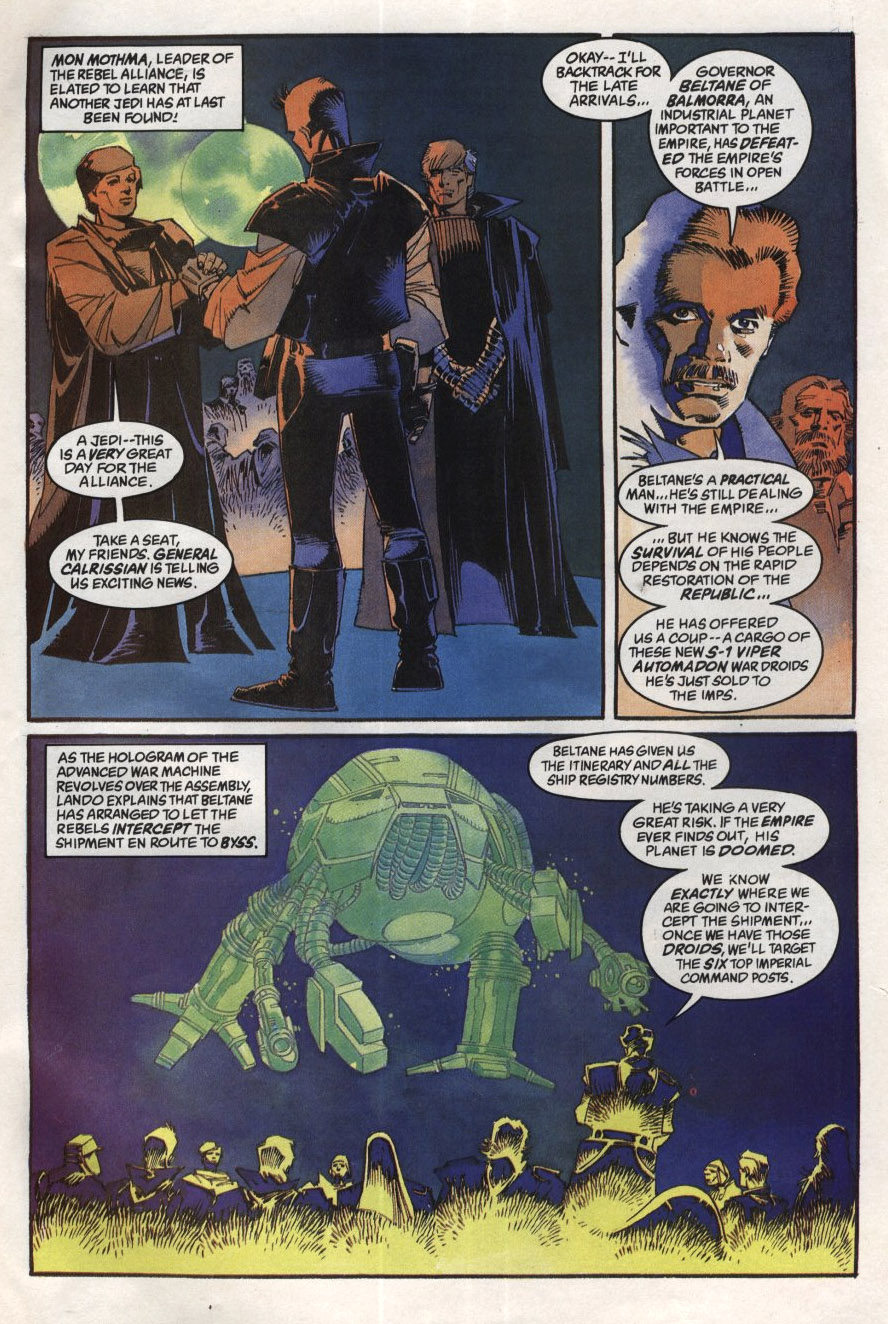
The Star Wars expanded universe was on fire in the early 90s, and these Dark Empire comics are among the standouts. Pretty much every painted page by Cam Kennedy is a masterpiece, and I’m glad to finally add one to my collection. Luke, Lando and the now ultra-essential Mon Mothma are featured here, along with that ridiculously cool war machine.
That was the Star Wars experience we deserved — then and now.
Ah, to have been a fly on the wall at a Marvel Comics- Lucasfilm meeting, about 9 months or so before the release of Empire Strikes Back in 1980:
Lucas: “So, guys, let us tell you— the next film is going to end quite dramatically: Han Solo will be in suspended animation, in the ship of a bounty hunter, on his way to the clutches of Jabba The Hutt. Chewie, and a new character, Lando, will appear to be going after them, and Luke, clearly not a Jedi yet, will remain with Leia and the droids in the rebel fleet.
Marvel: “Great, what happens next?”
Lucas: “That’s it, that’s the end of the film. It’s a cliffhanger.”
Marvel: “And we don’t know what transpires until the next film?” Lucas: “Correct.”
Marvel: “For three years?
Lucas: “Also correct.”
Marvel: “Ok. That’s about 36 issues. You’ll give us the broad strokes of how the next film opens so we can create scenarios and plots with the remaining characters accordingly?”
Lucas: “Er, we don’t have all the details yet, but we will figure it out.”
All credit to Louise Simonson, Archie Goodwin, Walter Simonson, David Michelinie and an hefty all-star group of talent for somehow making the challenge work.
And, of course, extracredit to Tom palmer, who, as always, made it visually come together, regardless of who penciled the book: Simonson, Ron Frenz, Gene Day, Kerry Gammill, et al.
Oh, and they recycled an unused Carmine Infantino John Carter of Mars story during this period as well.
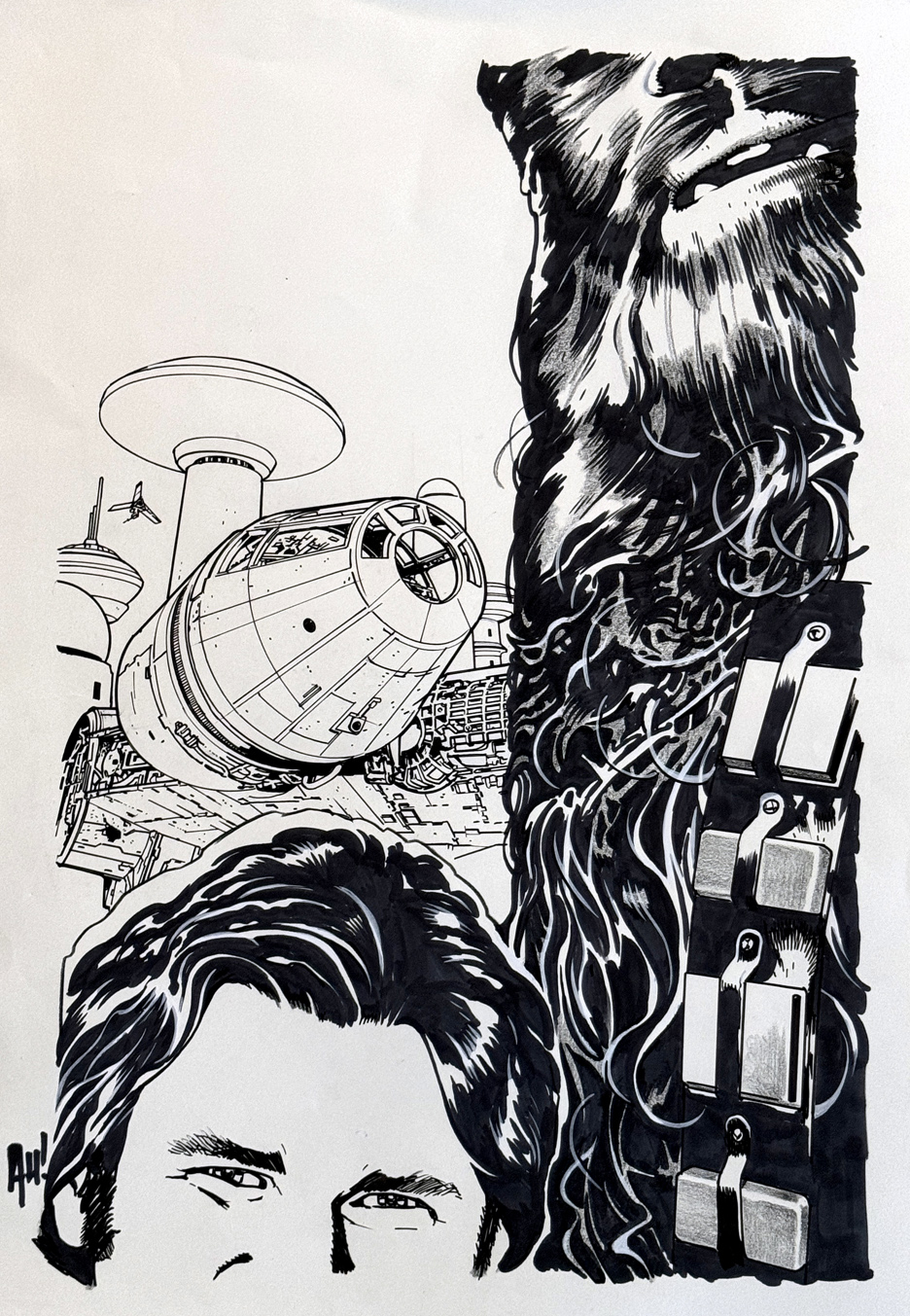
This fun Star Wars cover from Adam Hughes brings a giant smile to my face.
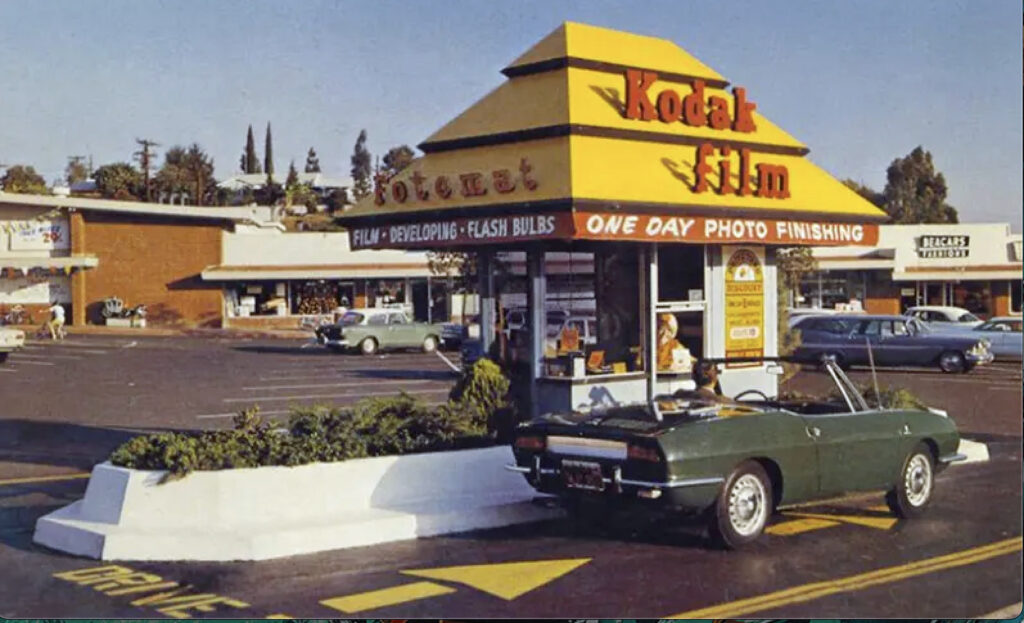
It reminds of the pre-digital age of photos, when we all used film cameras (with some notable exceptions thanks to Polaroid). We took the roll of film into a processor (Fotomat* anyone?) and never knew what we would find in return.
Didn’t quite frame all the subjects the way we planned? Oops, too bad. I had a few of those photos. Probably more than a few.
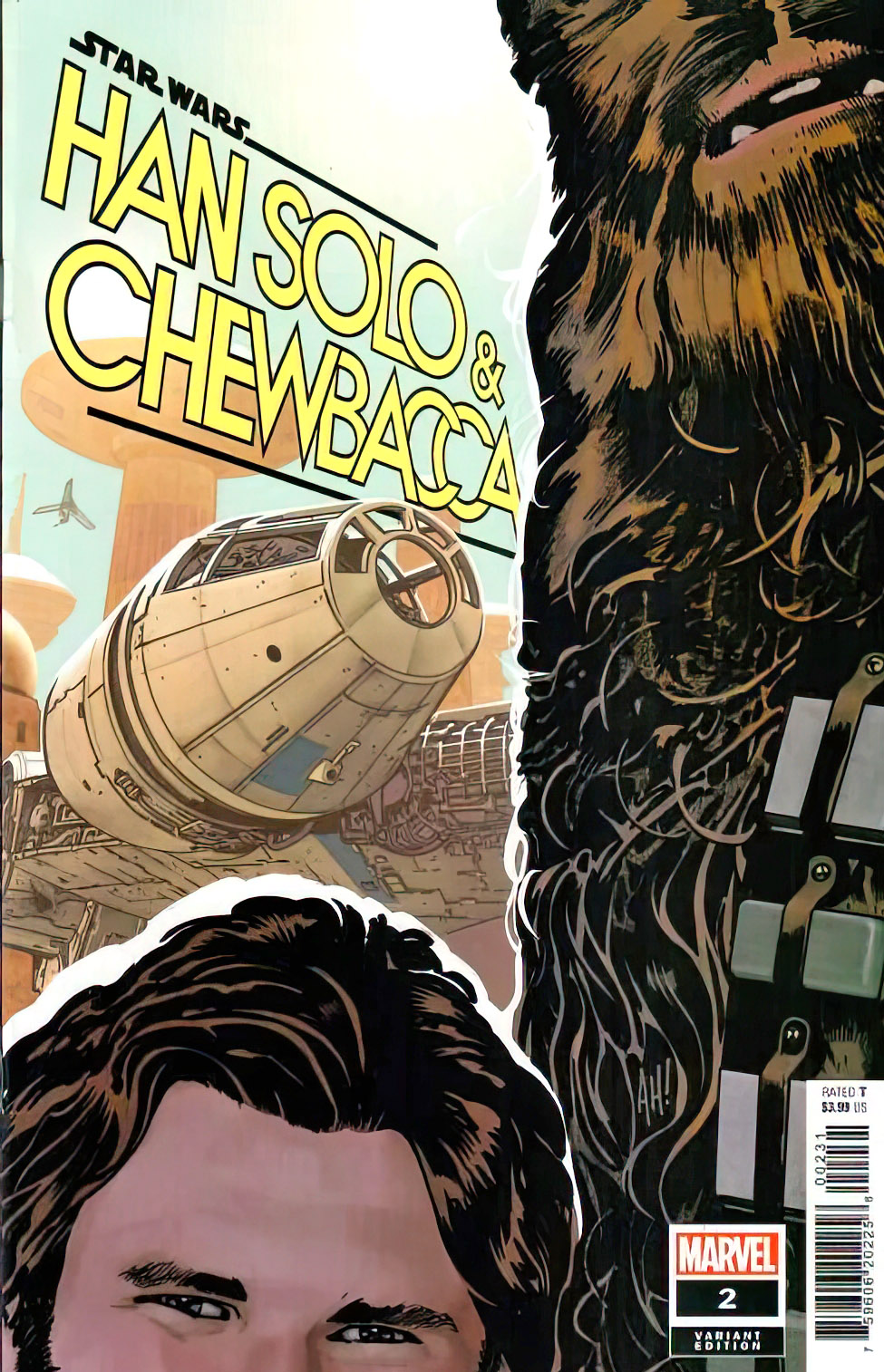
The focal point of Adam’s composition, of course, is to highlight the Millennium Falcon, something more obvious in the original art. The detail in the ship is just great, as is the clever cropping. (Much of the Falcon’s detail is obscured in the published color version.)
If it weren’t for the tiny ship in background flight, by the way, It looks like Han and Chewie visited Star Wars Galaxy’s edge at Disneyland and couldn’t quite get the selfie right. I think I may have one of those pictures myself.
Happy Star Wars month — more to come, of course. And of course, Happy 45th, Empire Strikes Back, as well.
*Odd fact of the day: Fotomat processing centers peaked in scope in 1980, with 4,000 locations, at about the release time of ESB.
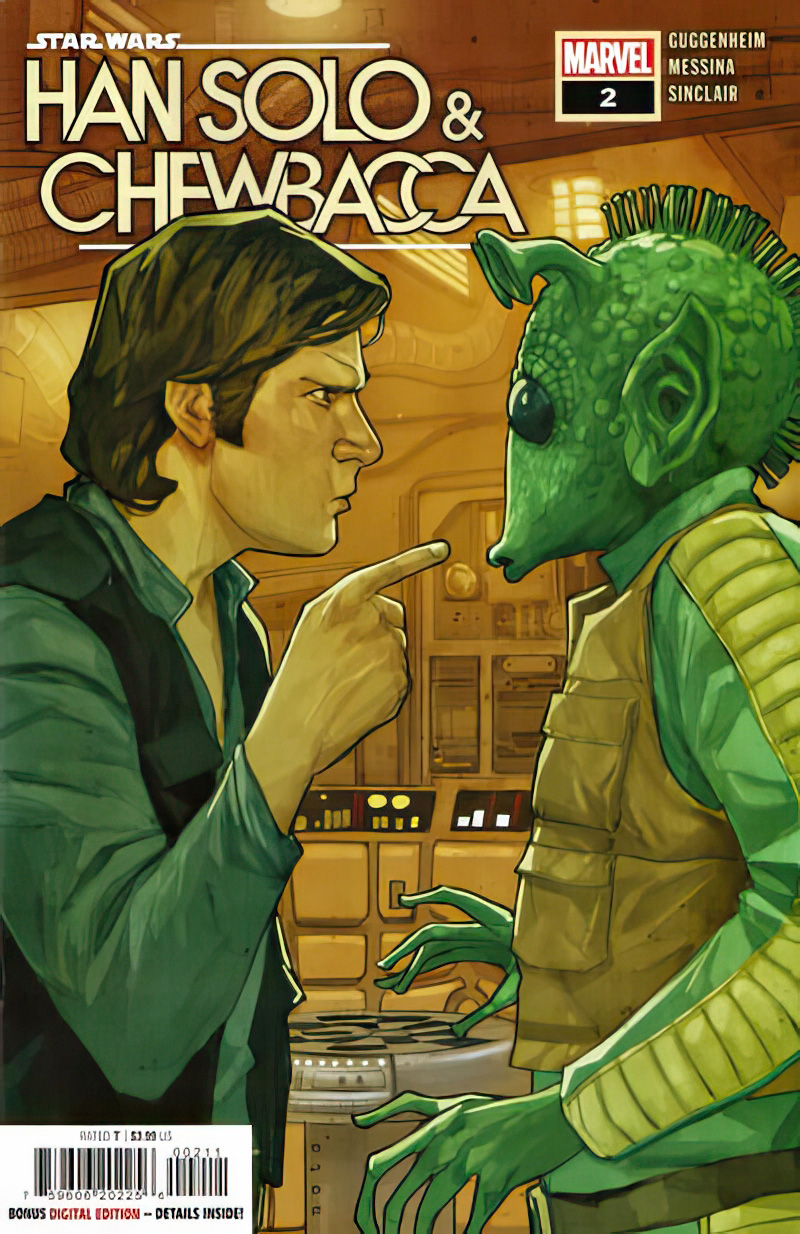
Fun covers all around: The Hughes variant and the “main” cover, courtesy of Phil Noto.
Peak Mike Kaluta. From a version of project that I didn’t recall at all.
This is one of two endpapers from the illustrated Metropolis (Limited Edition Hardcover). I believe all of Mike’s other beautiful art created for this project appears in both the softcover and hardcover edition, but not the endpapers. So, since I only had the softcover, I had never seen them.
This spectacular art came to market for the first time in years (if not for the first time ever) as a set of the two at SDCC this past summer. I didn’t want to blow my whole budget on both of them, and fortunately, neither did Hans Kosenkranius (Tri-State) so we did a smart thing — we split them. If we both hadn’t ended up in the right place at the right time, it’s likely that neither one of us would have ended up with them.
Both are equally gorgeous so it’s a win-win. Oversized art (nearly 2ft x 3ft!), and, like I said, peak Kaluta.
Fun fact: The film version of Metropolis debuted 98 years ago last week. It’s still ahead of its time.
The Metropolis film poster, and the cover to the Kaluta illustrated edition. Apparently, the original novel is actually a planned treatment for the film.
If the Metropolis robot (“Maria”) looks familiar, it could be because George Lucas and conceptual designer Ralph McQuarrie were inspired to create a certain protocol droid based on her design.
Here’s a terrific 1979 Star Wars splash page from Carmine Infantino; like a few other stories from the same era, it was originally exclusive to the Star Wars UK weekly.
I’ve never seen a definitive answer on this, but I suspect writer Archie Goodwin wrote several stories as “placeholders” until Lucasfilm gave Marvel some indication on the storyline/ direction of Empire Strikes Back. No one at Marvel could have been possibly known when that would be. So, Archie and Carmine kept going with “isolated” storylines, until they were brought into the loop.
(The ESB embargo date must have changed a few times too. Marvel advertises the adaptation at the end of #37 for the very next issue — which ends up as a filler story — because Empire doesn’t start till #39.)
Lovely brushwork from Pablo Marcos nicely compliments and enhances Carmine’s “loose” pencil work. (As Carmine aged, his styled became looser and looser. Check his 80s return to DC’s original Flash series a few years later.)
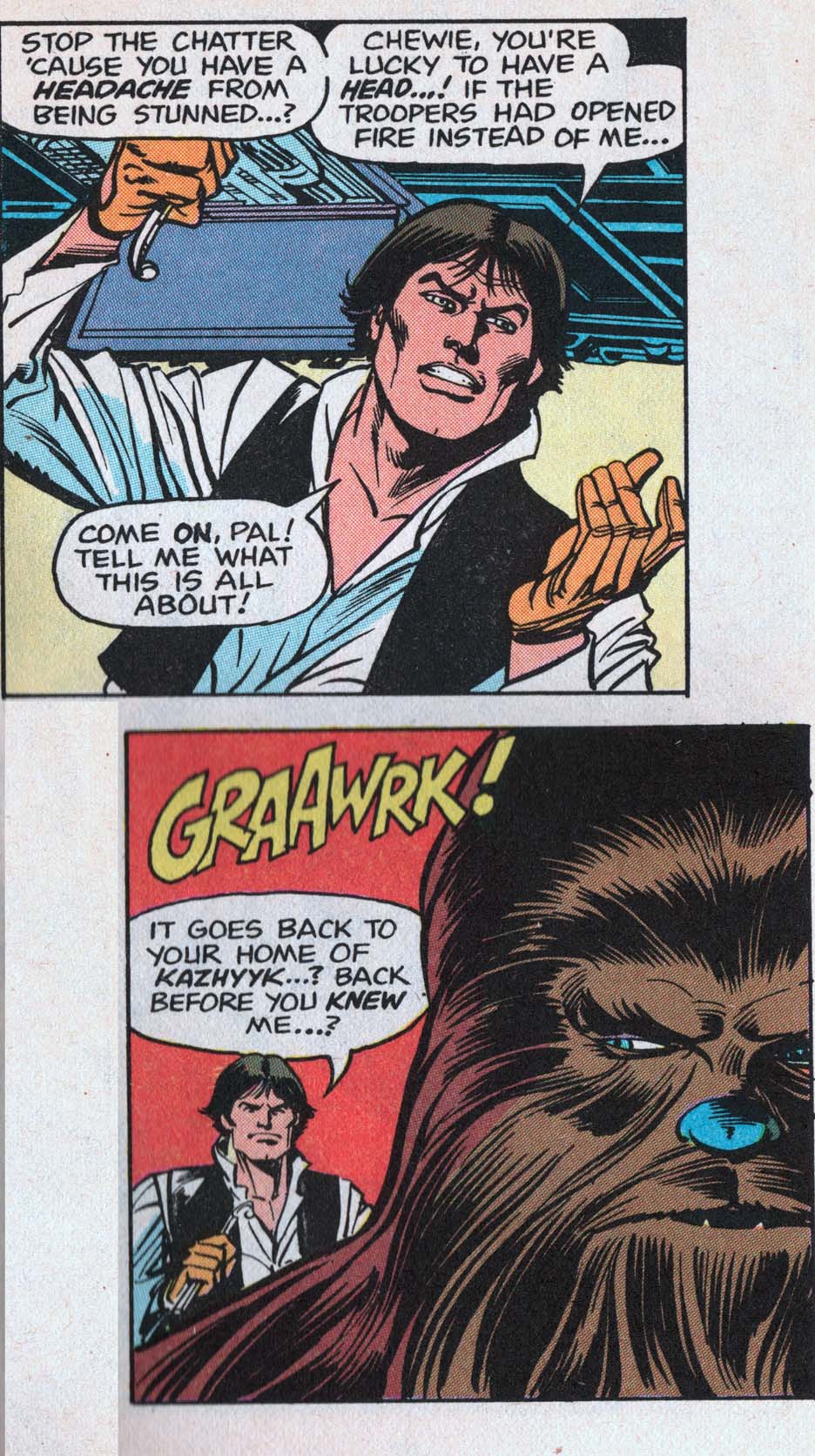
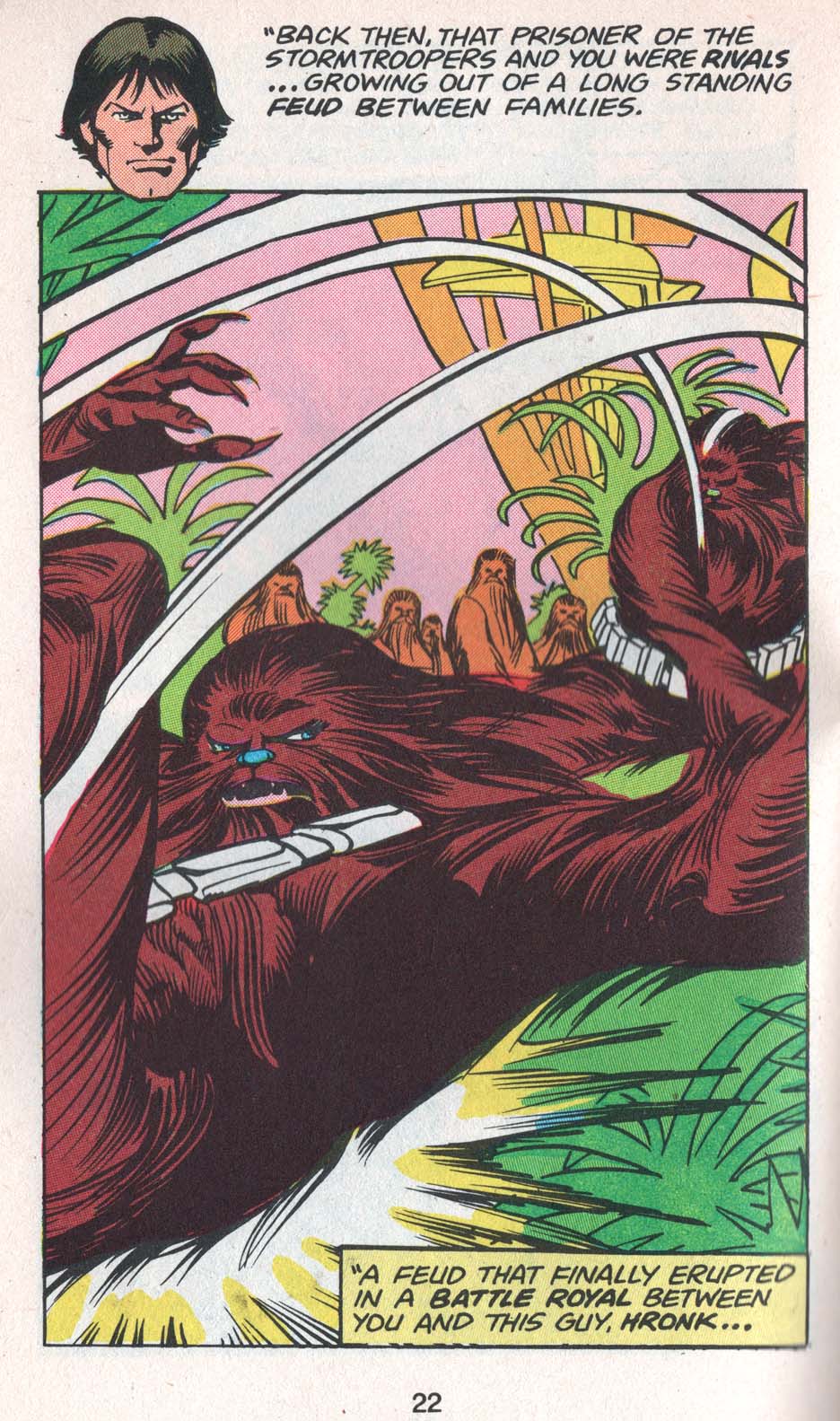
Another quirk about this story. It ultimately appeared in color (from Marie Severin) in a Marvel US paperback collection of “new” Star Wars stories. Cropping on the panels is inconsistent because the pages had to fit the odd format. (See below.)
George Lucas thought SF comics legend Al Williamson (EC, Flash Gordon) was an ideal choice to draw the original Marvel adaption of Star Wars. (Now officially titled Chapter IV: A New Hope.)
Unfortunately, Al was locked into his deal for the Secret Agent Corrigan newspaper strip and couldn’t take the gig.
(Fortunately for George, his other choice came through: Howard Chaykin, who was extraordinarily familiar and comfortable with SF and swashbuckling came on board for the adaptation and a few additional issues. But, as always, we digress.)
Al ultimately ended up doing wonderful adaptations of both Empire Strikes Back and Return of the Jedi. The stories are gorgeous.
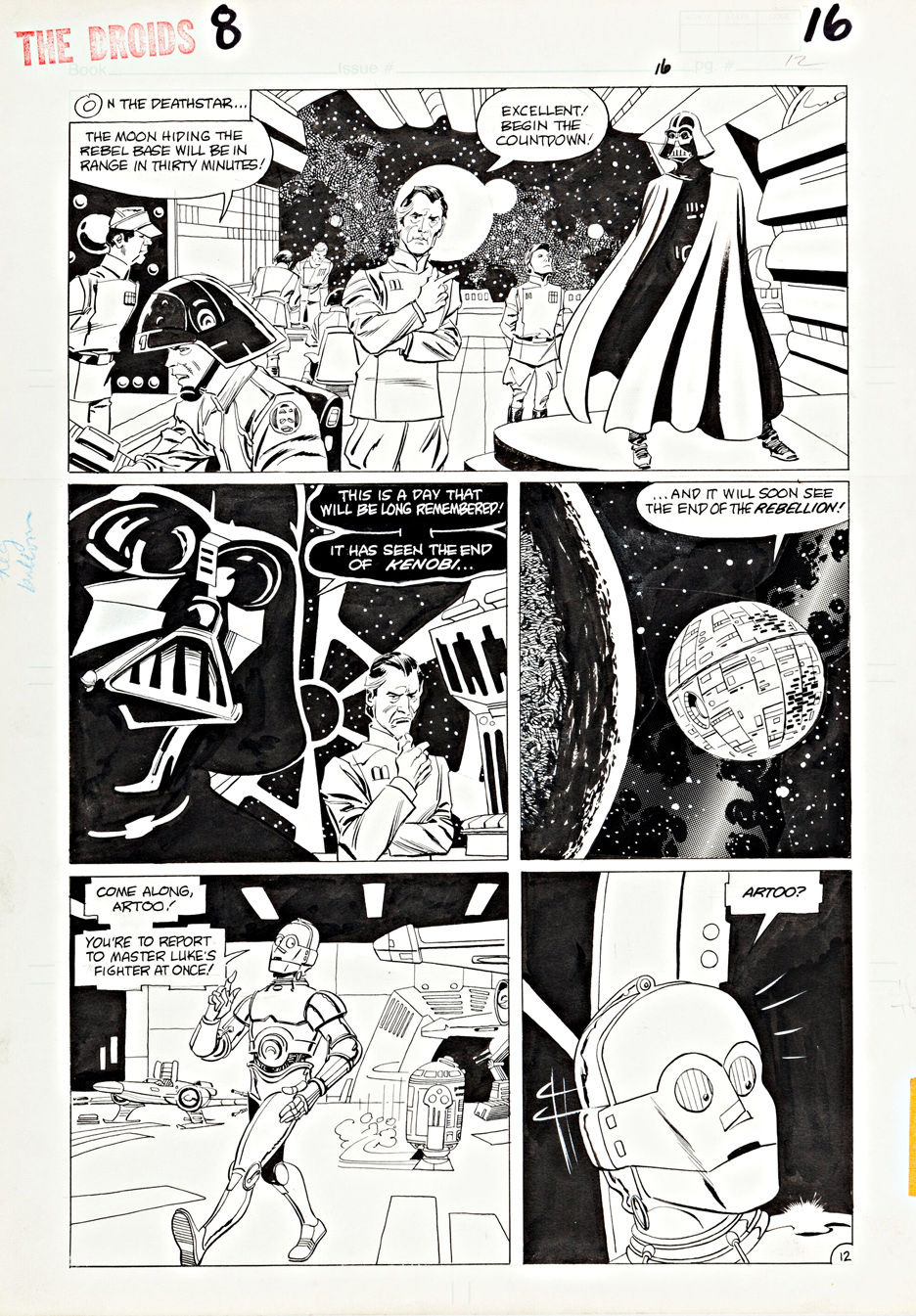
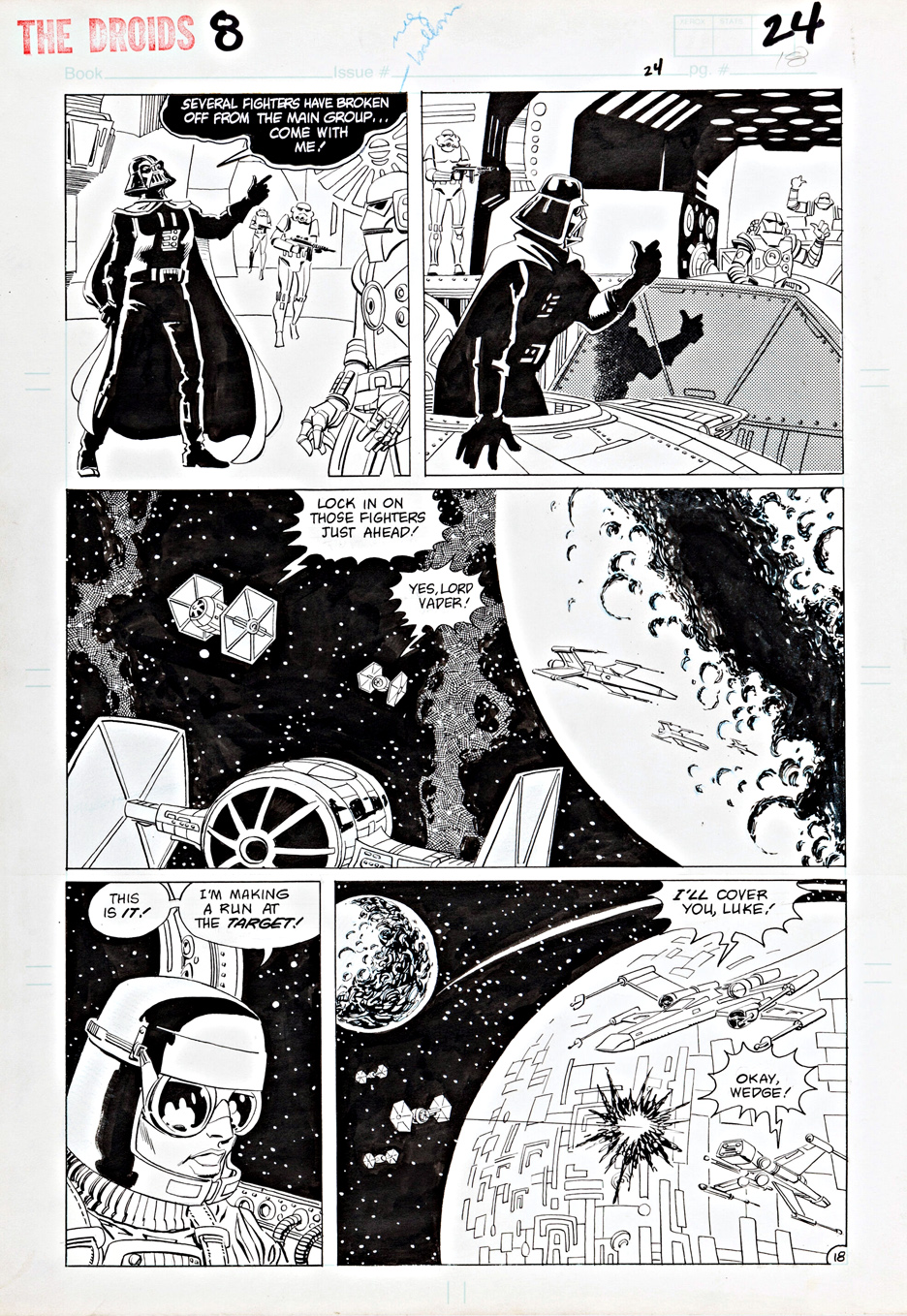
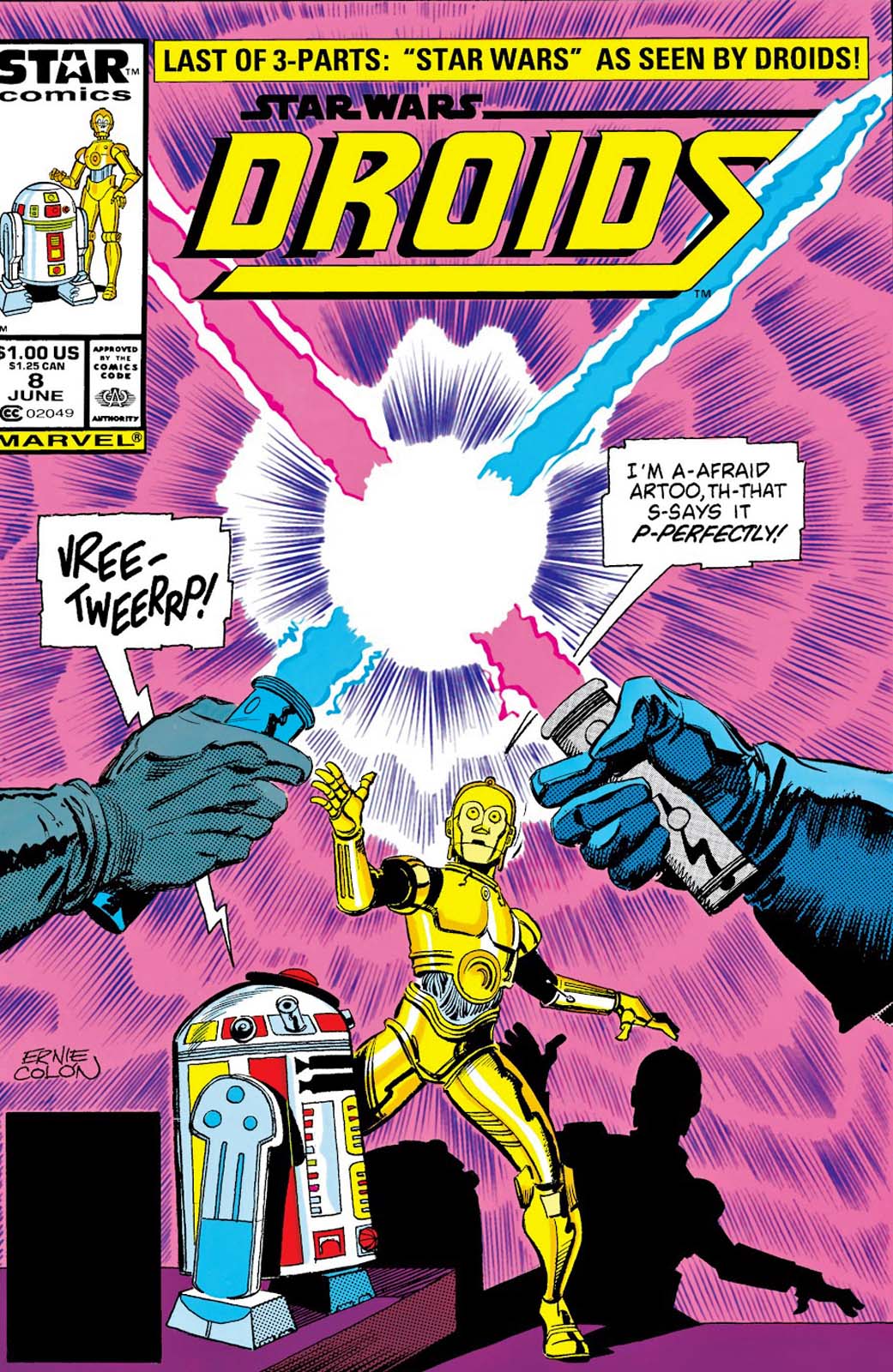
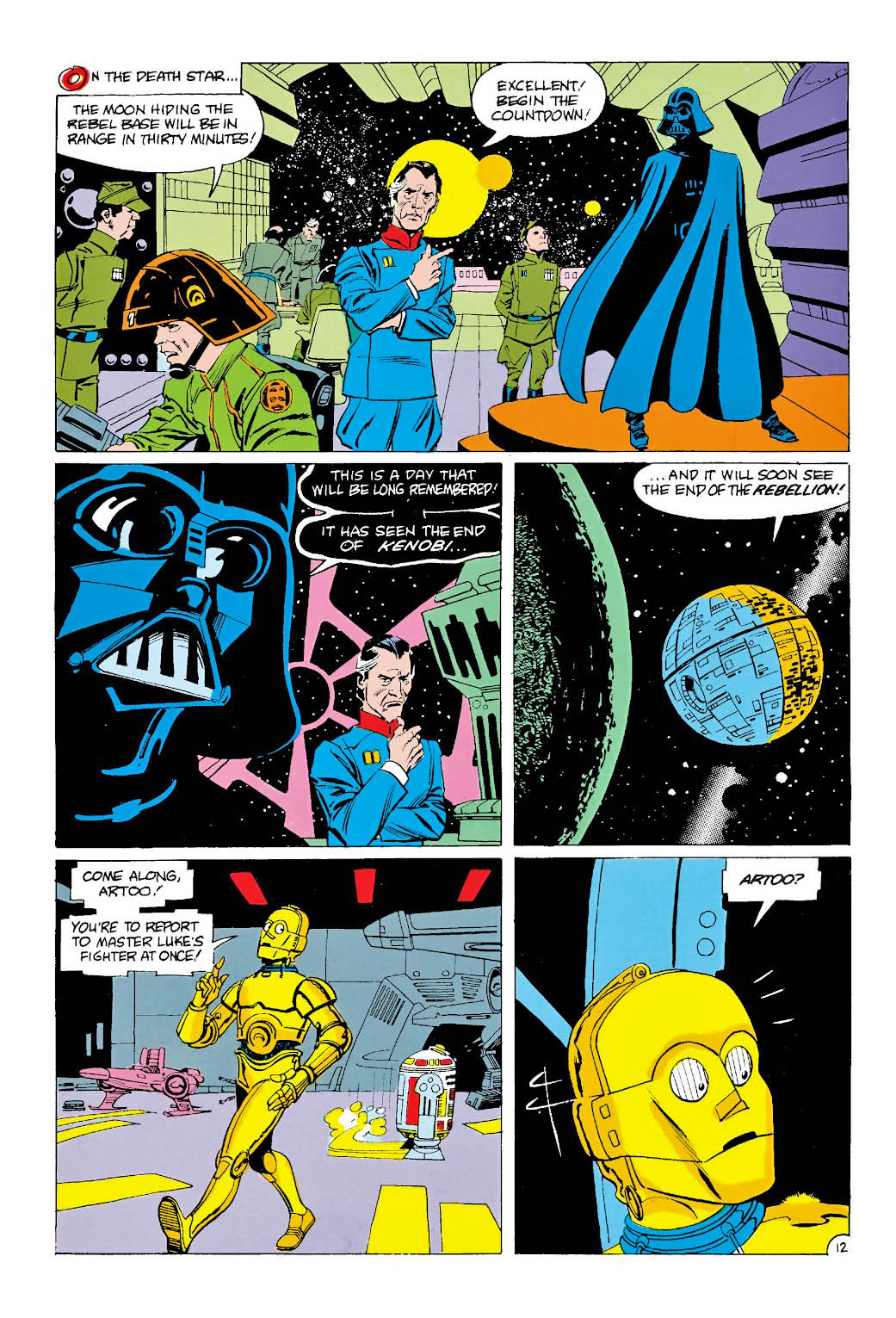
But… Al gets another shot on the original film, when, 10 years after the fact, Marvel decides to adapt A New Hope again — this time as a three-part story in the kids’ comic, Droids.
Ernie Colon provides lovely storytelling, and Williamson provides his beautiful inks, giving him credits on all three Star Wars original trilogy films.
As for the story itself — the main selling point is that this adaptation is told from the Droids’ point of view — which seems odd, since Lucas told interviewers that the films were told from the Droids’ POV, in the first place.
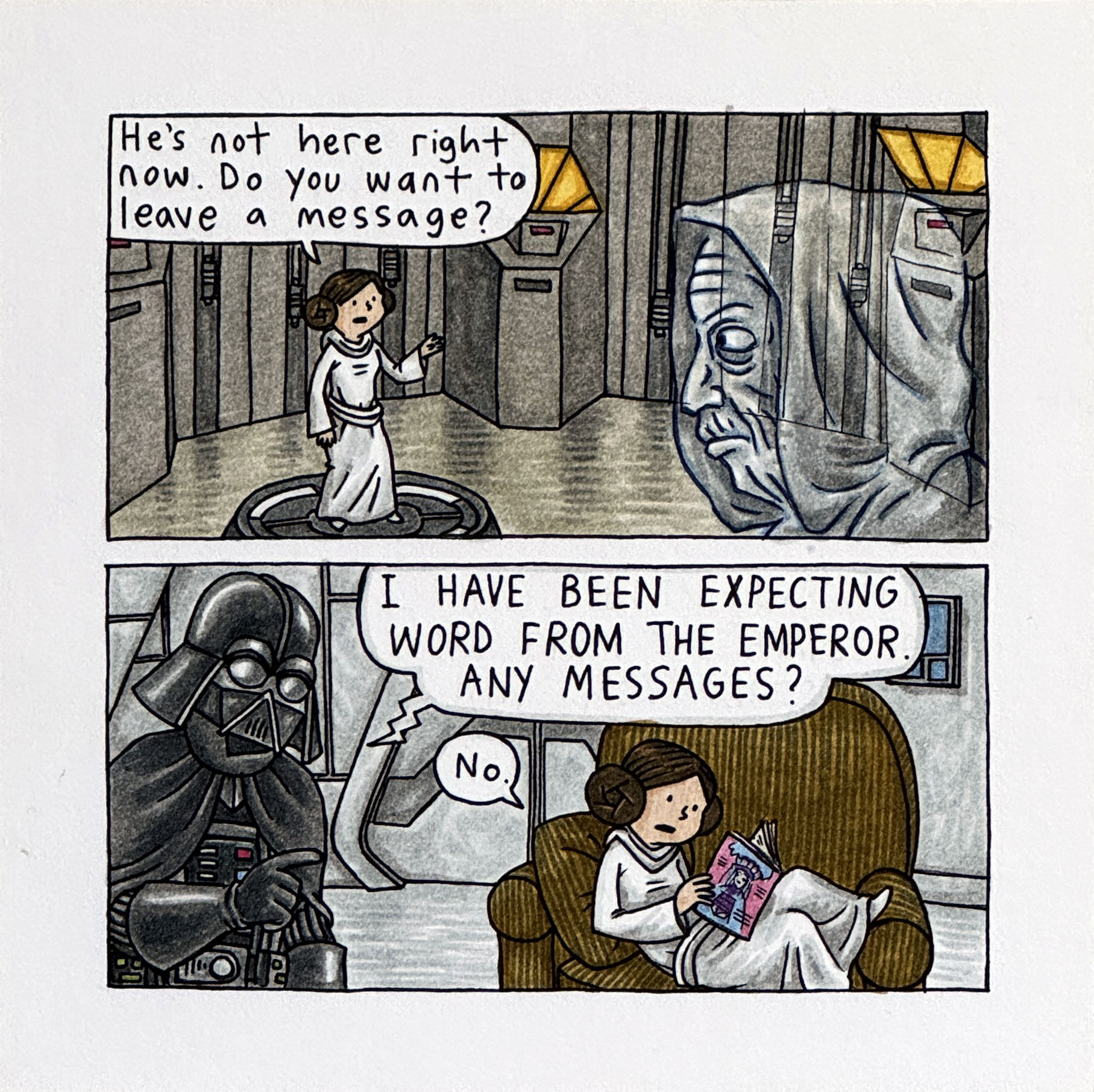
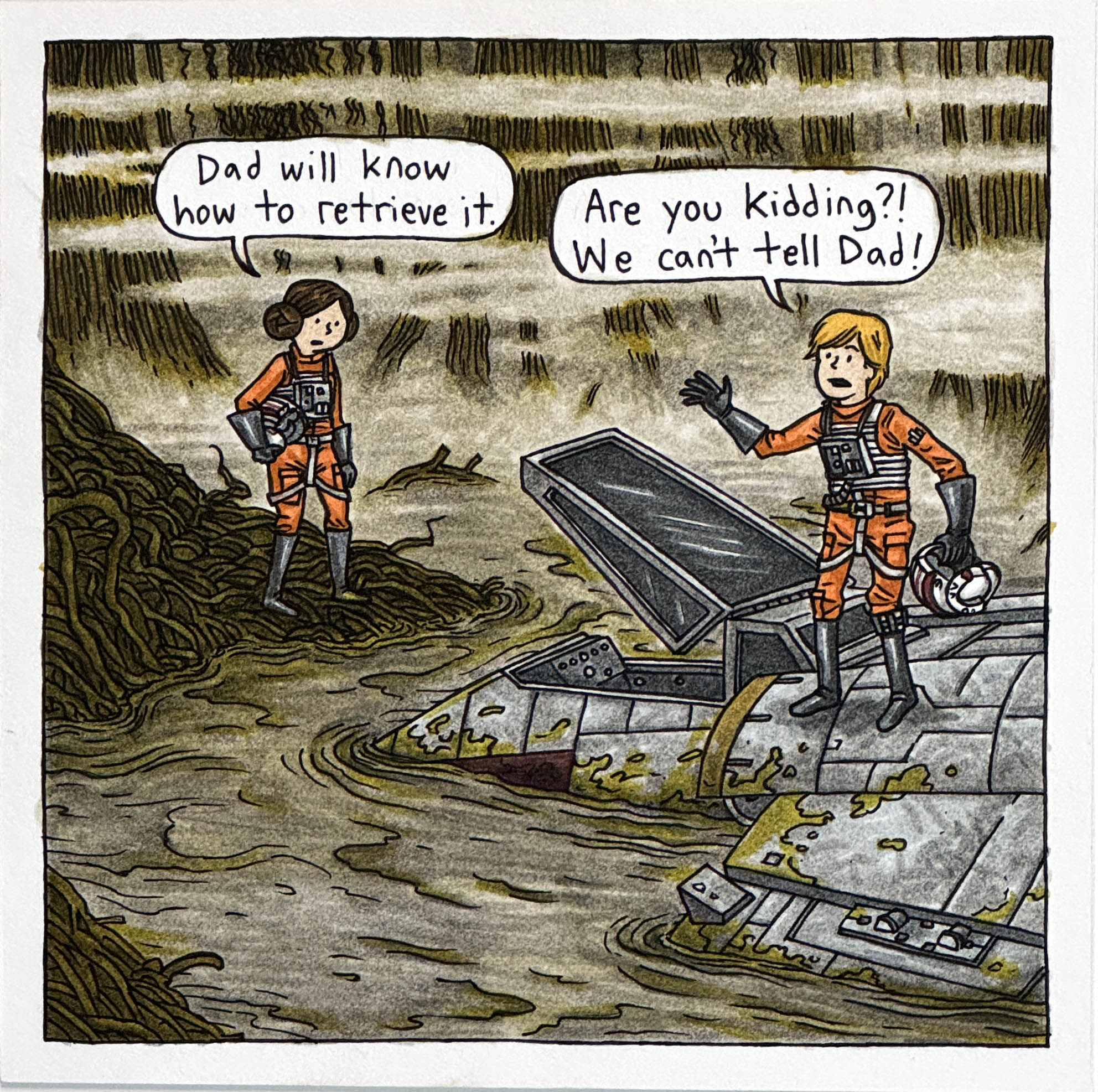
Here are two wonderful cartoons from Jeffrey Brown’s delightful Star Wars “kid’s” books. Kids is in quote marks, because honestly the jokes play even better with adults, especially those that have seen the films multiple times.
I acquired two of the originals, because, well, I have two kids, and they may want souvenirs from my art collection. (Adults now actually, but still my “kids.” Oops, more quote marks.)
Not to mention that they are beautifully done, and I would probably acquire more if they weren’t so pricey.
Come to think of it that might apply to the kids, as well as the art.
Don’t them I said that.
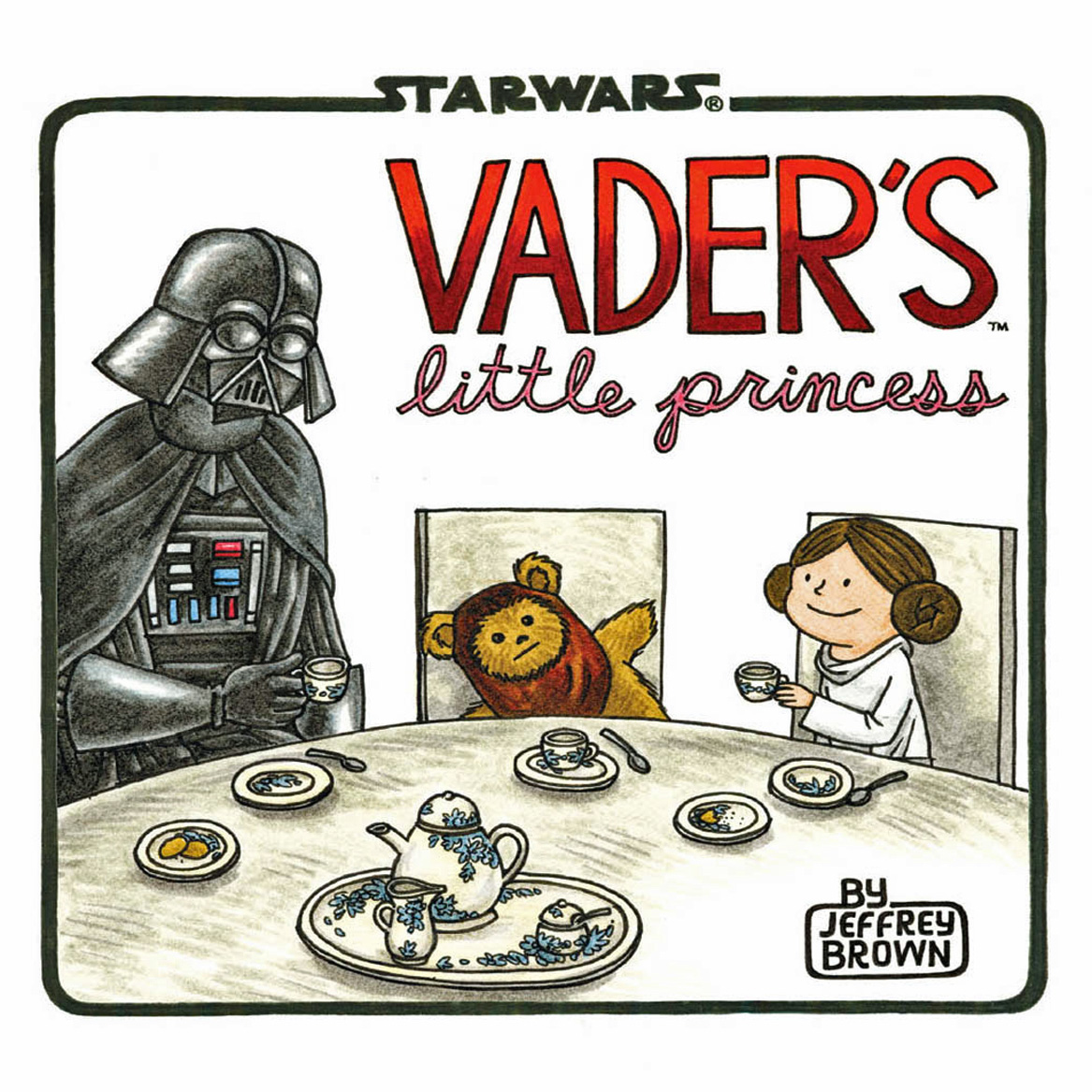
From the Publisher:
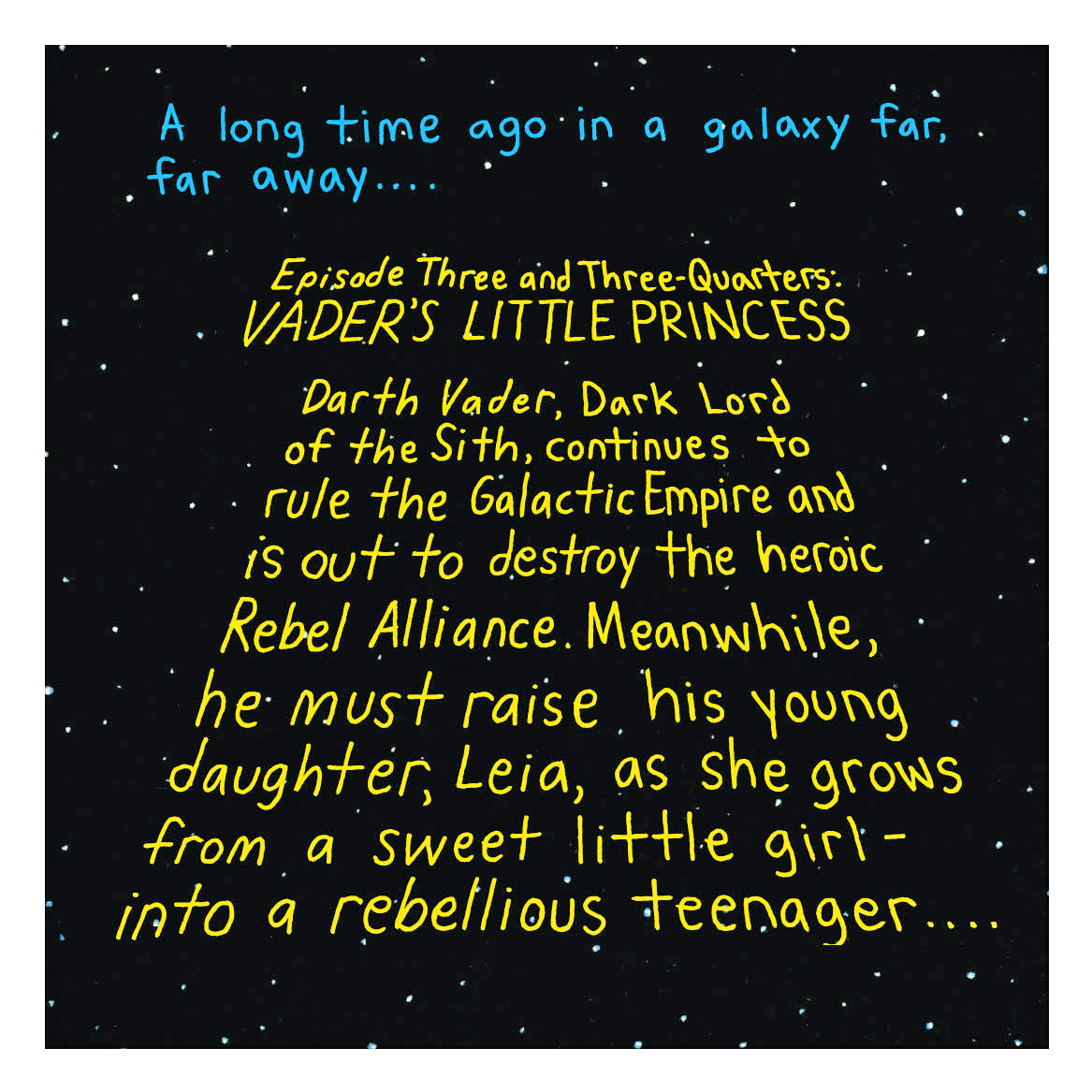
“Darth Vader is learning that being a Sith lord and dedicated father to Princess Leia isn’t quite so easy…
In this irresistibly funny follow-up to the breakout bestseller Darth Vader and Son, Vader—Sith Lord and leader of the Galactic Empire—now faces the trials, joys, and mood swings of raising his daughter Leia as she grows from a sweet little girl into a rebellious teenager. Smart and funny illustrations by artist Jeffrey Brown give classic Star Wars moments a twist by bringing these iconic family relations together under one roof. From tea parties to teaching Leia how to fly a TIE fighter, regulating the time she spends talking with friends via R2-D2’s hologram, and making sure Leia doesn’t leave the house wearing only a skirted metal bikini, Vader’s parenting skills are put hilariously to the test.”
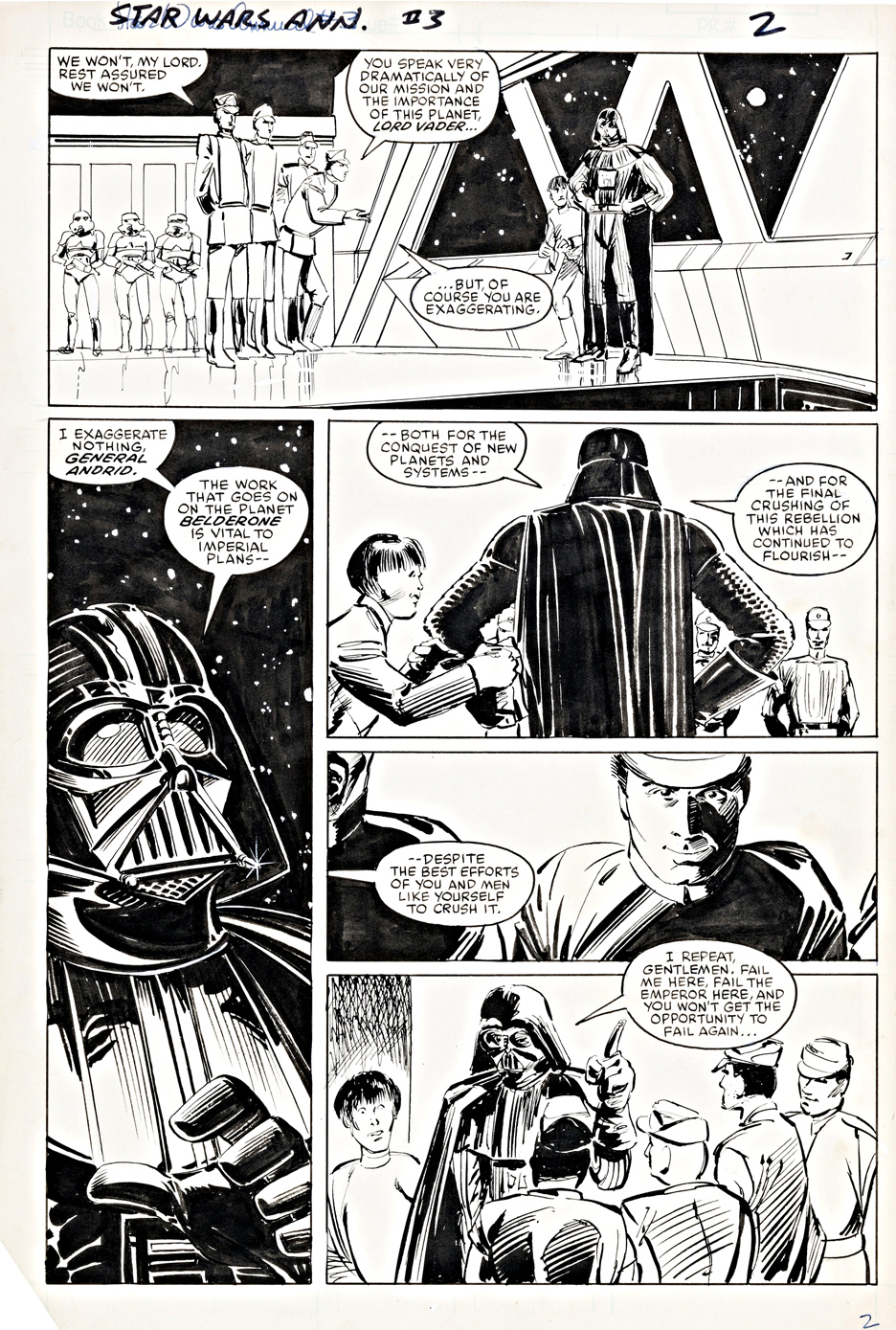
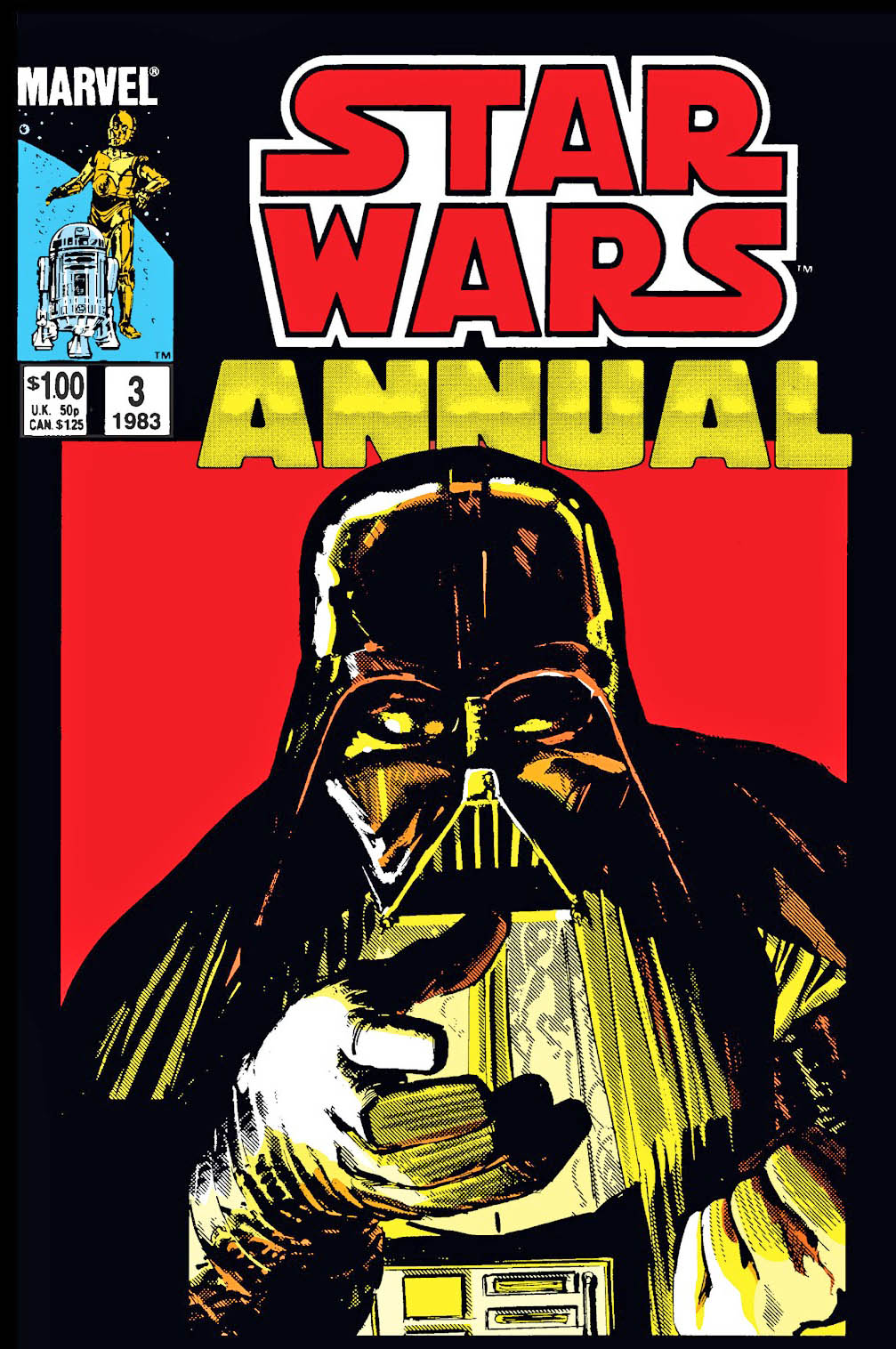
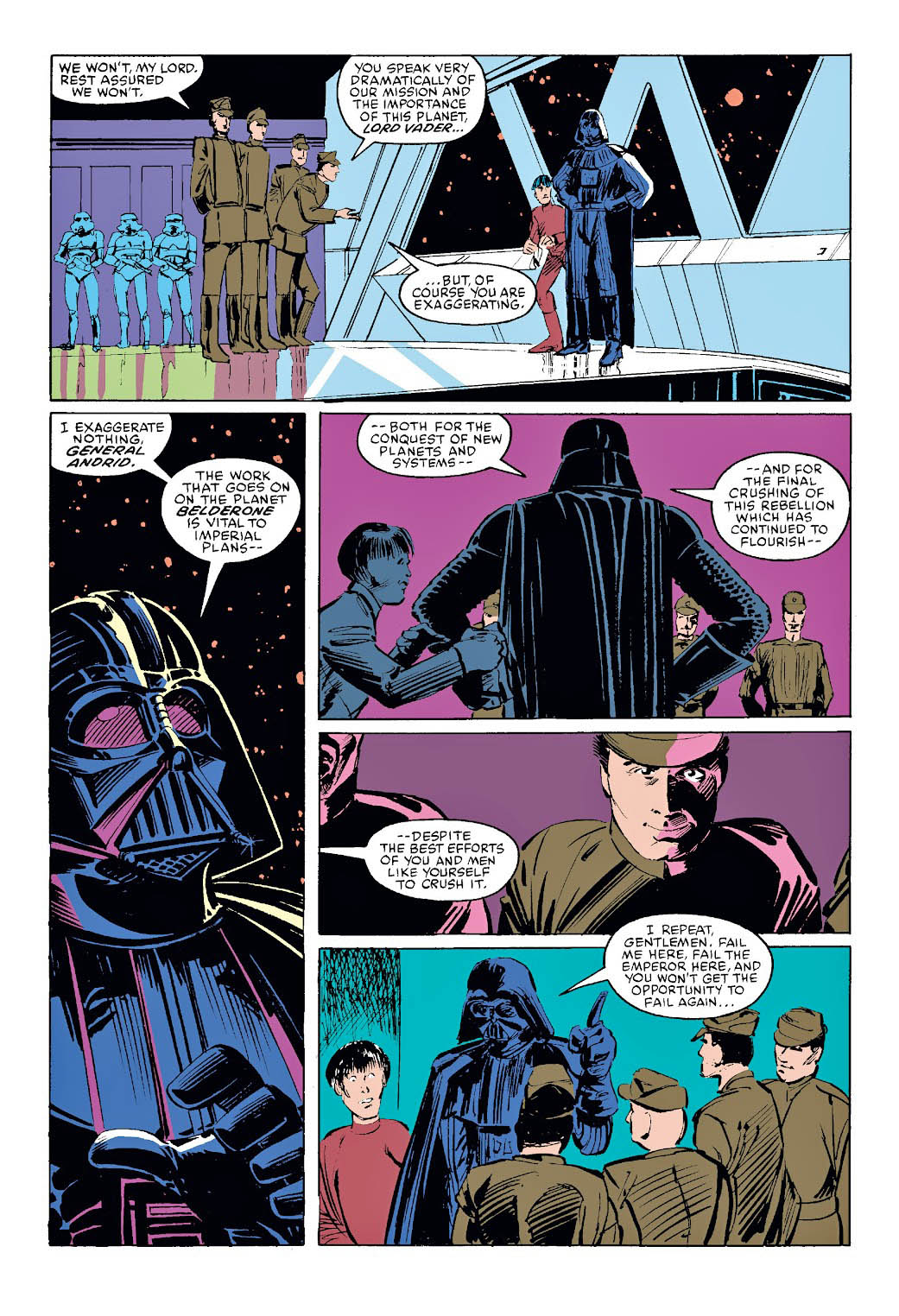
1983 was a busy year for Star Wars… and Klaus Janson.
Janson pencils, inks, and colors a terrific looking stand-alone Star Wars annual which releases in the summer. At the same time, he’s inking and penciling over Frank Miller’s layouts on Miller’s legendary Daredevil run. (Ultimately penciling and inking four issues on his own.)
On the Lucasfilm front, Return of The Jedi releases in May 1983, concluding the original trilogy — with the gazillion licensed products that follow suit. (The Jedi adaptation from Marvel is released as a separate series, in addition to the monthly Star Wars ongoing comic book.)
The first three pages of this Star Wars annual came up for auction late last year and fortunately, I snagged one.
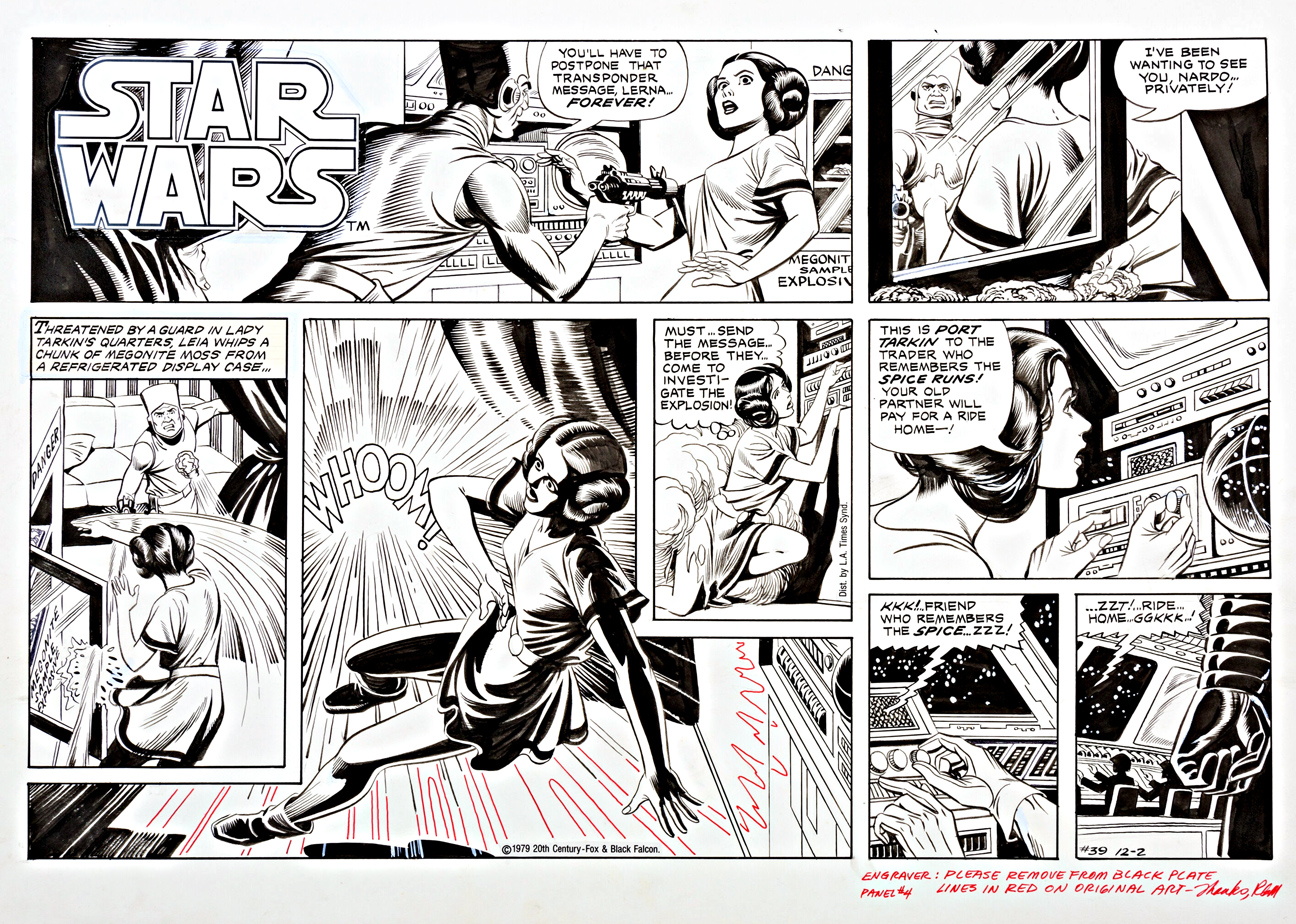
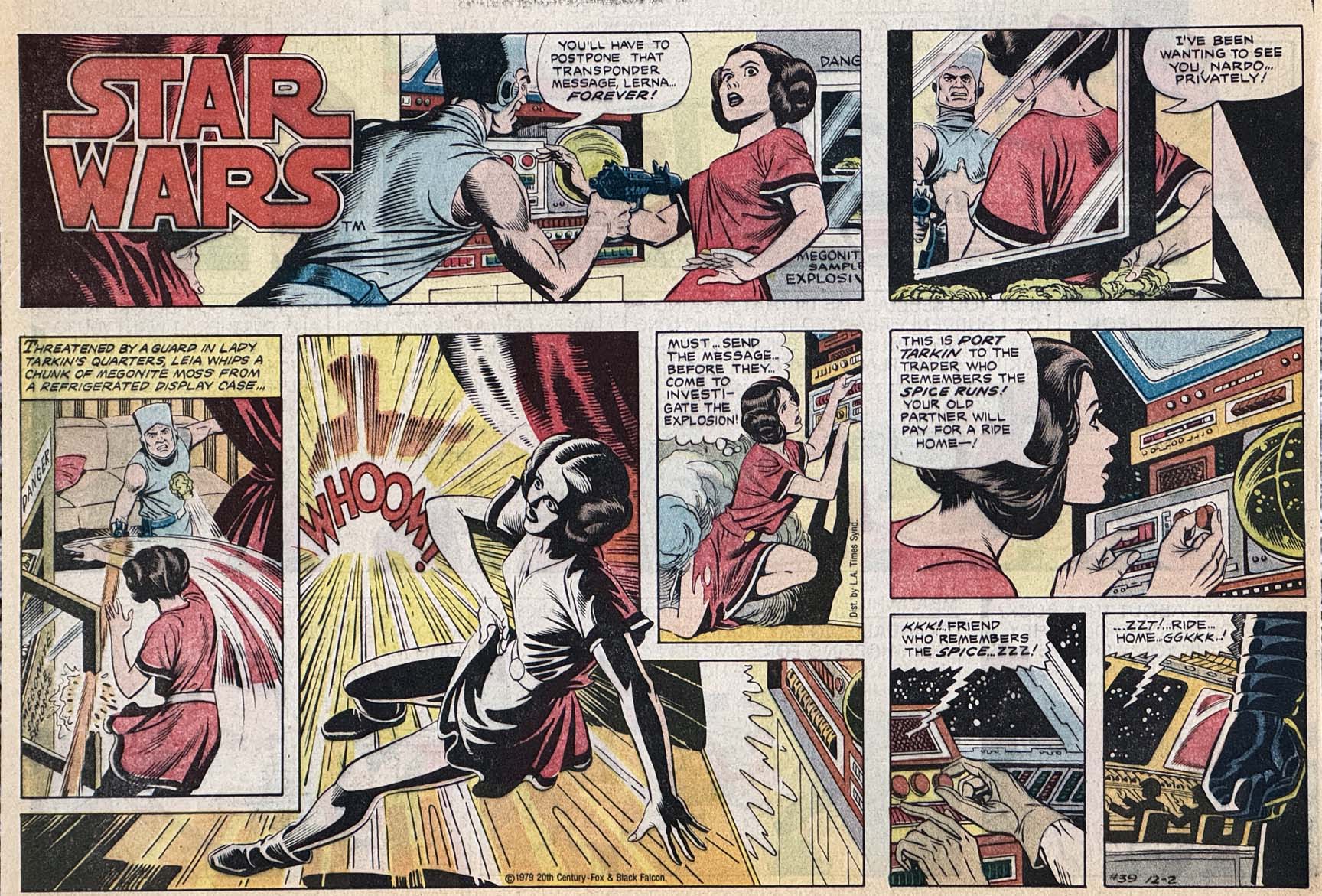
I finally checked off a piece of art from my OA “bucket list” with the acquisition of this terrific Russ Manning Star Wars Sunday strip late last year.
I own some great Star Wars original art, but not much focusing on Leia, so I’m especially pleased I won this strip at auction. Coincidentally, I was the underbidder the previous time it had appeared at auction — second time is the charm, apparently.
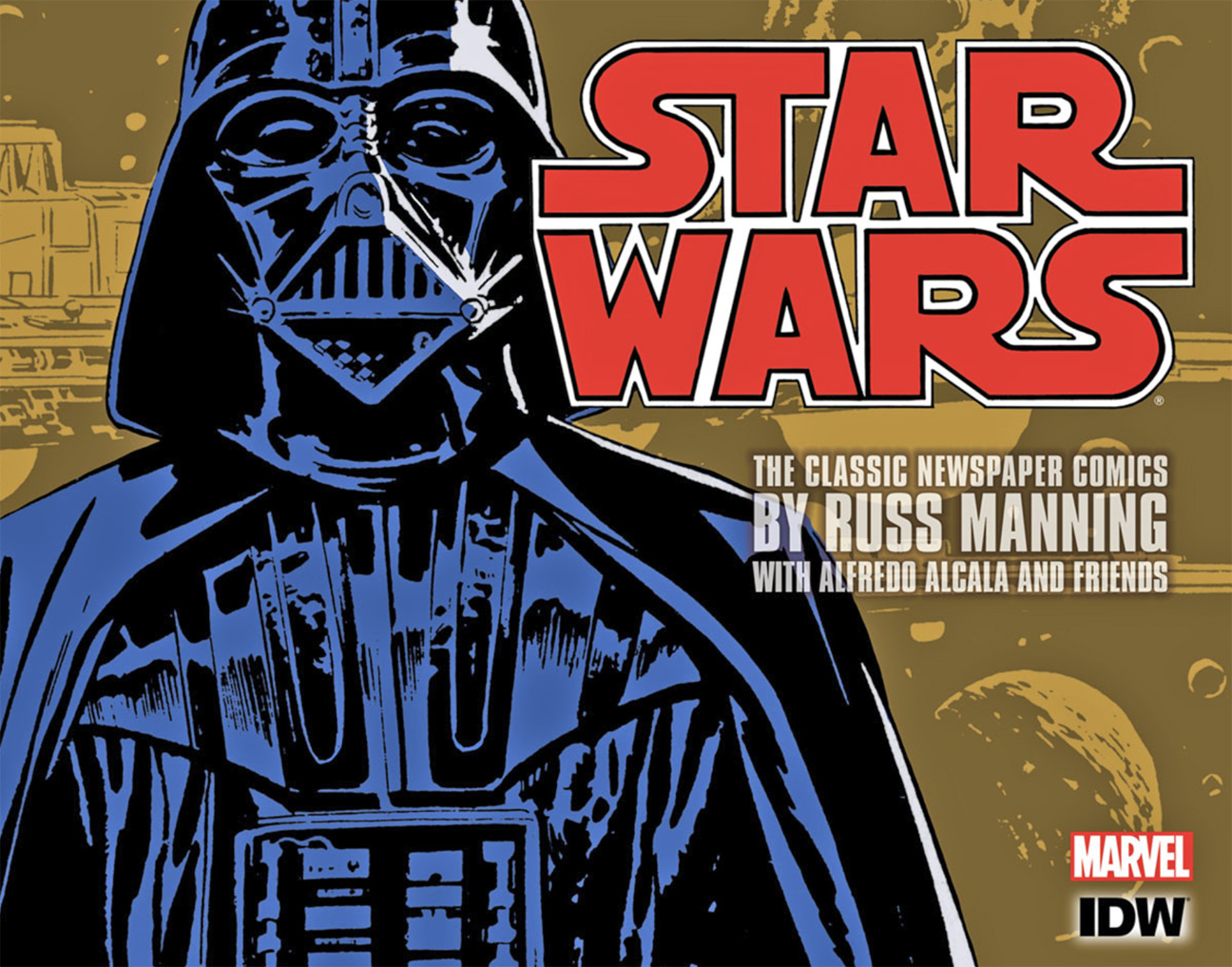
When we had the opportunity to collect the complete Star Wars strip collection at IDW Publishing, it was yet another box checked off from the publishing bucket list. Dean Mullaney and the Library of American Comics (LOAC) crew produced (as always) an amazing three-volume set.
Welcome to Star Wars “month.” May the force be with you throughout.
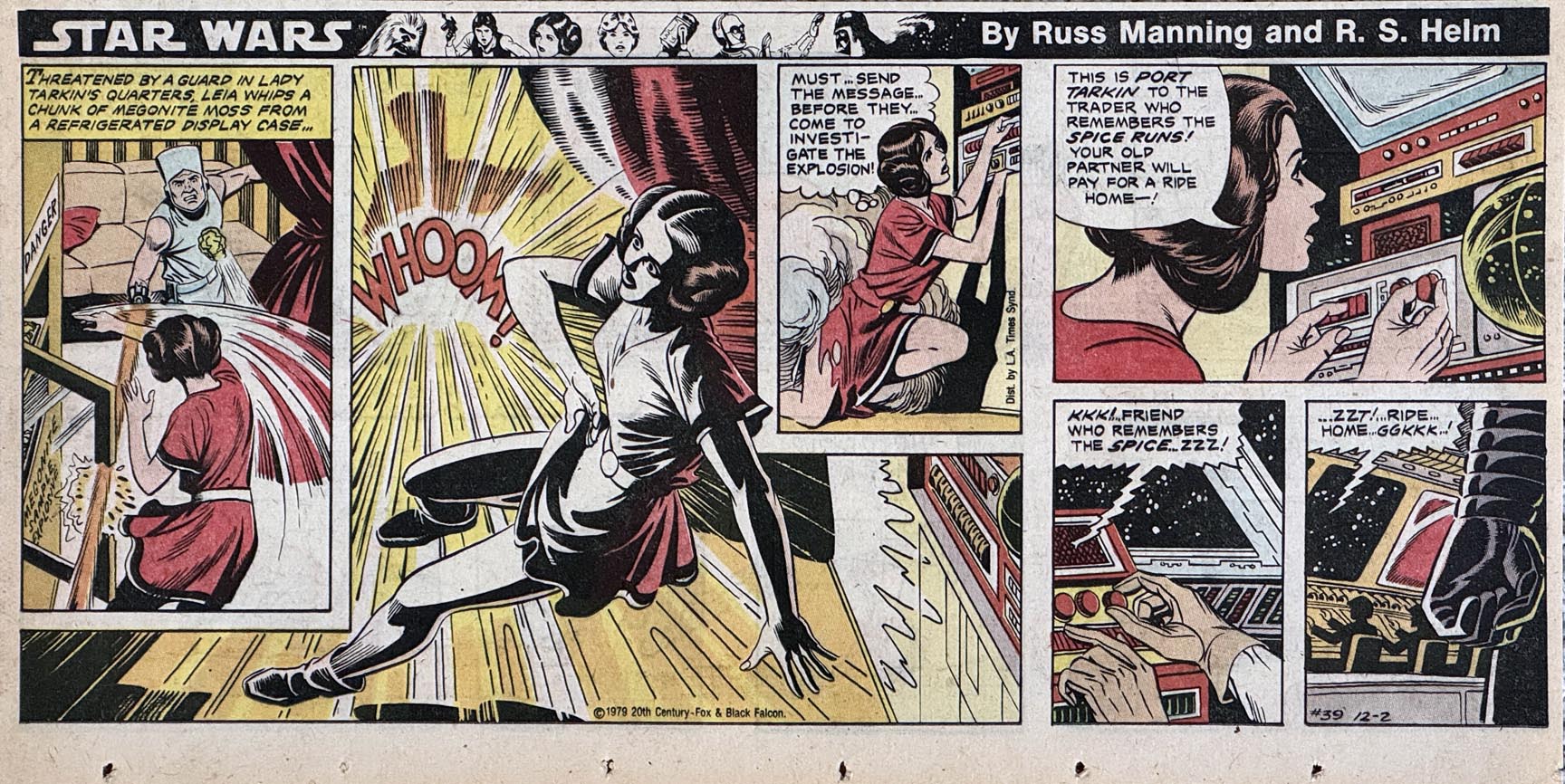
Did your newspaper make room for the full strip, or the “abridged” version, featuring Sundays without the top tier?Screenshot