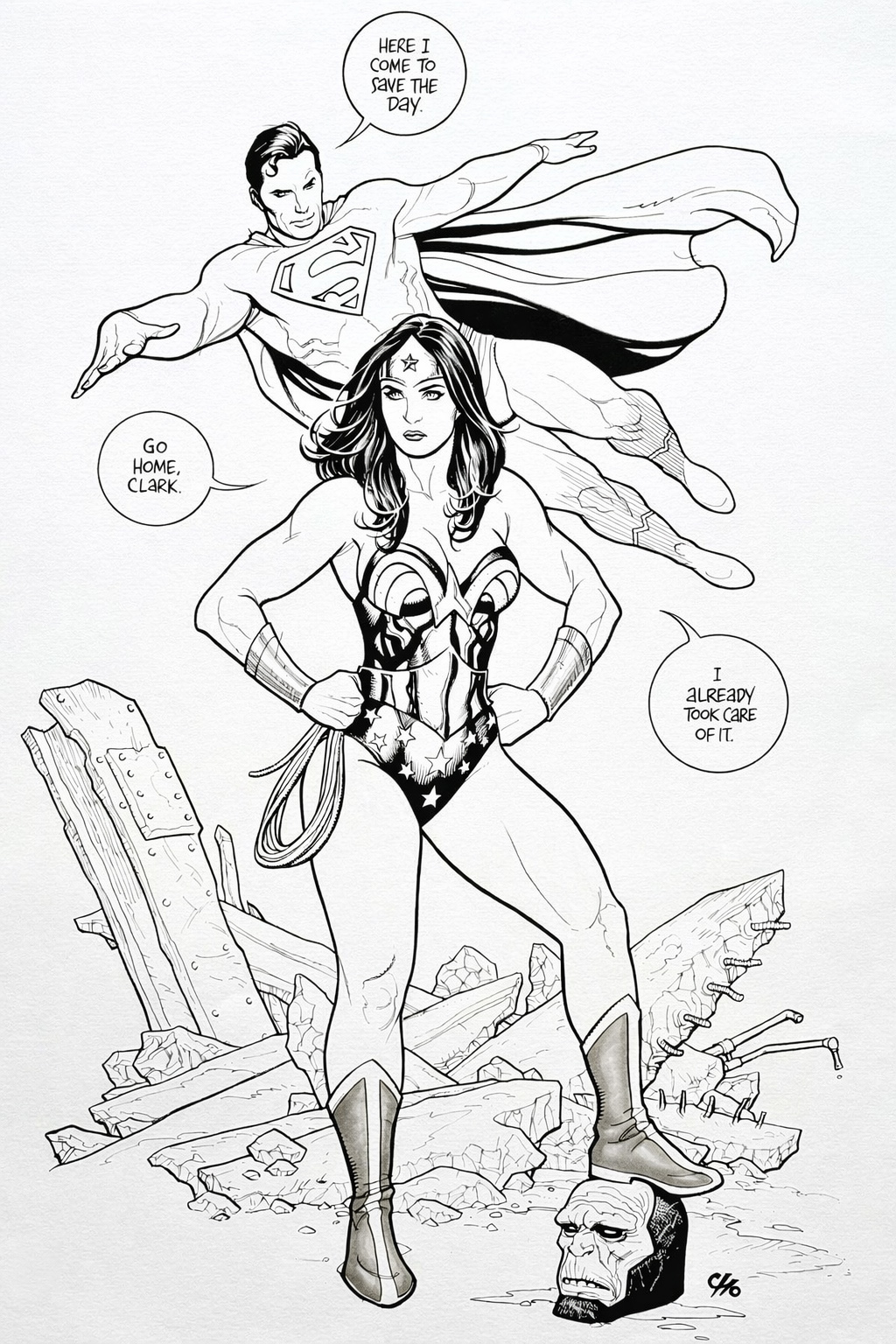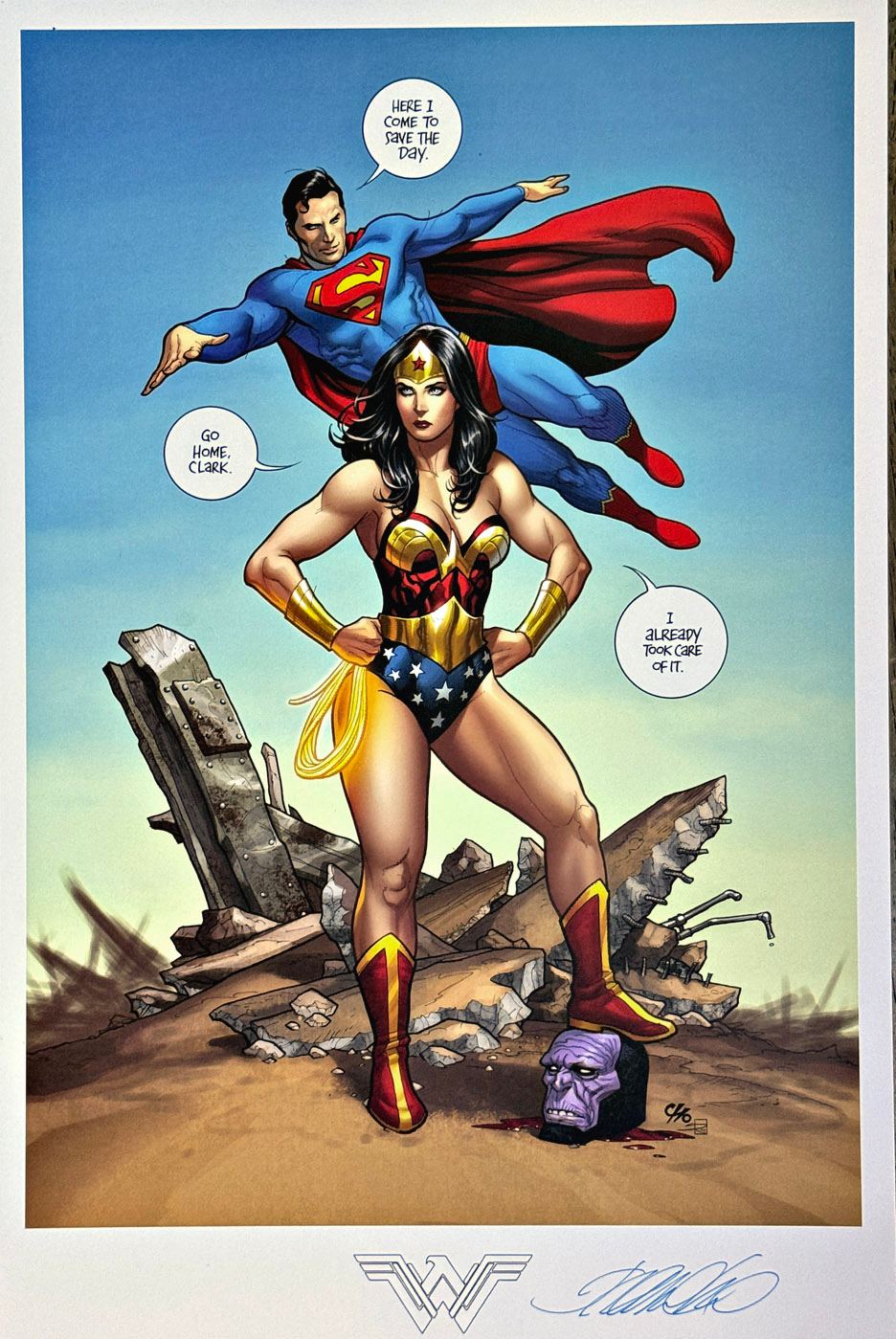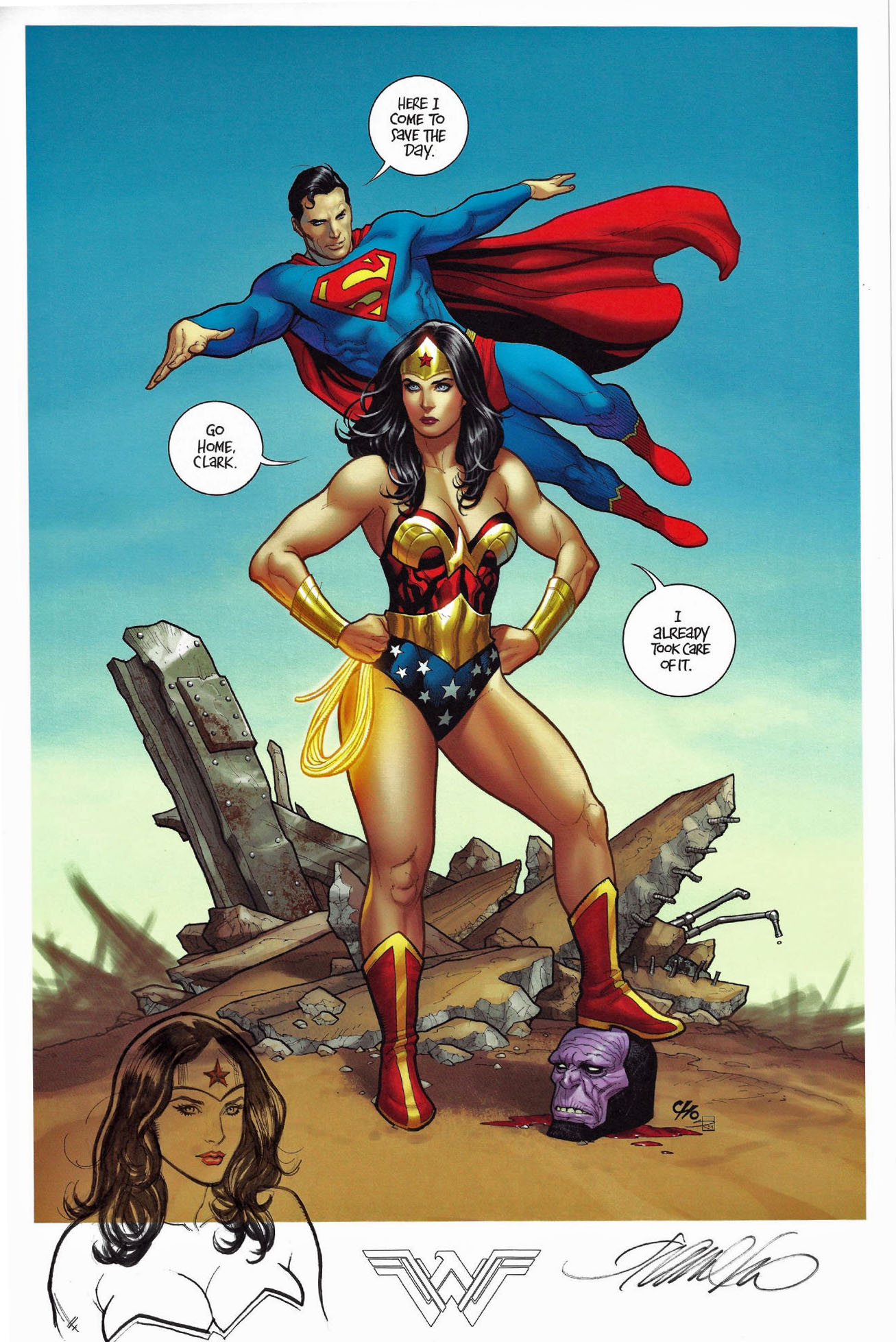
I love a great Frank Cho specialty piece. Rock-solid draftsmanship paired with a genuinely good sense of humor. (Which is rarer than you’d think—superheroes can swing from humorless to campy at light speed.)
Clean lines. No clutter. A powerful—and beautiful—Wonder Woman.
And a simple joke, told exactly right. From a very talented cartoonist and creator.
It doesn’t hurt that the piece is about 18 × 24 in size. Yowza.
Cho mentioned on social media that this was one of the first drawings he finished during the pandemic lockdown.
Now that was time well spent.
If you were in the right place at the tight time, you could get your print re-marqued. Mine (left) is not, but I own the original, so zero regrets.
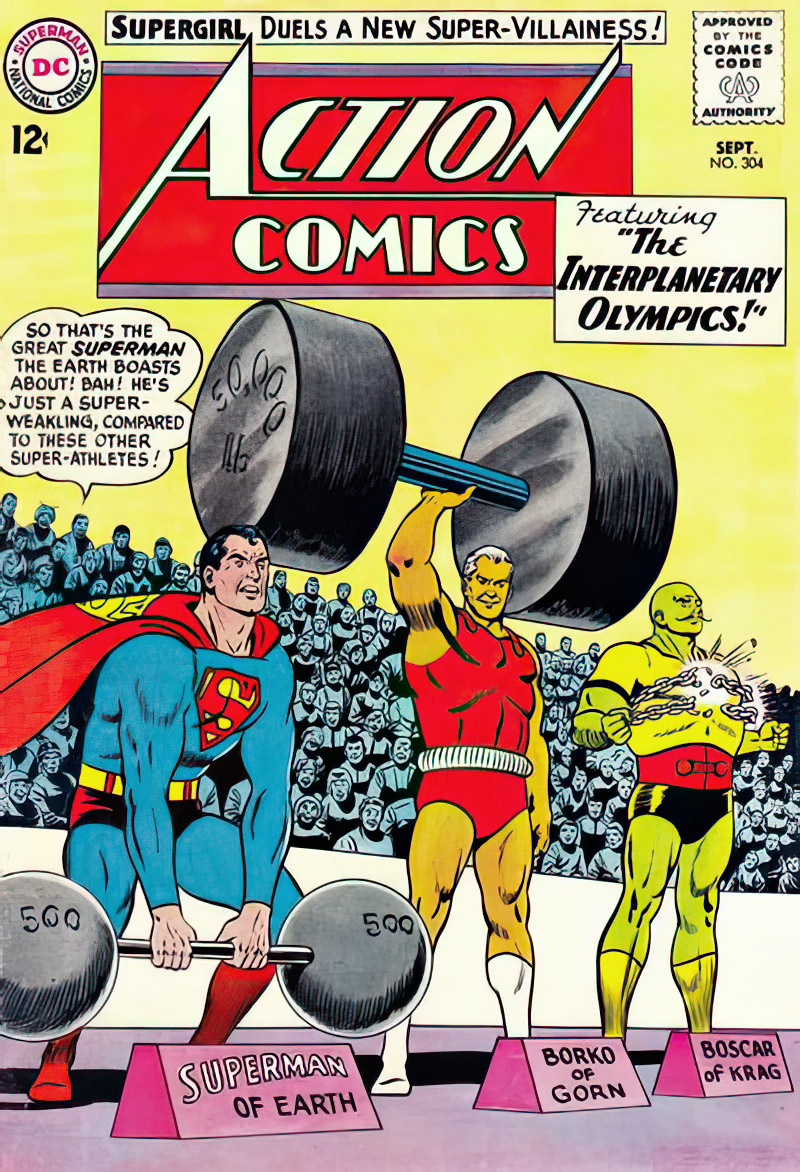
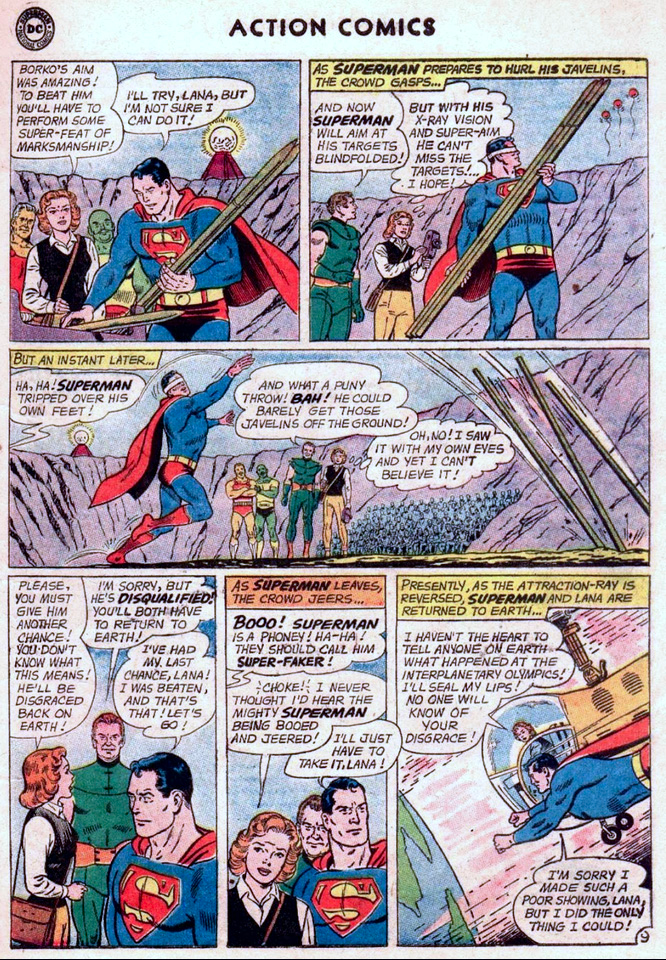
If you ever need proof that George Klein was Curt Swan’s best inker on the Superman books, just pull out this page from Action Comics #304. No explanations required—the art does the bragging for you.
From the first panel, Swan gives Superman that clean, honest pose only he could draw, and Klein locks it down with lines that are confident without showing off. Superman looks strong, sure—but also human. That balance? Classic Klein.
Jump to the big panel—Superman wrangling those hilariously oversized javelins—and you see the Swan/Klein team firing on all cylinders. Klein never wrestles for control; he boosts Swan, picking exactly the right details and politely ignoring the ones that don’t matter.
Across the page, the “S” shield is crisp, the cape moves like actual fabric, and the crowd reads clearly without becoming a visual traffic jam. It’s the kind of clean storytelling that looks effortless—until you see someone else try it.
And that bottom tier—Lana’s concern, Superman’s sheepish dignity—Klein hits it perfectly. Just enough warmth to make the moment feel lived-in.
Look, I love Murphy Anderson on Swan. (And pretty much everywhere else.) But the truth is simple:
George Klein doesn’t just ink Swan. He completes him.
I had my eye on this page for a while before I finally pulled the trigger — and I’m certainly glad I did.
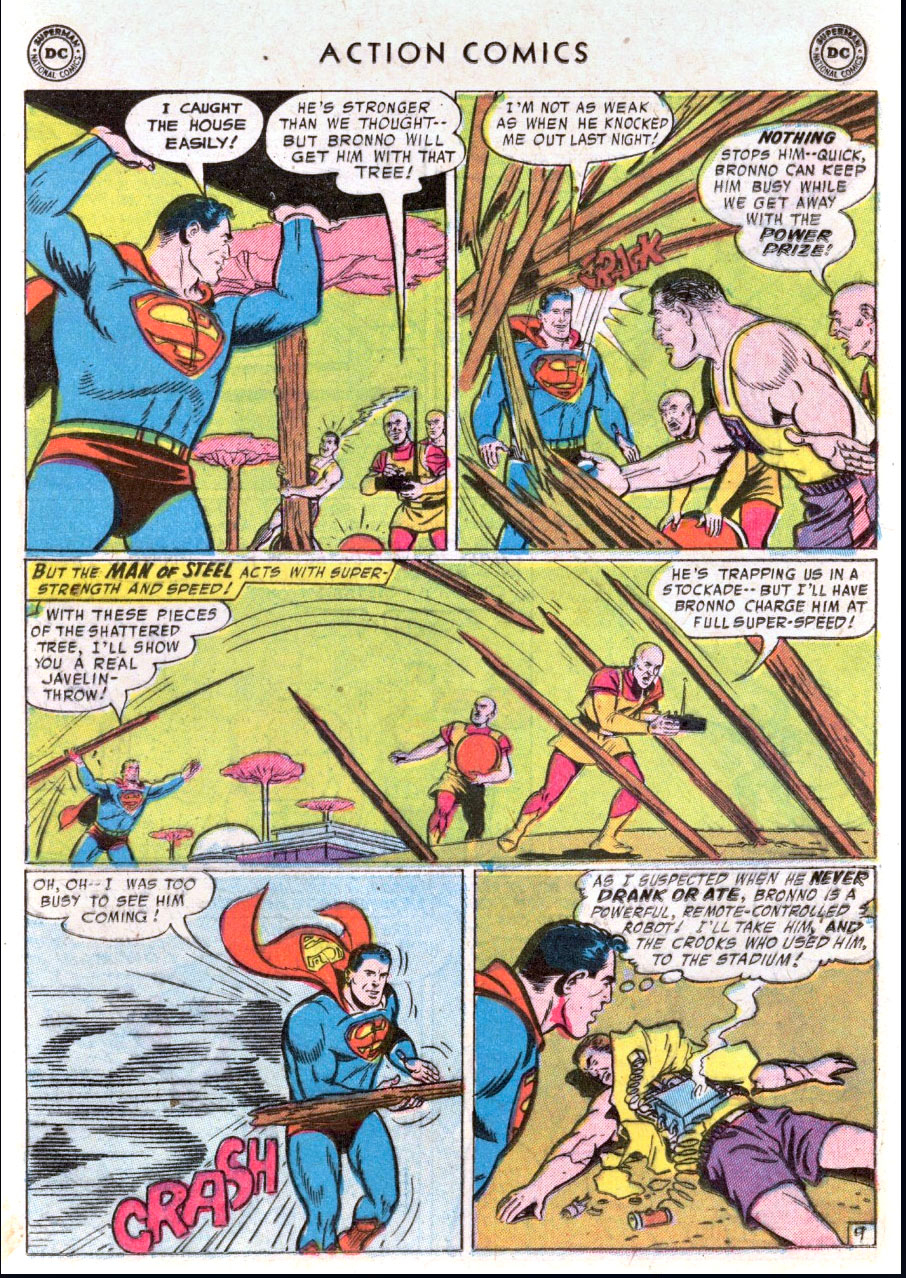
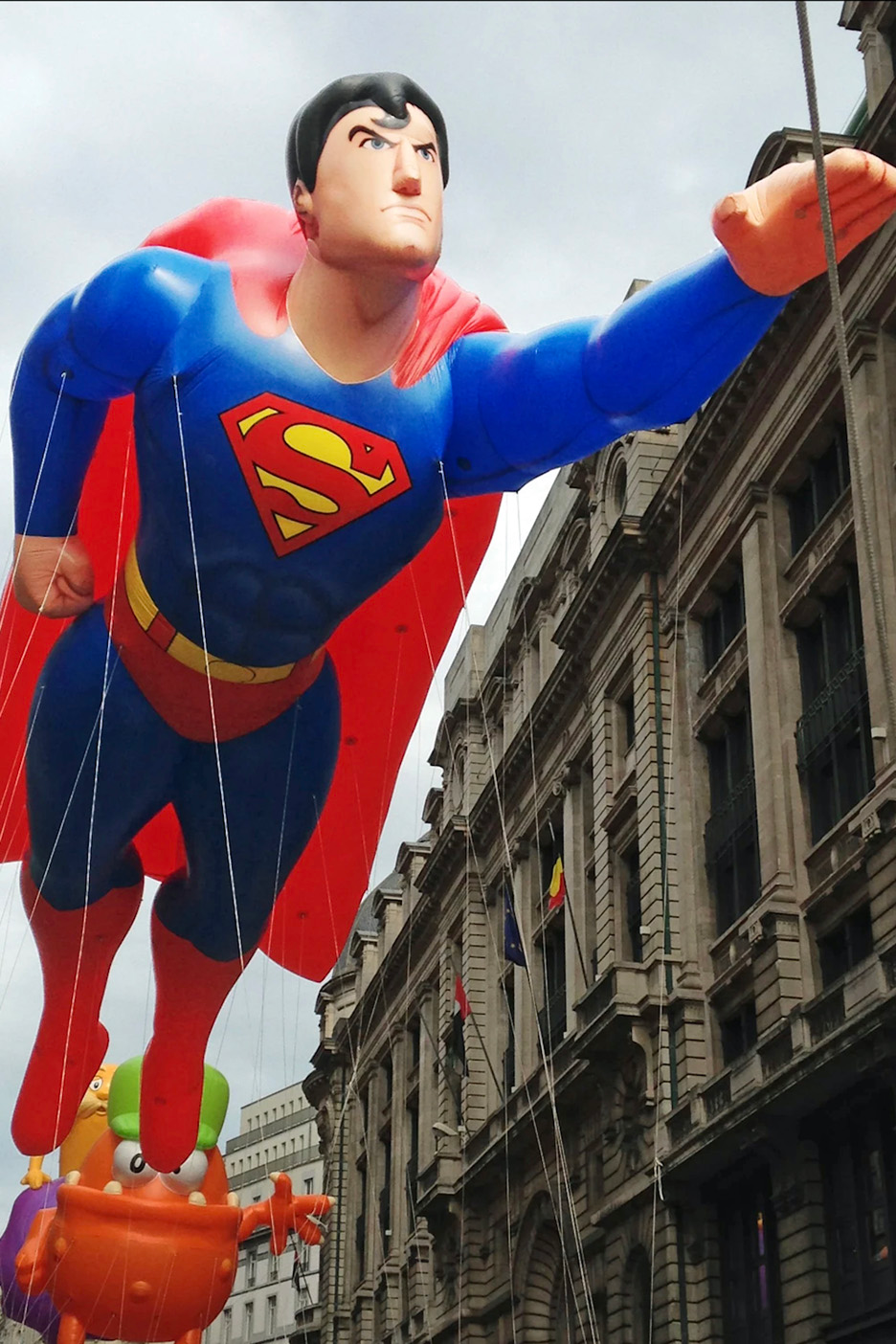
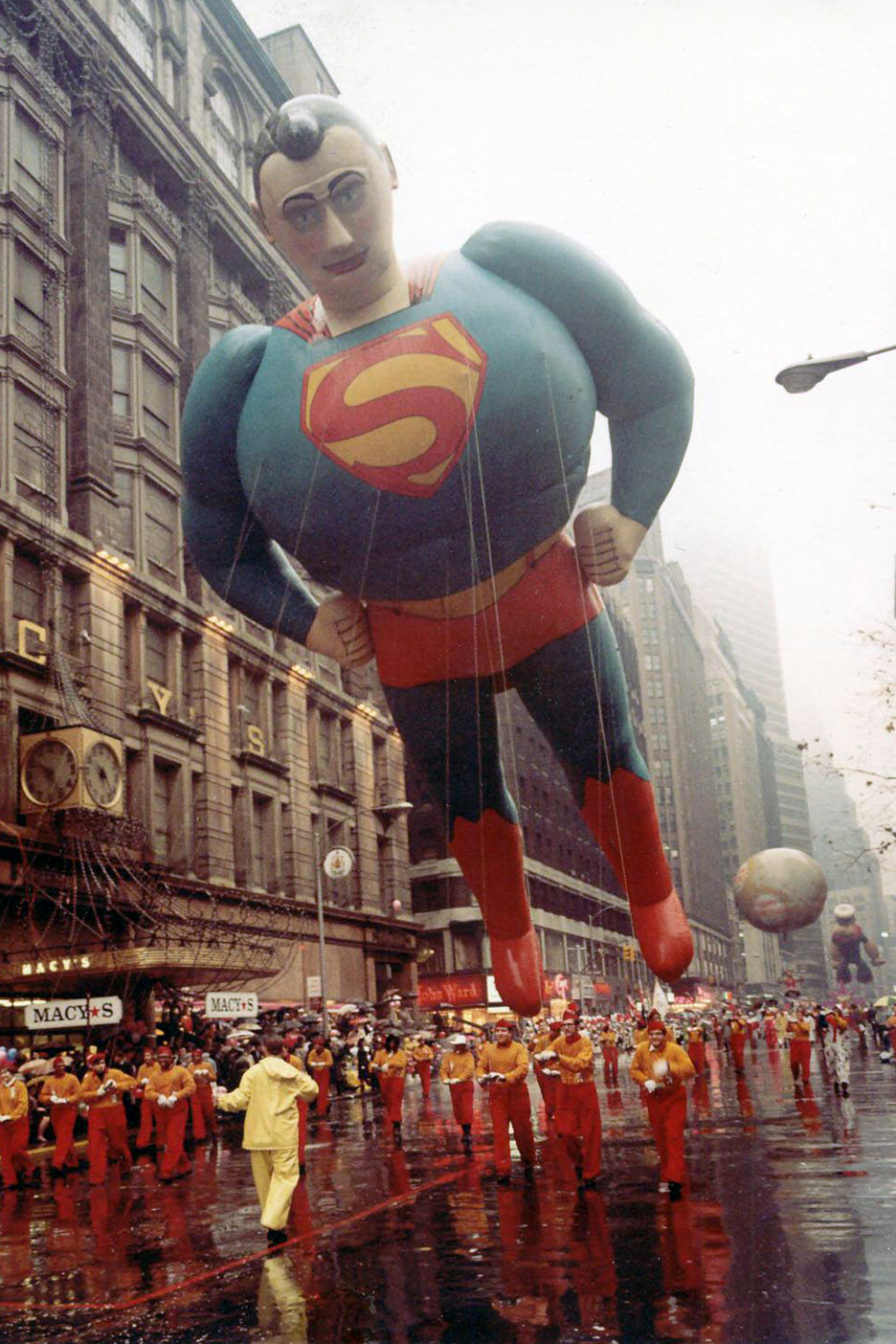
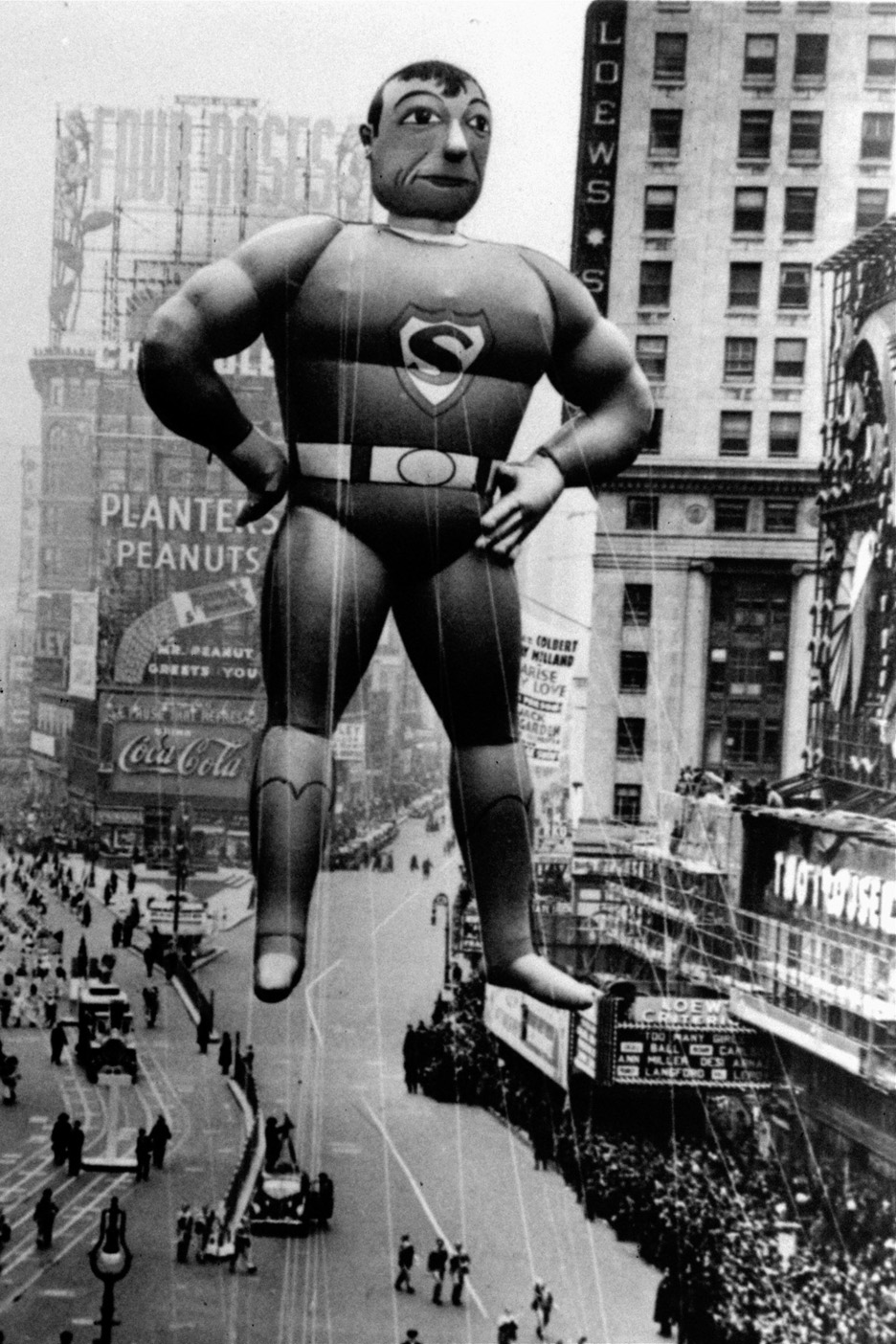
Fun Fact: The story itself is a reworking of an earlier Golden Age story, published seven years earlier in Action #220.It’s Thanksgiving Day tomorrow, which means it’s time for the annual Macy’s NYC parade. I think it’s about time we get a new Superman balloon: From L-R: Superman in the 80s, 60s and 40s.
Who would’ve thought that Superman — the true beginning of the DC Universe, and the ignition for the fire that became the world of modern superheroes— AND The Fantastic Four — the first superheroes in the modern Marvel Universe — would hit the silver screen with major reboots at the same time? Definitely an unlikely coincidence.
So…
Here are all the Superman posts on the blog the last five years…
Let’s say you have a terrific Superman original art page from the equally terrific Arthur Adams…
And let’s say someone else also thinks it’s a terrific page — and makes you a fair offer for it…
So, you say to yourself: “Well, I’ll sell it, and get another terrific Adams Superman page down the line…”
But somehow, you actually don’t.
And then, one fine day (actually, a rainy one — but I digress), years later, you’re flipping through another collector’s portfolio, and you stumble on… the same page you had owned.
Offered at a much higher price than you received for it, naturally. Enough time has elapsed.
And you stare at it, and mutter to yourself: “Why did I sell this?”
So… you swallow your pride, and after some minor haggling, you purchase the page.
Congratulations! You’ve just discovered yet another inventive way to shred money — to get right back to where you started.
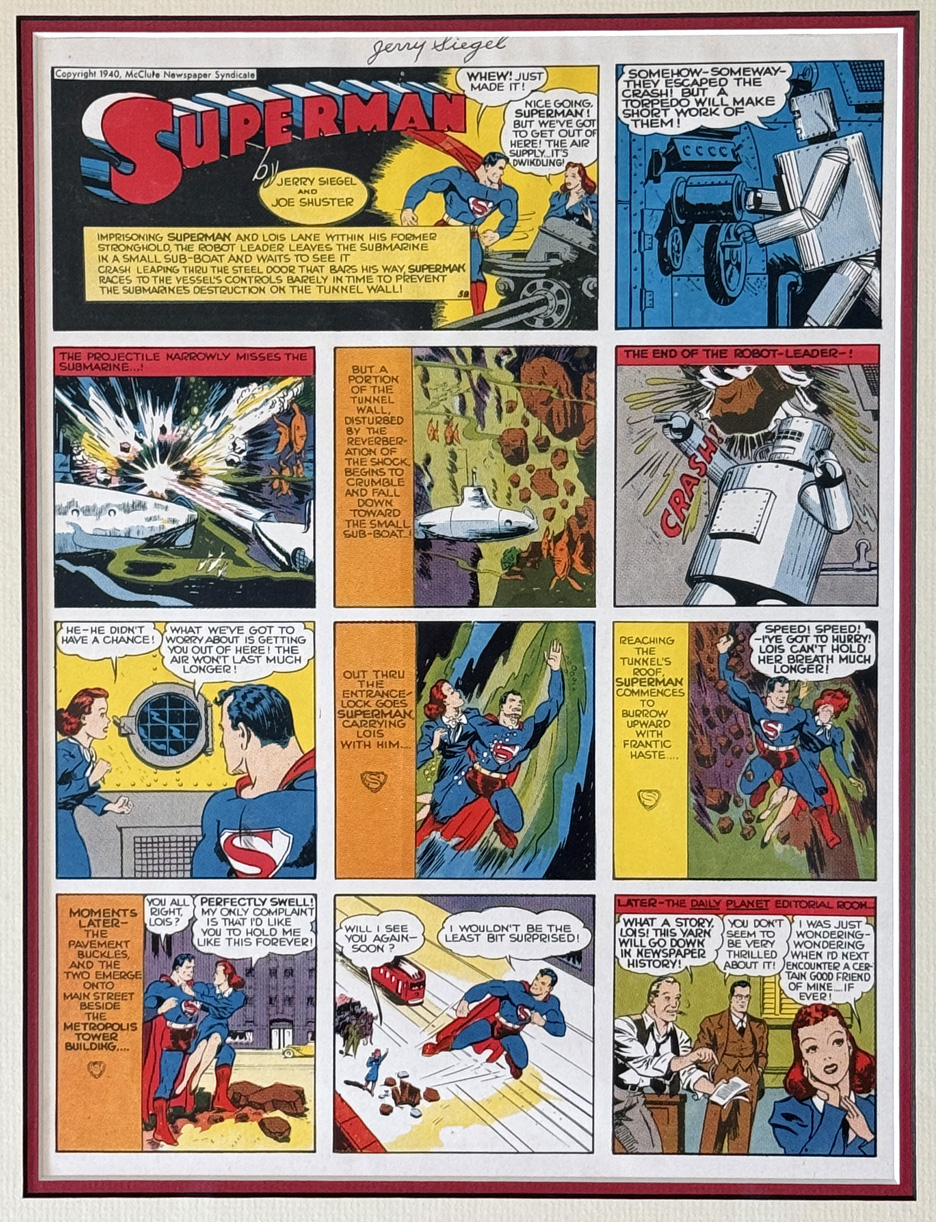
Superman Sunday Strip, (Syndicate Proof Sheet), December 15, 1940
Not quite original art, this is a syndicate proof sheet for the Superman Sunday comic strip, from December 15, 1940. The proof sheets are printed on higher quality paper, and the colors are extremely vivid — which you can see even though I photographed this example under glass.
(For an amplification of how this proofing process worked, see the new edition of Jack Kirby’s Sky Masters Sunday strips, which explains the process in some detail.)
I enjoy these early strips — Shuster’s art here often seems more polished than the comic books, where some of the art suffers from inconsistency. That’s of course not shocking: Superman’s explosive —and nearly instantaneous —popularity meant that Shuster, with the help of assistants and other artists, had to keep up with a prodigious amount of publishing.
This proof came from co-creator Jerry Siegel’s personal collection , and I was fortunate enough to snag one with a giant robot. (Plus, it is signed!)
Superman, Lois AND a giant robot. Seems like a hat trick to me.
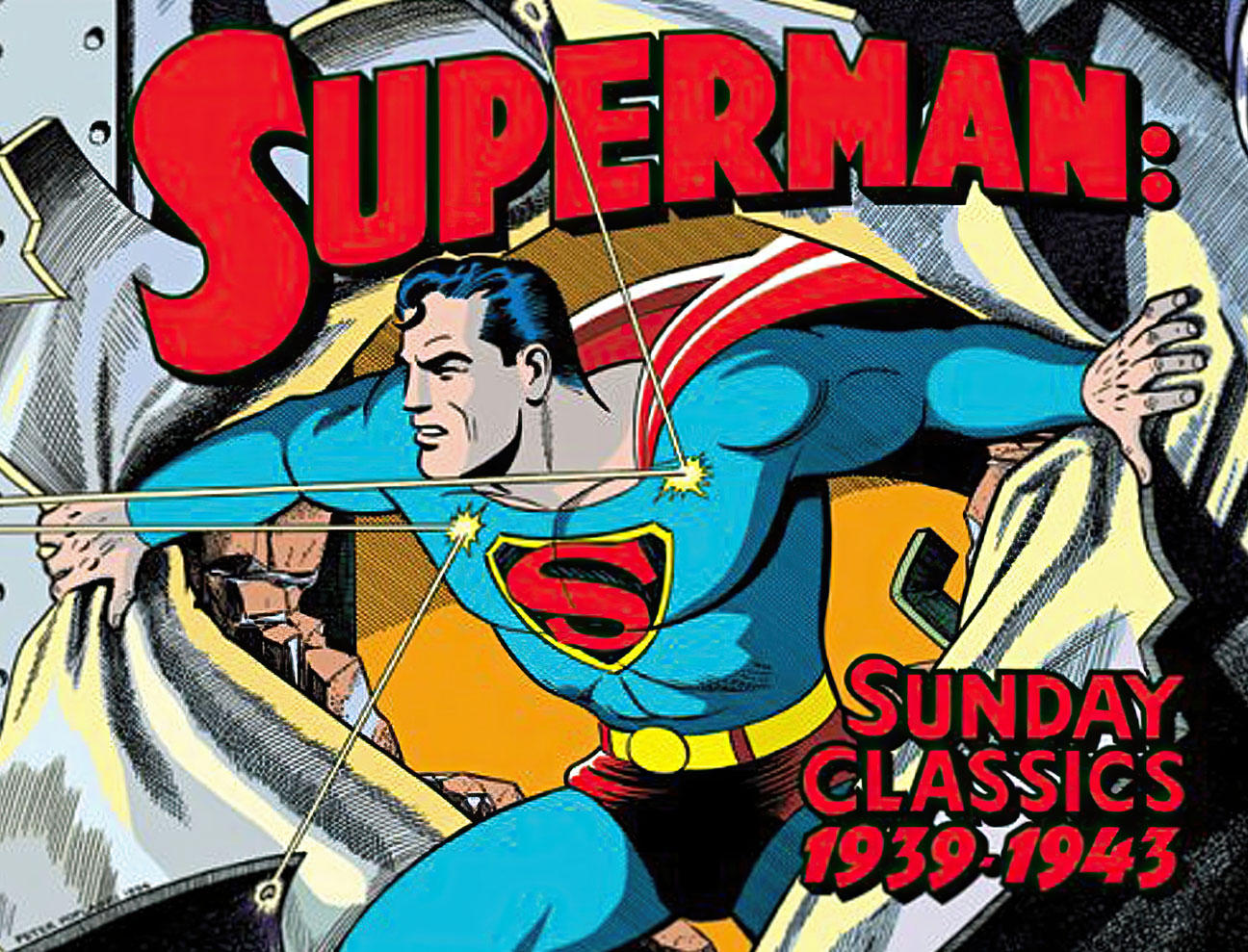
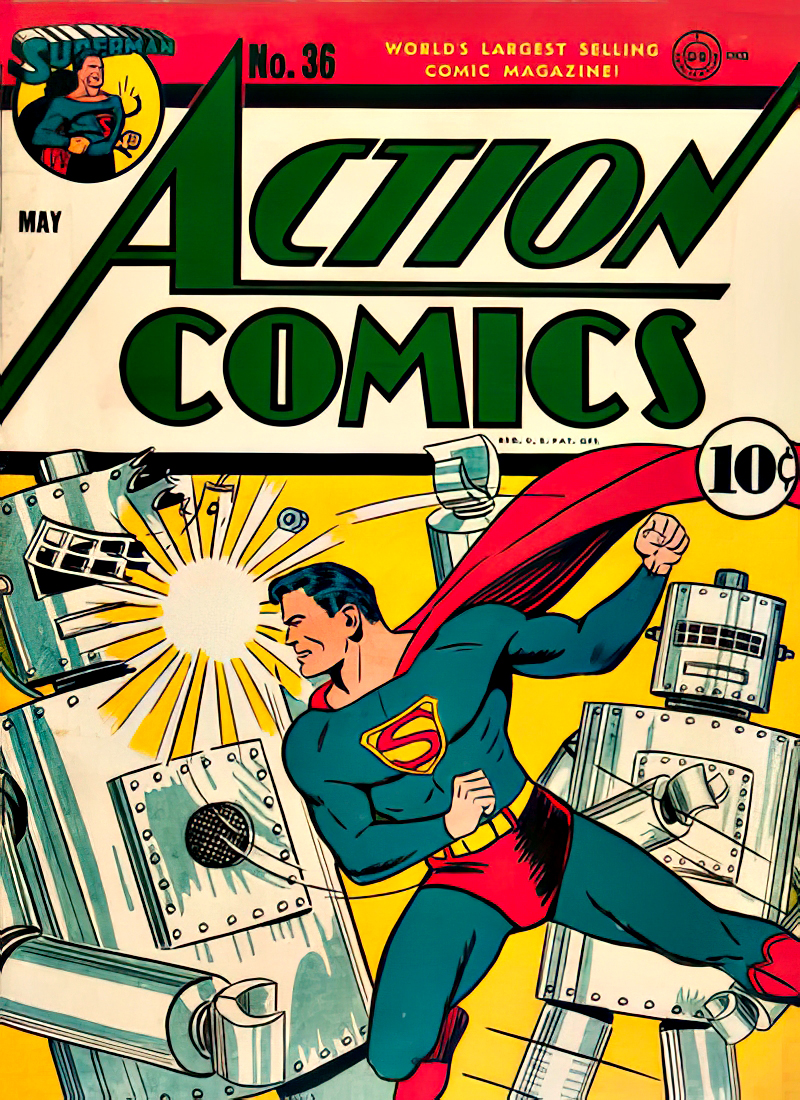
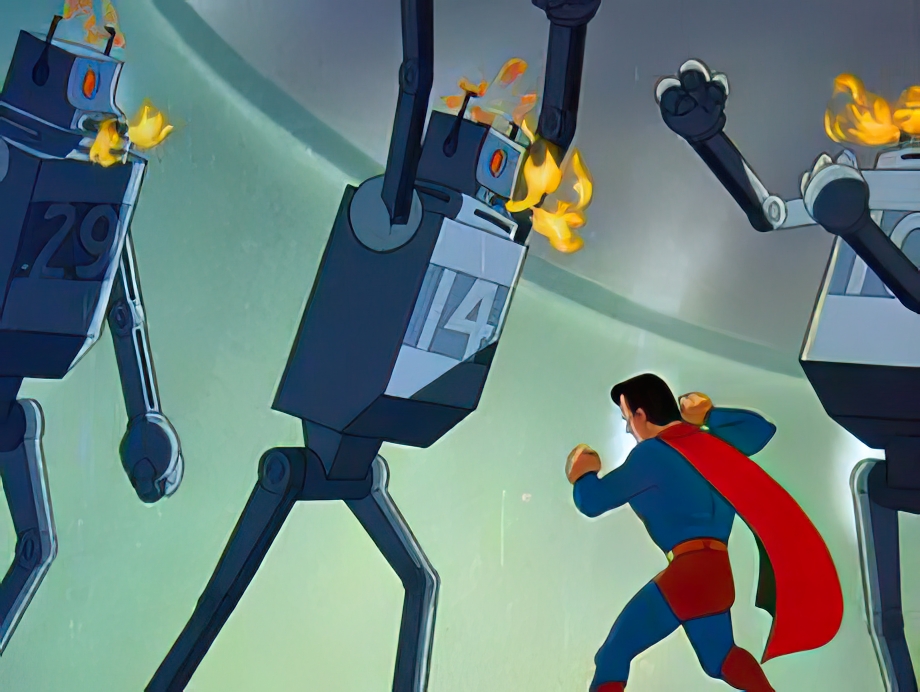
A tear sheet from the Houston Chronicle features the strip in a classic half page format.The original classic Superman strips (first reprinted by Kitchen Sink) are available in at least four different book formats; although they are all technically out of print, most are readily (and inexpensively) available from secondary booksellers. Because they are so easy to obtain, when we launched the Superman reprint program at IDW Publishing in 2013, we started with the next group of strips.Superman fought the “Bandit Robots” a few months later on the cover of Action #36 (great art by Fred Ray.) But… there’s no matching story on the inside!The Man of Steel fights similar (albeit not quite identical) robots in 1941’s “Superman and the Mechanical Monsters,” the classic episode of the wonderful Fleischer animated series of cartoon shorts.
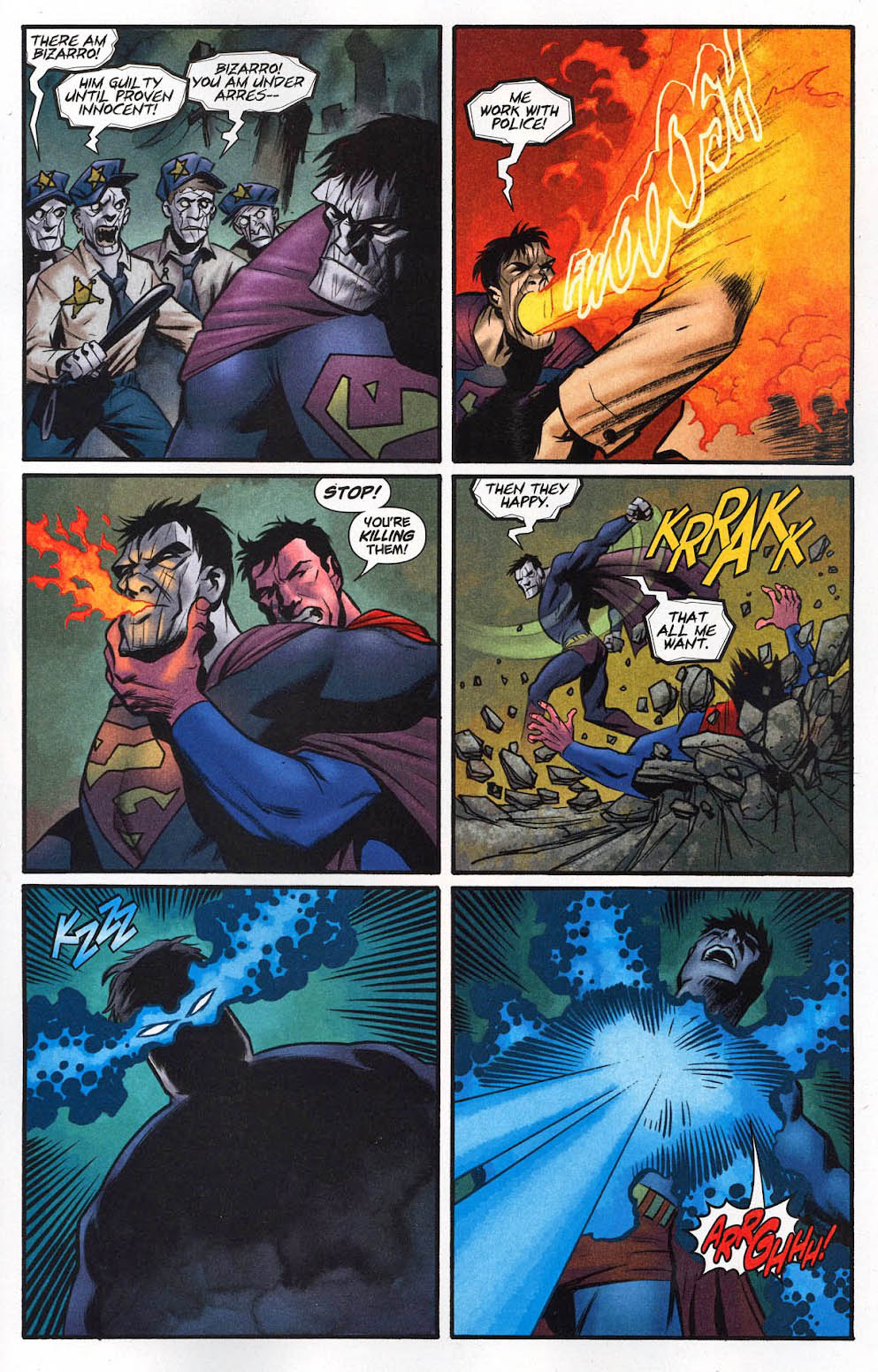
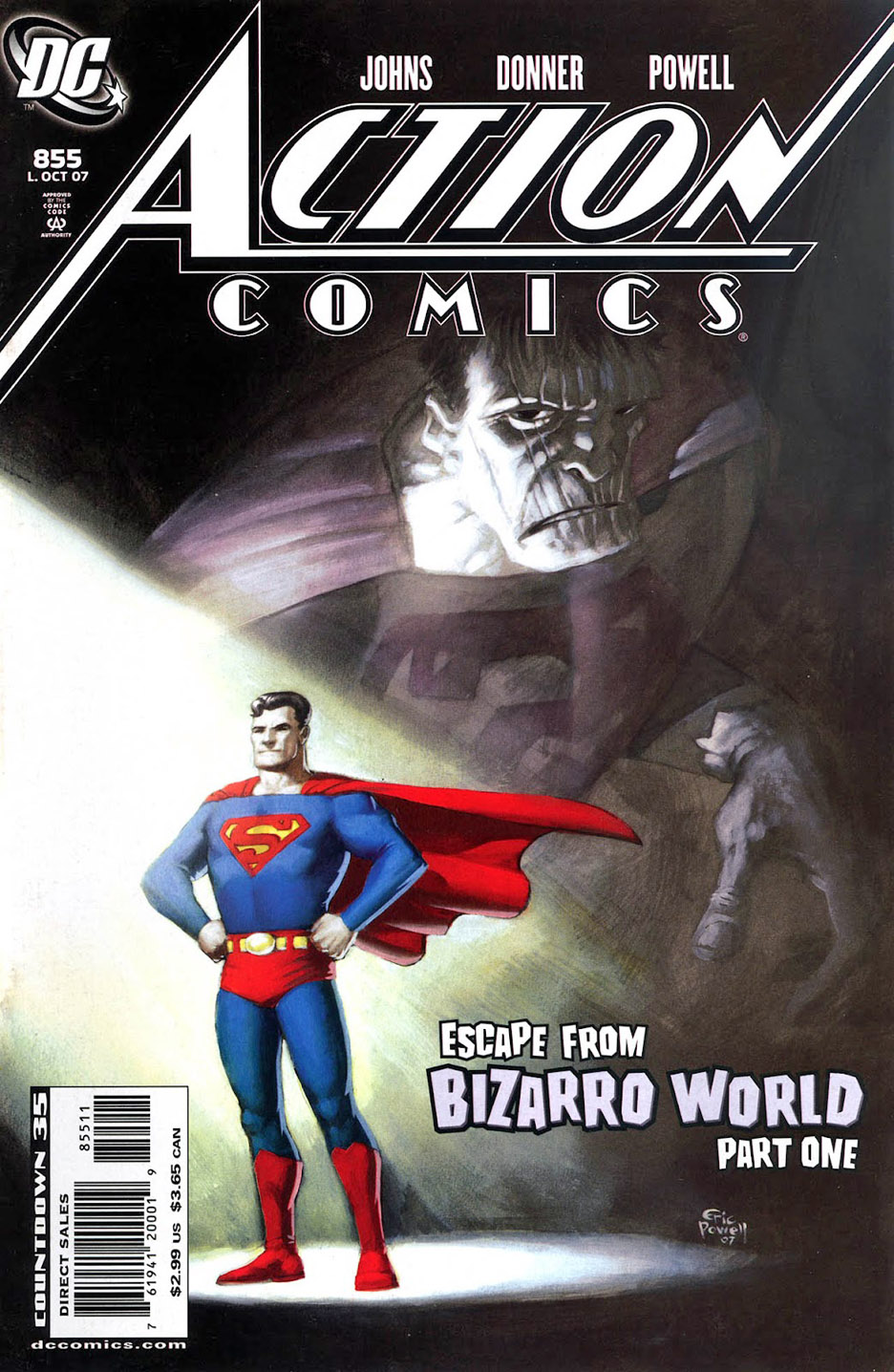
Geoff Johns, Richard Donner and Eric Powell creating a multi-part Bizarro story?
Sign me up.
Spoiler alert: It’s absolutely terrific — fun and affectionate — start to finish. Powell knocks the art out of the park. Many mainstream superhero readers tracked down Powell’s Goon series after they saw this.
You can bet the farm — Kent’s or otherwise — on that.
One final time — Happy Halloween, 2024!
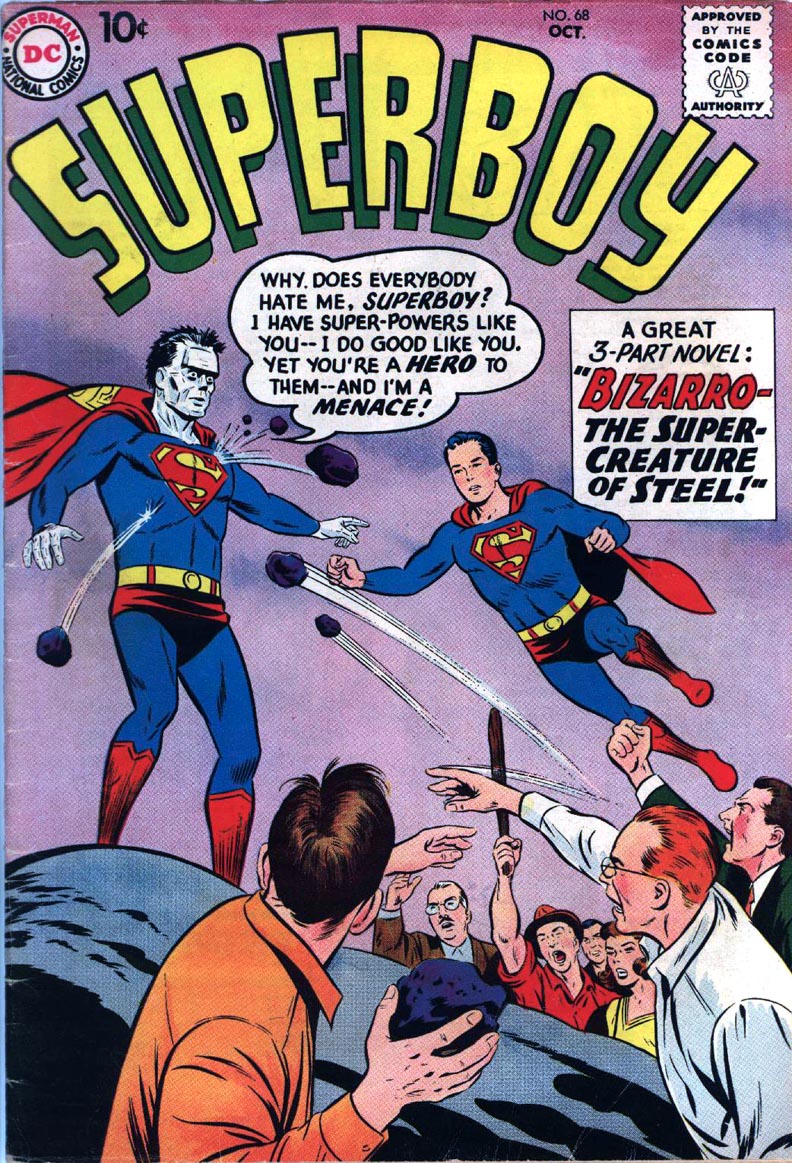
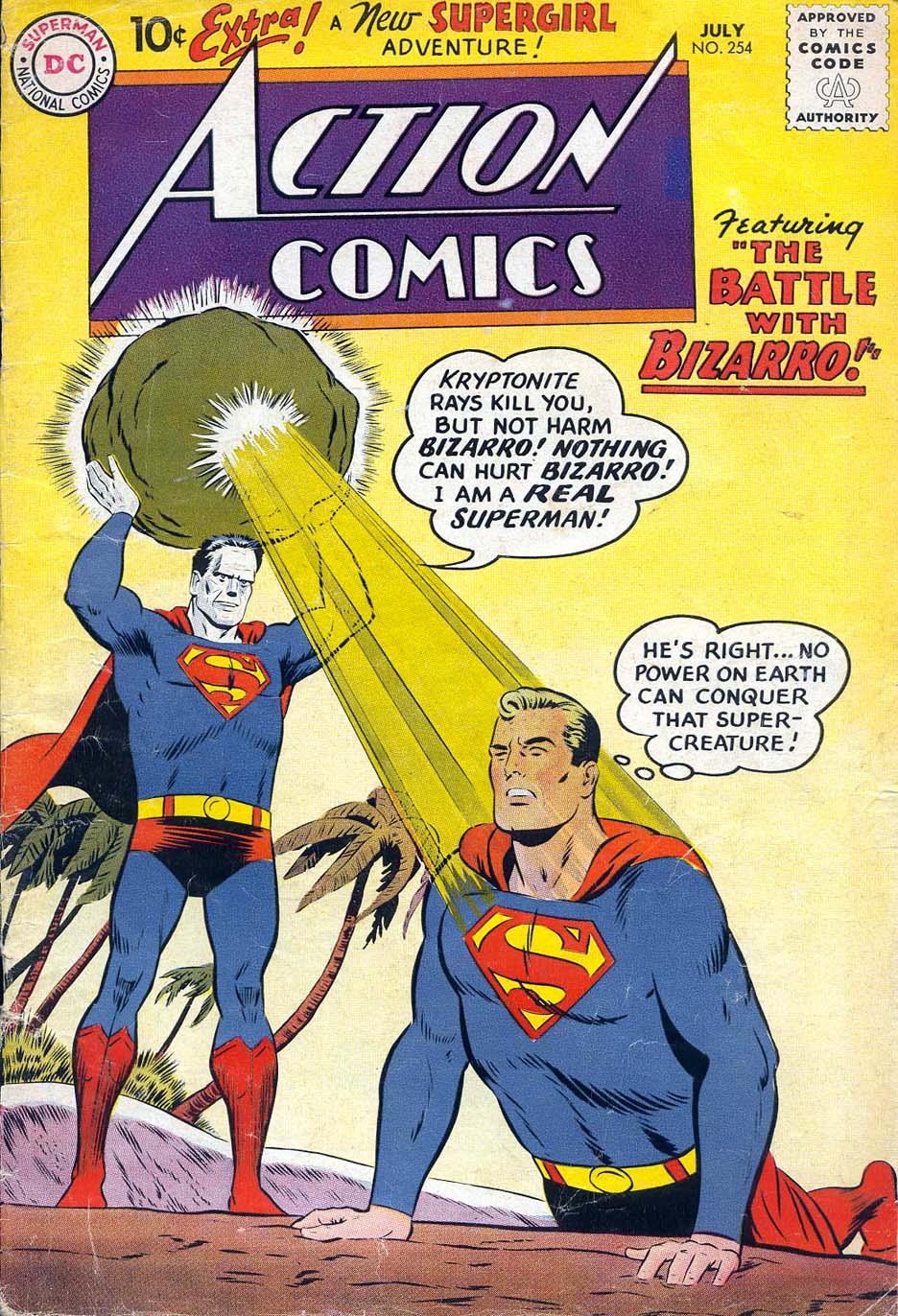
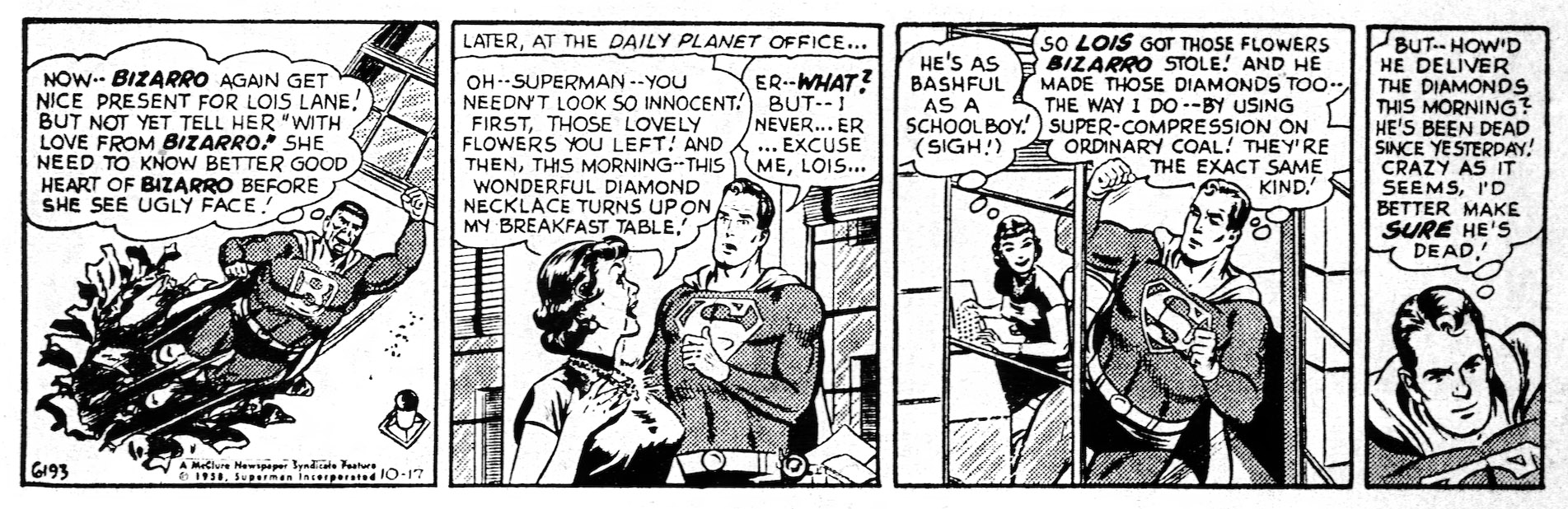
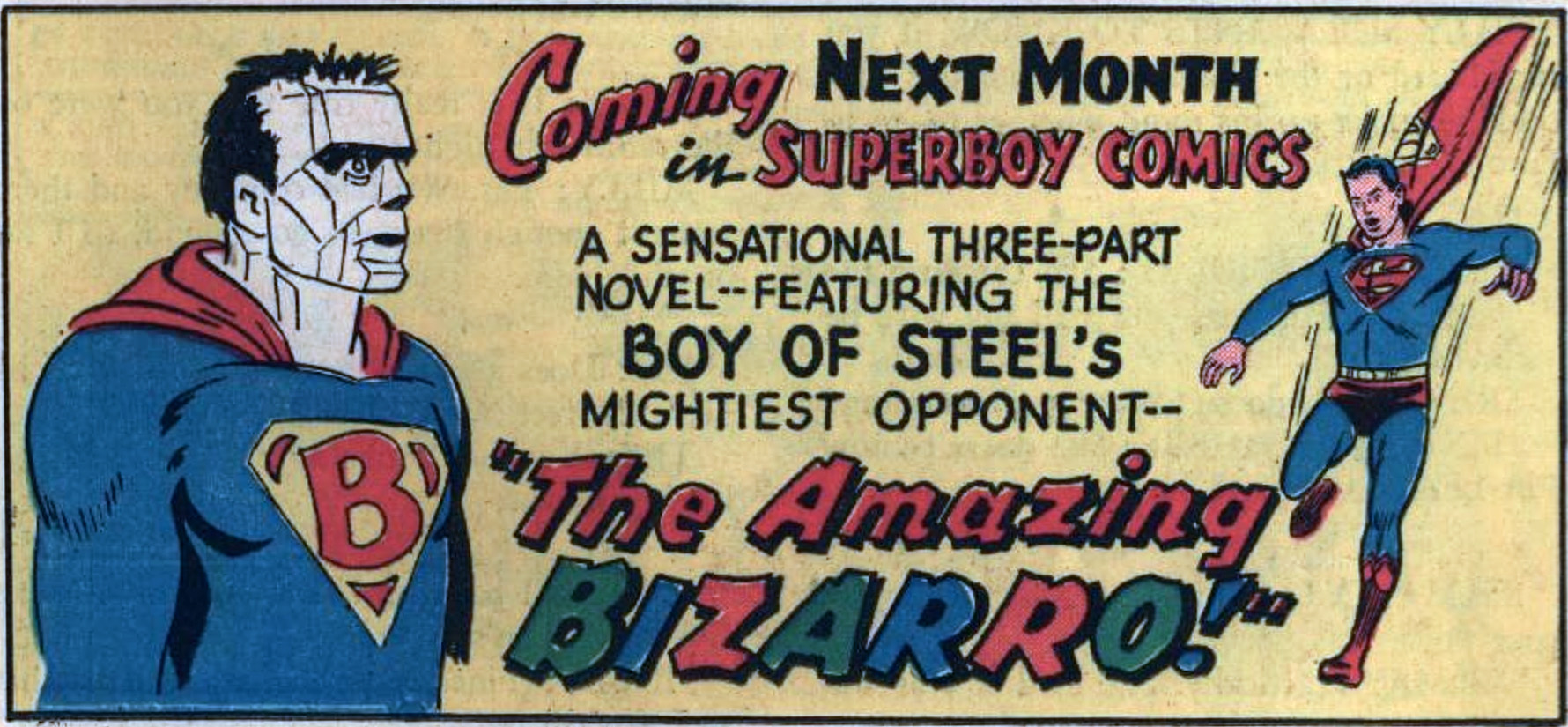
ScreenshotSilver age comic book readers first encountered Bizarro in Superboy #68, and then another version shortly thereafter in Action #254. But sharp eyed comic strip readers may have caught an even earlier appearance in Supes’ daily newspaper strip. Also above — the house ad in Superboy #67, with the alternative costume logo.
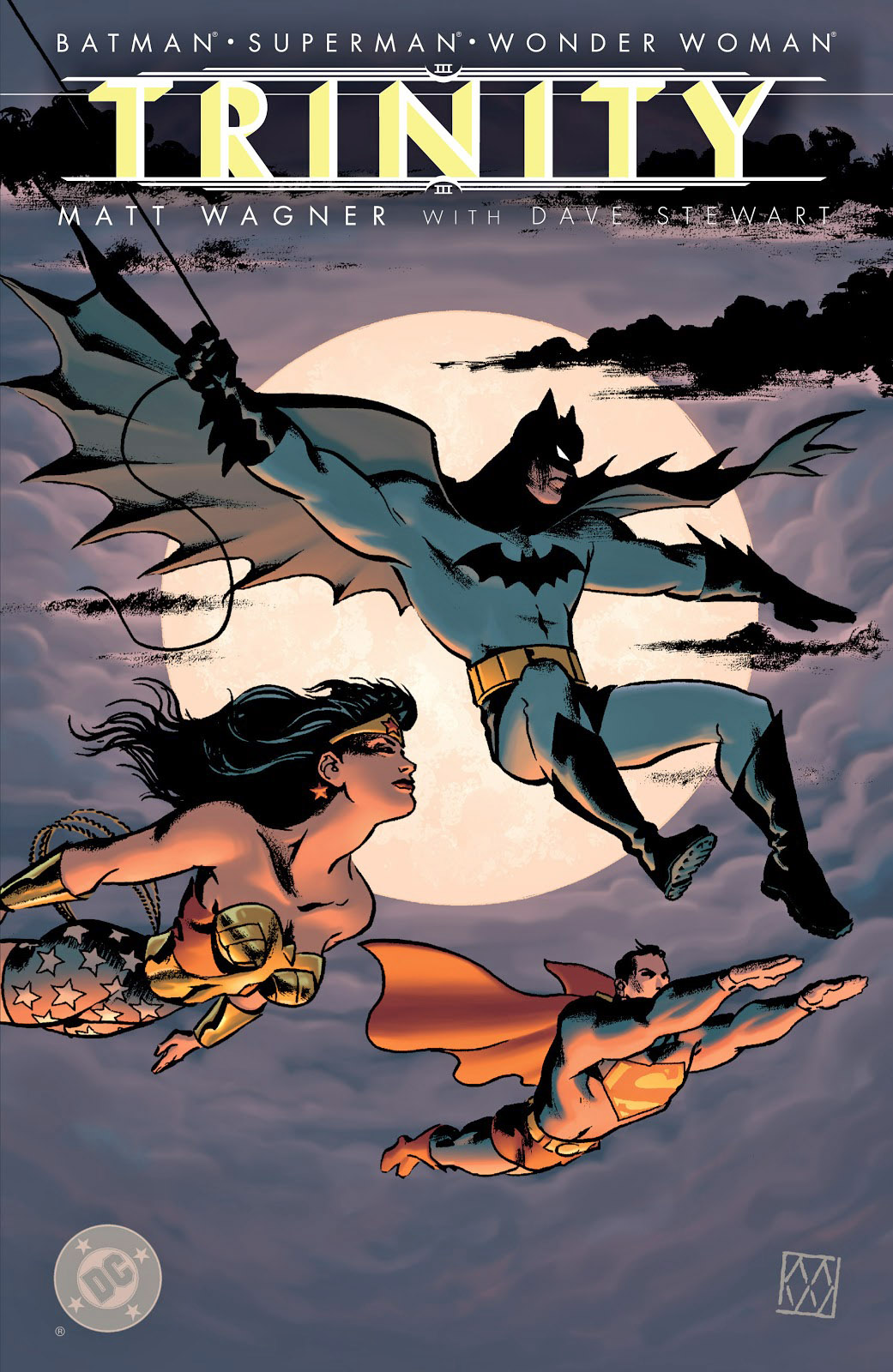
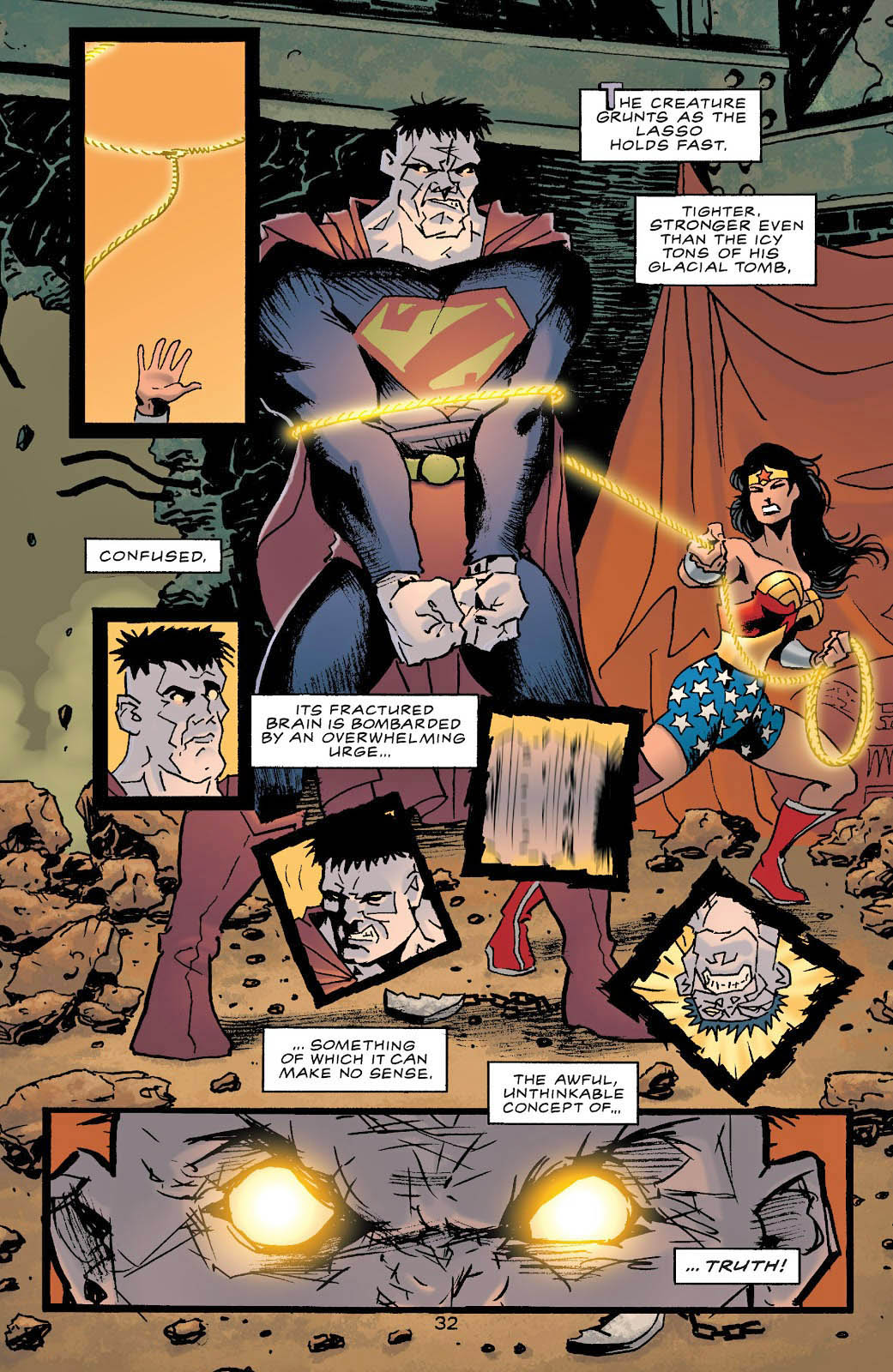
Batman / Superman / Wonder Woman: Trinity #2, September 2003
Batman / Superman / Wonder Woman: Trinity #2, 2003
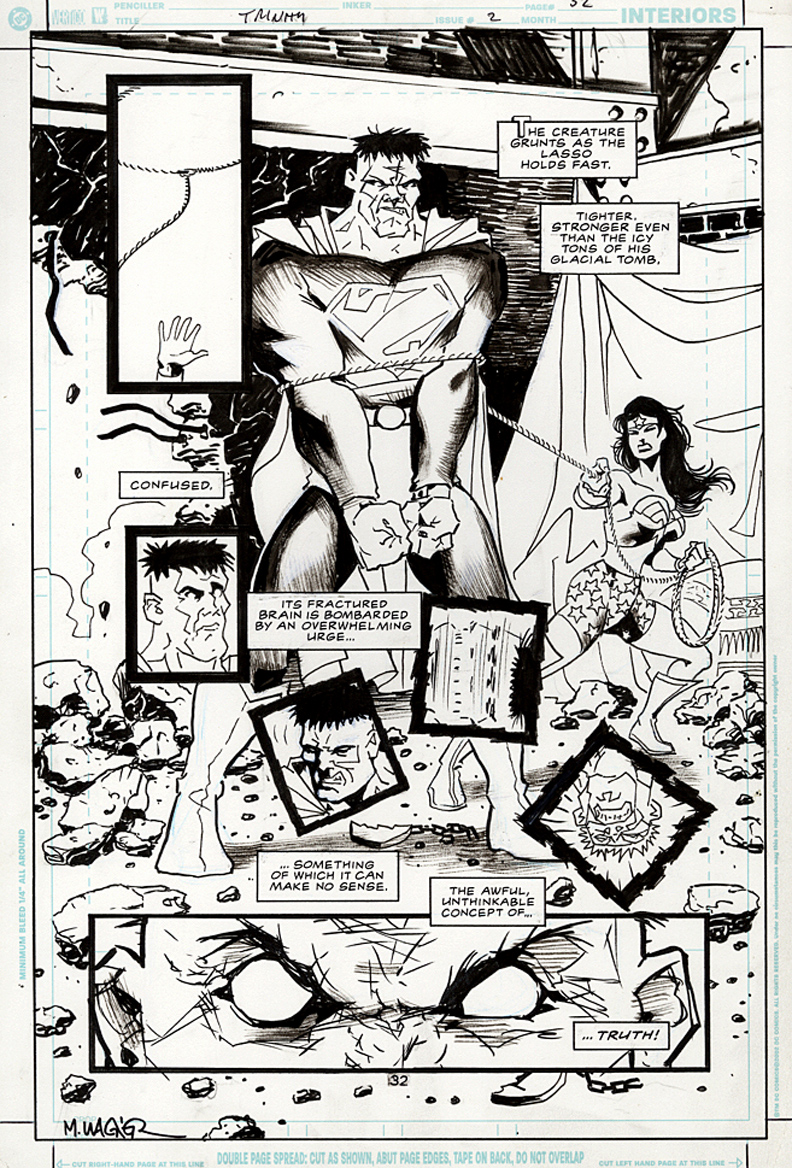
Here’s a great Matt Wagner splash featuring Wonder Woman doing her best to rein in Bizarro. Spoiler alert: It doesn’t go all that well.
Wagner delivers page after page of visual dynamics and terrific storytelling in this underrated series featuring DC’s “Big Three.”
The only thing I don’t like: The “official” book title, which is a bit long and definitely not obvious. (Publishers occasionally forget that readers have to be able easily find the title at retail. Trust me on this.)
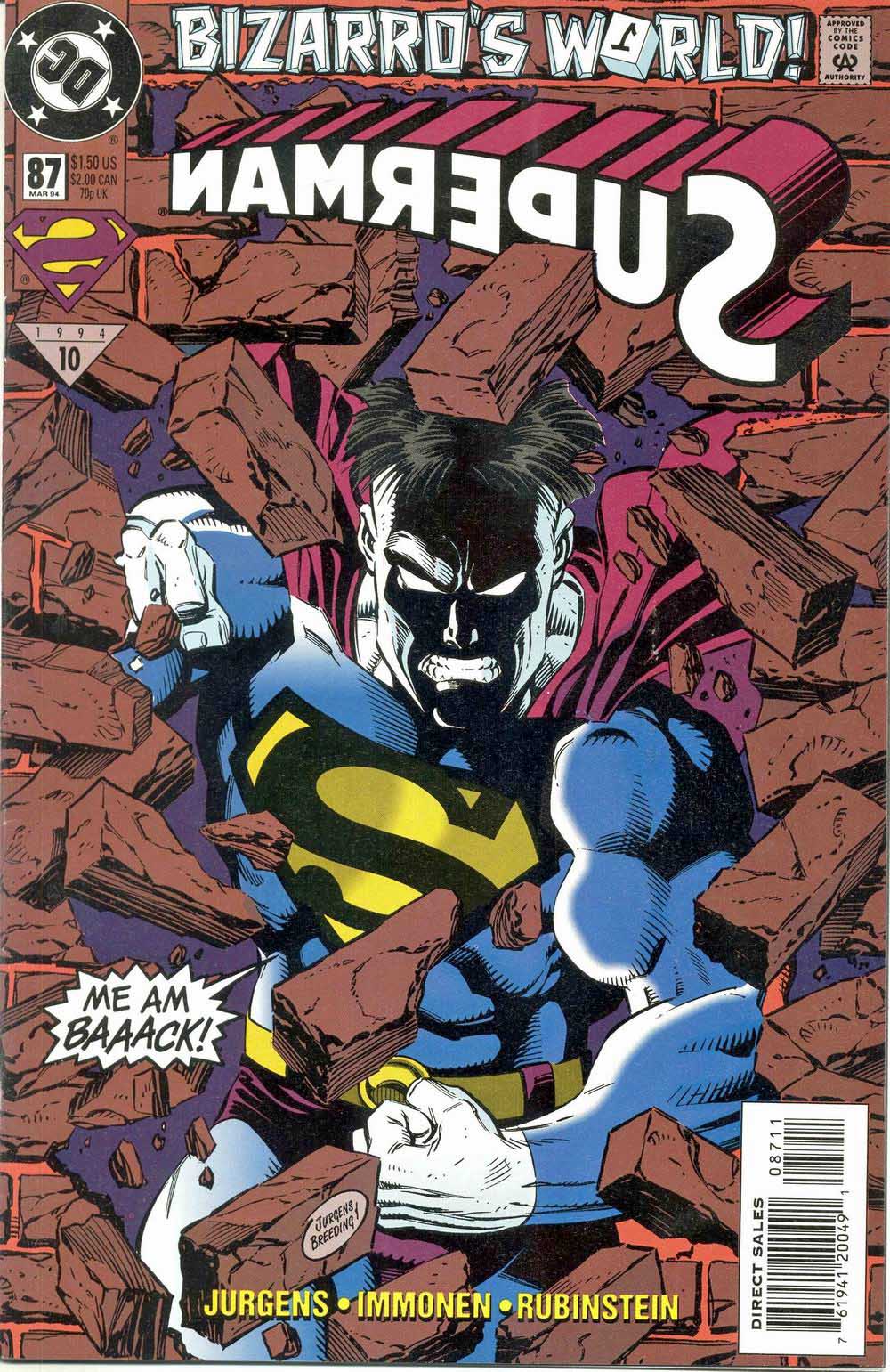
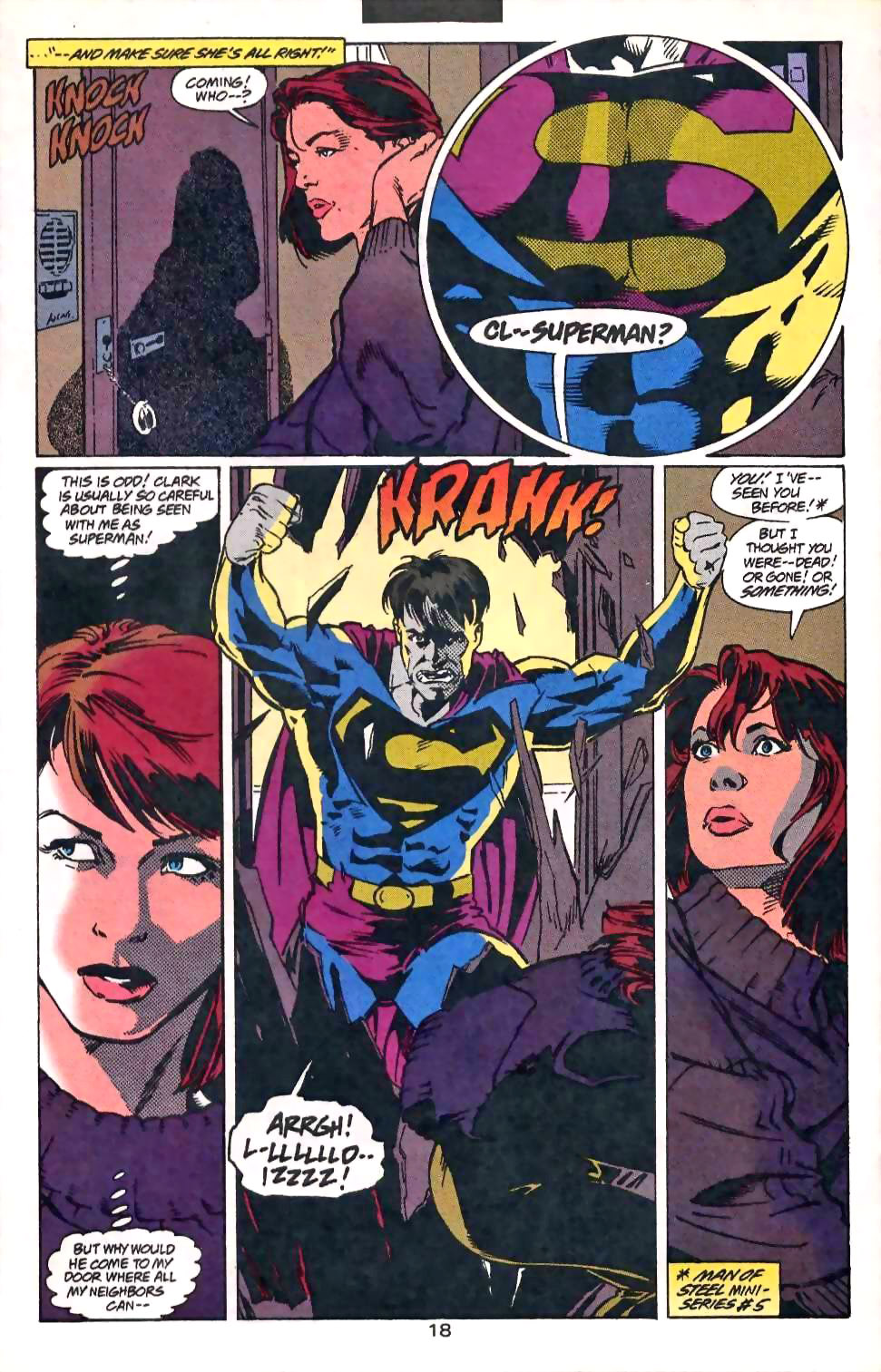
Stuart Immonen — guest penciling in Dan Jurgen’s regular slot — has some fun with Bizarro, and the rest of the Superman cast in this two-part story from 1994.
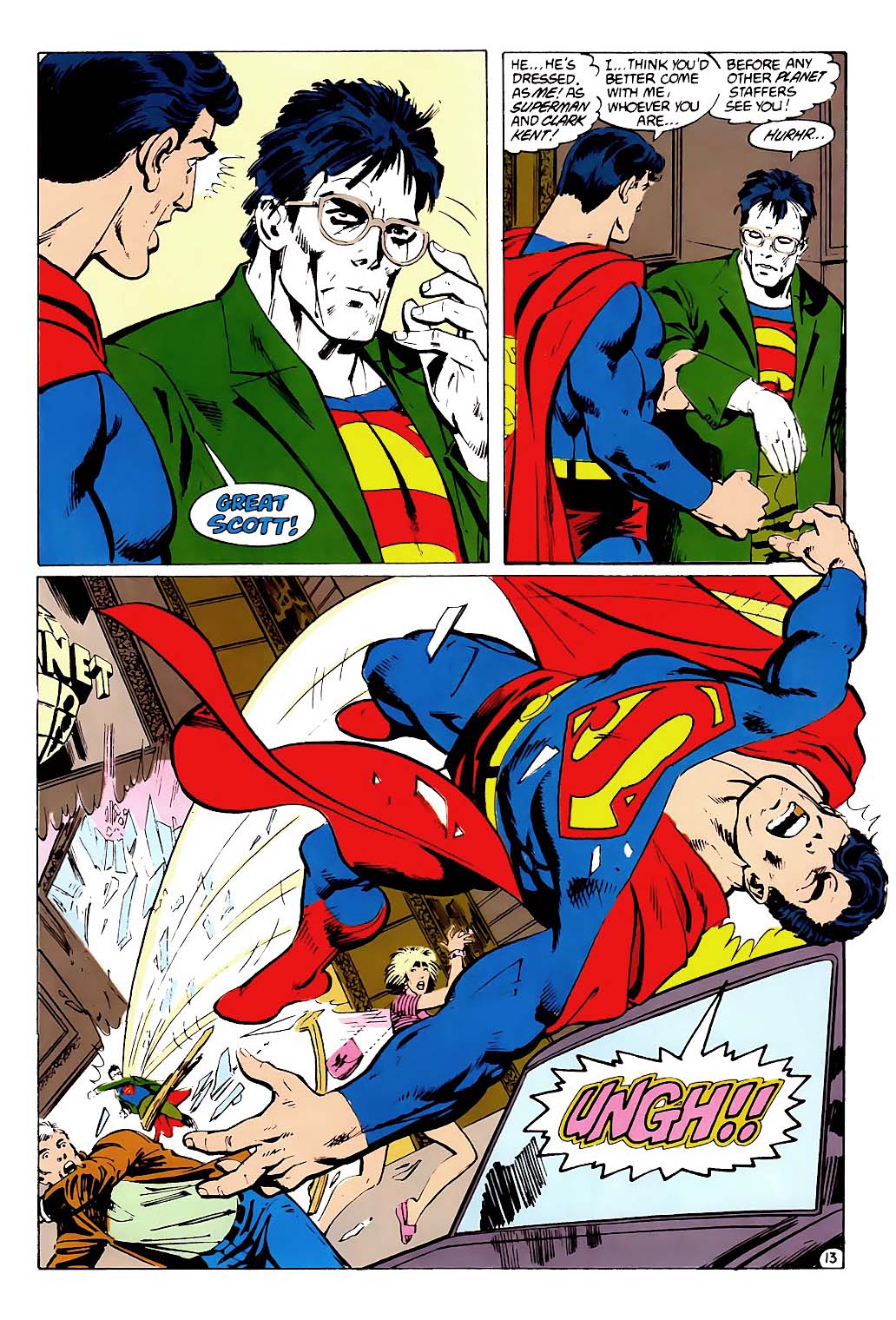
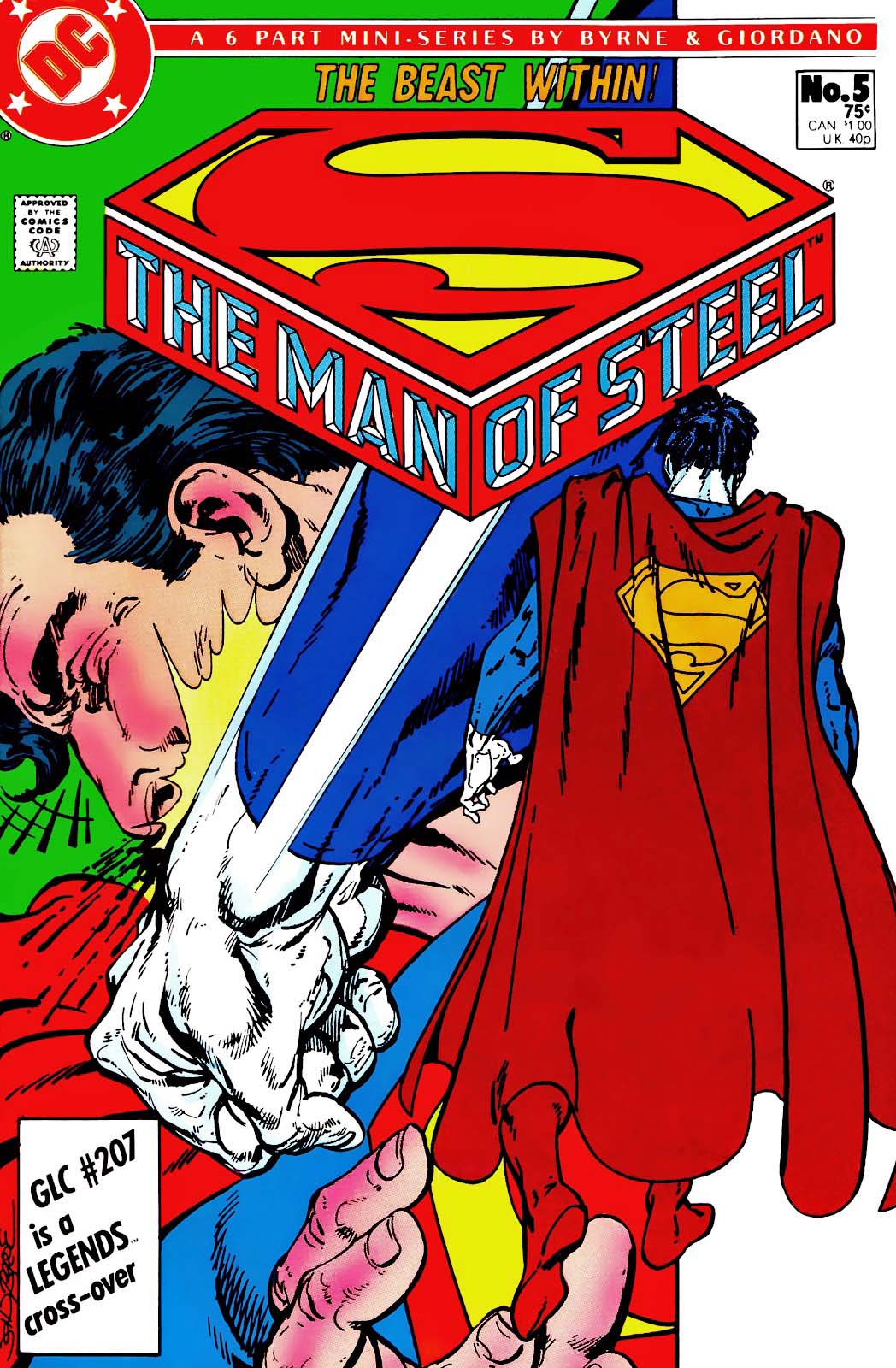
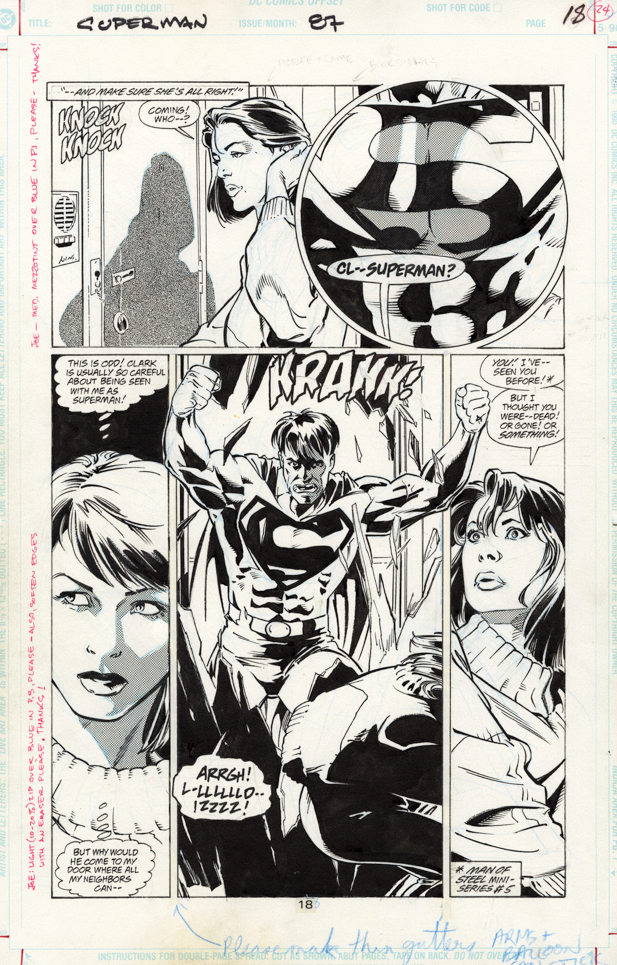
This is only the second appearance of Bizarro in the “modern” superman era. John Byrne used the character in the Man of Steel mini-series (#5) and promptly destroyed him.
Spoiler alert: Lex Luthor resurrects the Superman cloning idea in this issue, and things don’t go much better. (Although I guess Bizarro lasts two issues instead of just one this time around, so there’s that.)
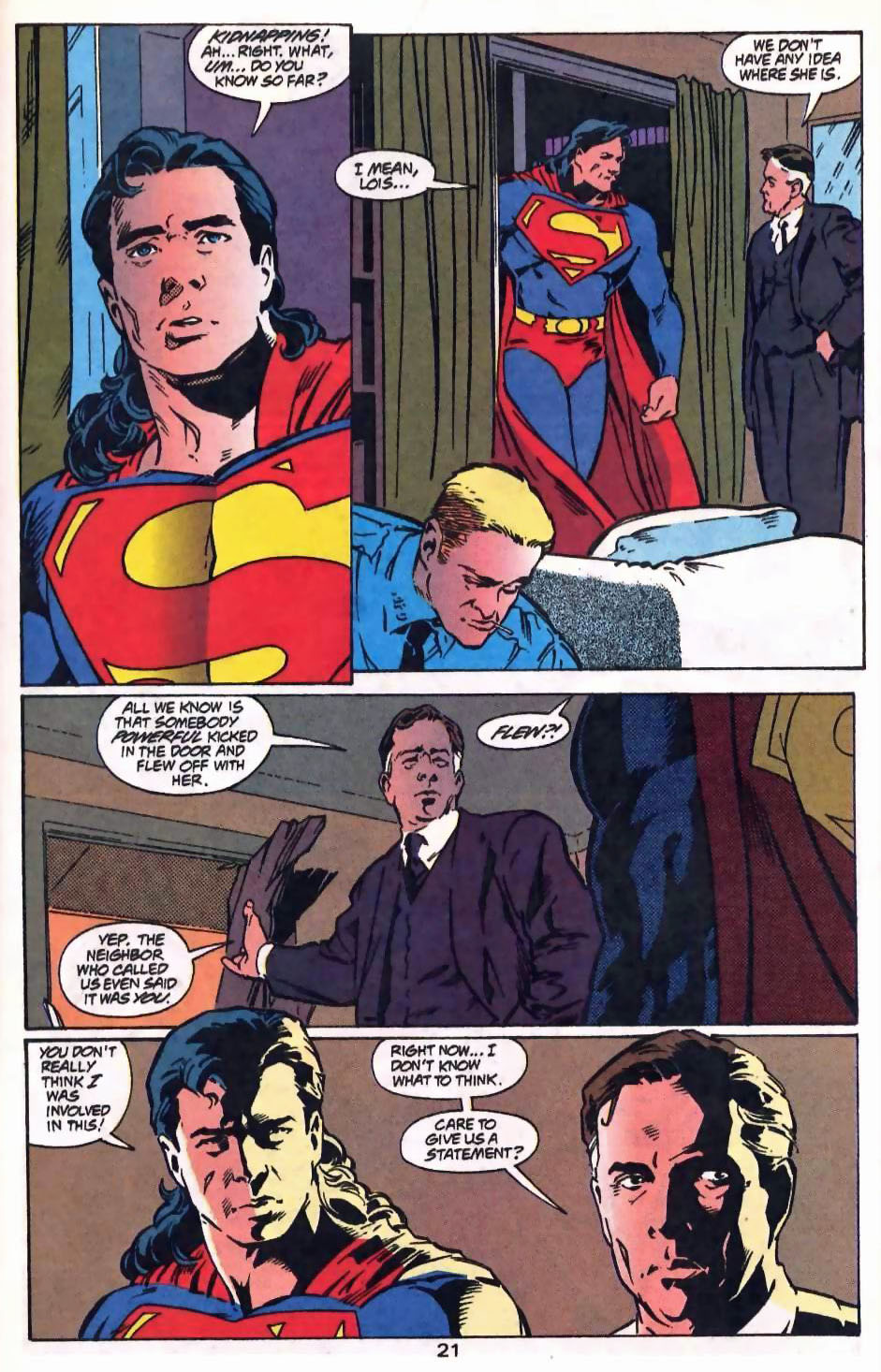
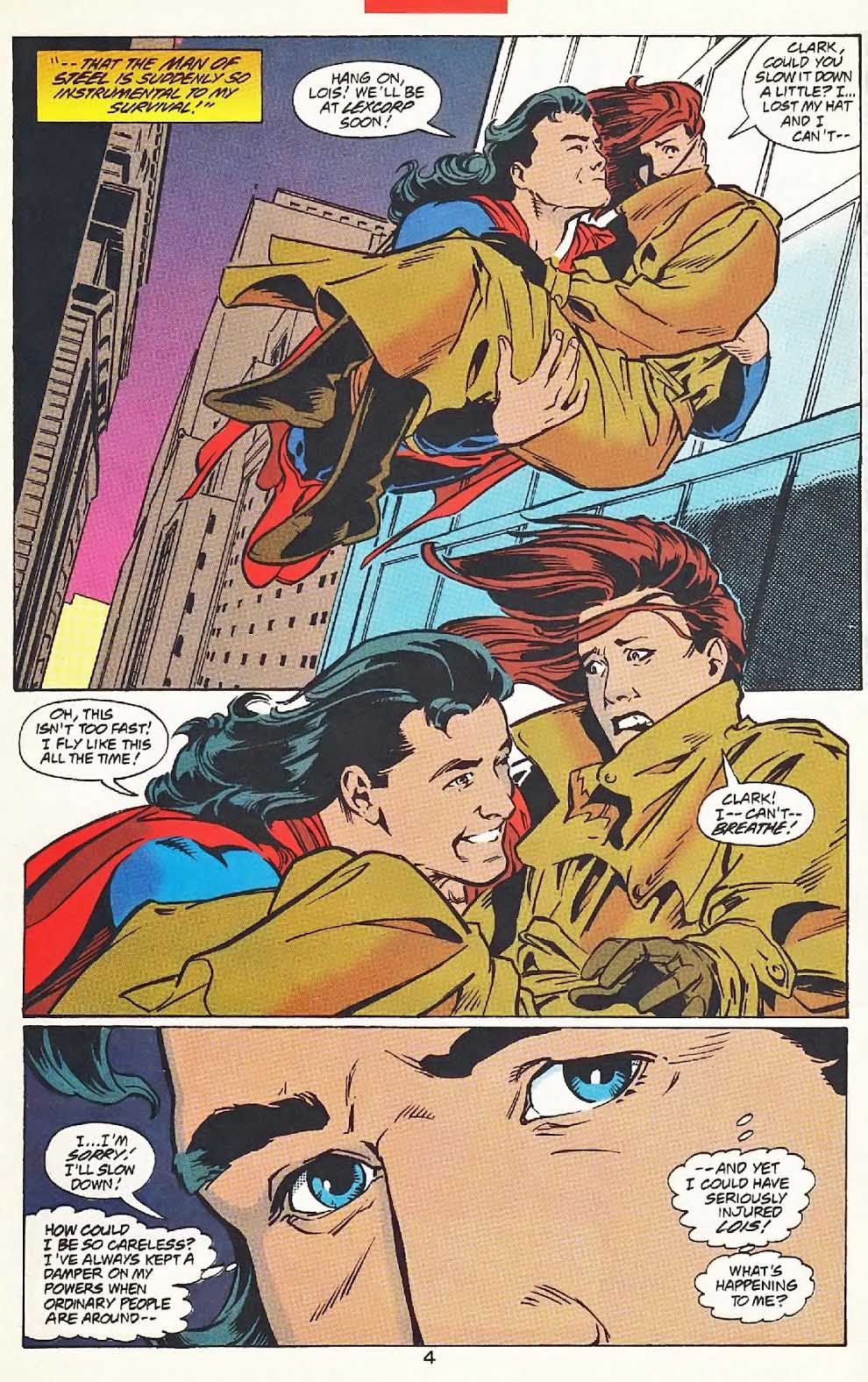
I definitely dig Immonen’s art — but if you thought Jurgens drew Mr. Kent with a big mane of hair, definitely check out Stuart’s version. Superman’s hair starts big in issue #87 and might even be fuller and longer by #88.
Definitely ready for a time-travel trip to the Hyborian age.
Happy Halloween —all month long!
Superman was in his long hair phase in these days and artist Immonen was not messing around. (Pages from issue #87 and #88.)John Byrne’s reboot of Superman brought Bizarro back for one issue in the original Man Of Steel mini-series, but he was toast by the end of the issue.
Michael Golden draws a terrific Superman here — likely with the most detailed and beautiful cityscape to ever appear on a comics page.
First it was commissioned as a cover — then it went into inventory — then it came back out as a pin-up in the 600th issue of Superman.
And look, I know it was just after 9/11, and the “American Way” theme made sense. But… when you look at the printed cover, and compare it at this amazing Golden piece, you simply shake your head at the missed opportunity.
(Side note: As noted previously, I am a sucker for “happy” Superman art. If you had those powers, wouldn’t you be happy — at least some of the time?)
Superman: Blood of My Ancestors is an unusual project. Gil Kane was the original penciller, but he passed away before he could finish it, and then John Buscema took over the penciling, and did manage to finish it — before his passing shortly thereafter.
So, when the book finally see print in 2003, both pencillers, giants in the industry were gone.
Kevin Nowlan provides finishes for both. (And as a bonus, because Kevin inked Gil’s pages, they won’t fade away like so many of the other Kane “marker era” pages from his latter DC comics career.)
Not a ton of Superman in this one-shot since much of the story revolves around an early ancestor of the House of El. In fact, most of the Buscema pages look like a classic barbarian tale. Kal-El’s distant relative is a dead ringer for Conan.
Who knew?
Gil’s depiction of Superman in flight made the back cover of the one-shot as well. It reminds me a lot of this great house ad for Gils underrated run on Superman in the early 80s, just prior to John Byrne’s overhaul of the character and the mythos.