Greg Goldstein's Comic Art Gallery

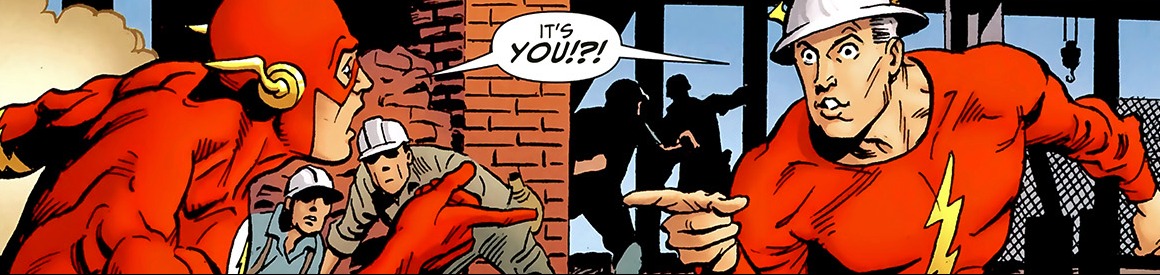
Dick Dillin — Come Together

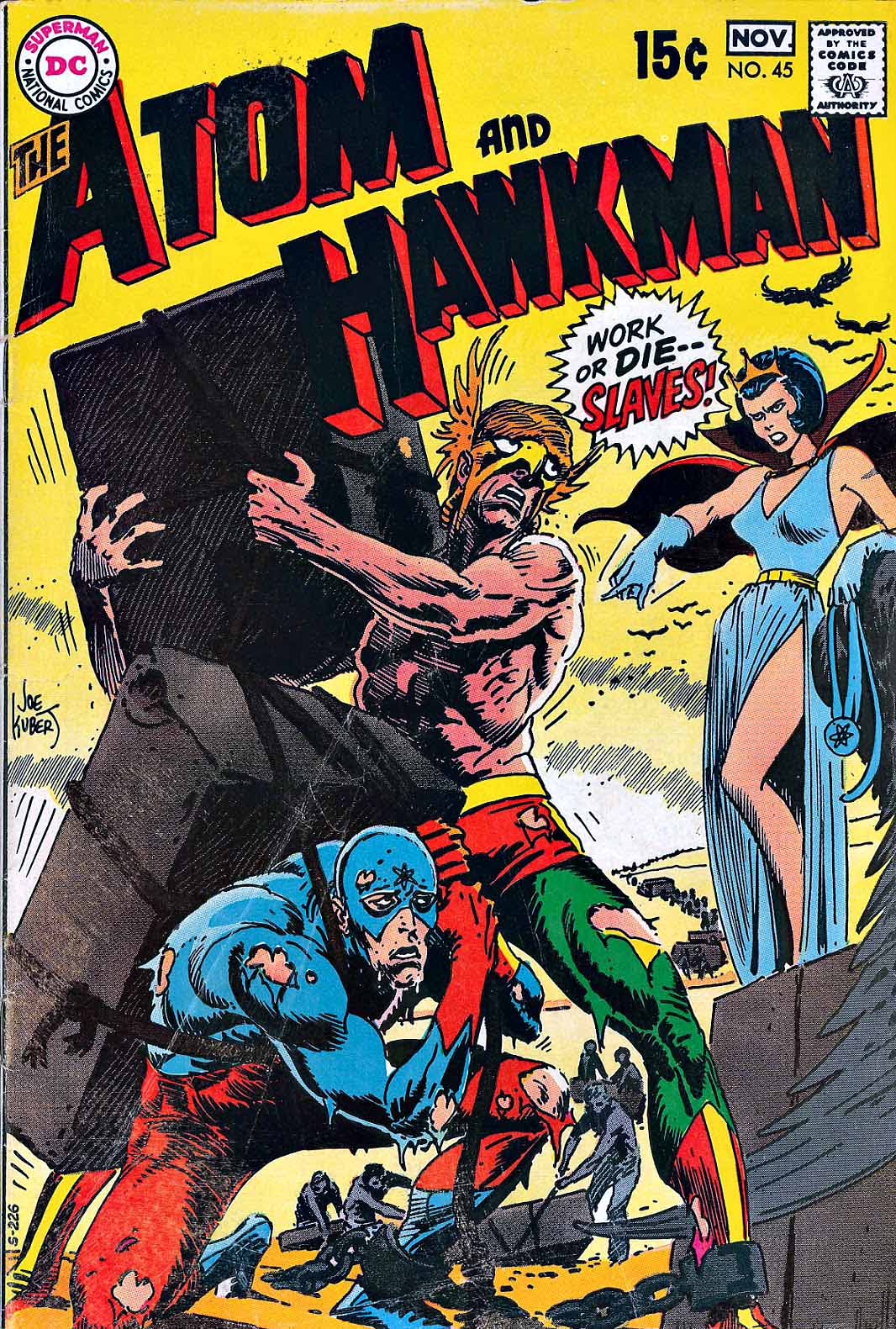
The Atom and Hawkman #45, November 1969

As discussed earlier this year, 1961 is an anniversary for both the Sliver Age versions of Hawkman and The Atom.
 
Neither character was ultimately commercially viable for his own comic book, so DC tried combining two titles into one.
 
Unfortunately that didn’t work long either, but as they say, it was fun while it lasted.
 
Dick Dillin was one of DC”s “B-team” artists who deserves more respect than he typically receives.
 
Although his draftsmanship may not have been up to the higher levels of some of his peers, his ability to draw with imagination and solid storytelling was pretty on point in my book.
 
He pretty much drew every issue of Justice League of America for 12 years starting with issue #64 (1968) and ending with his untimely death at #183(1980). Considering all the various JLA crossovers (JSA, Freedom Fighters, etc.), Dillin likely drew hundreds of different heroes and villains during that time. 
 
Just Atom and Hawkman? Piece of cake.

Jim Lee — Divine

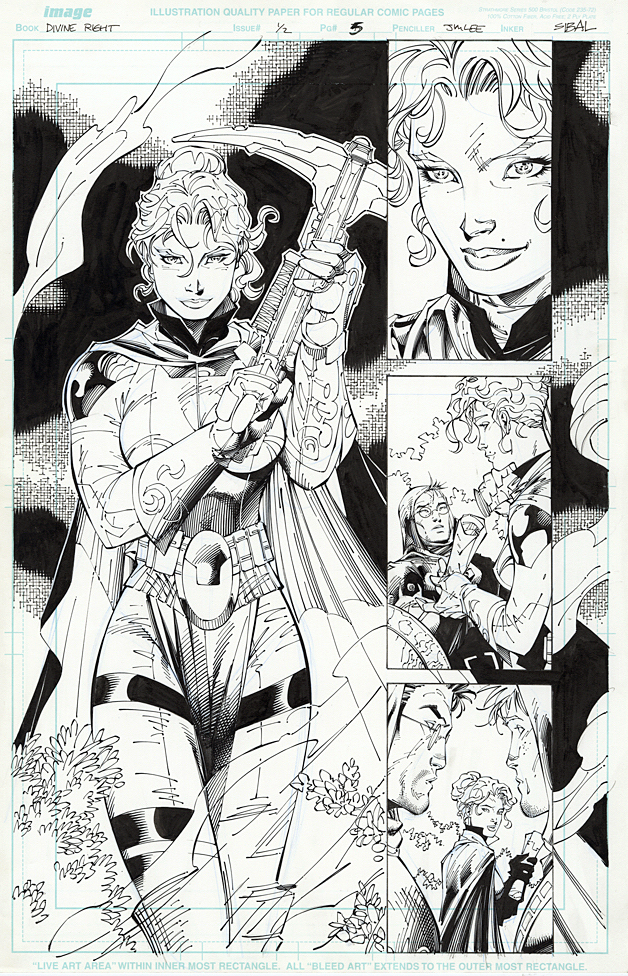
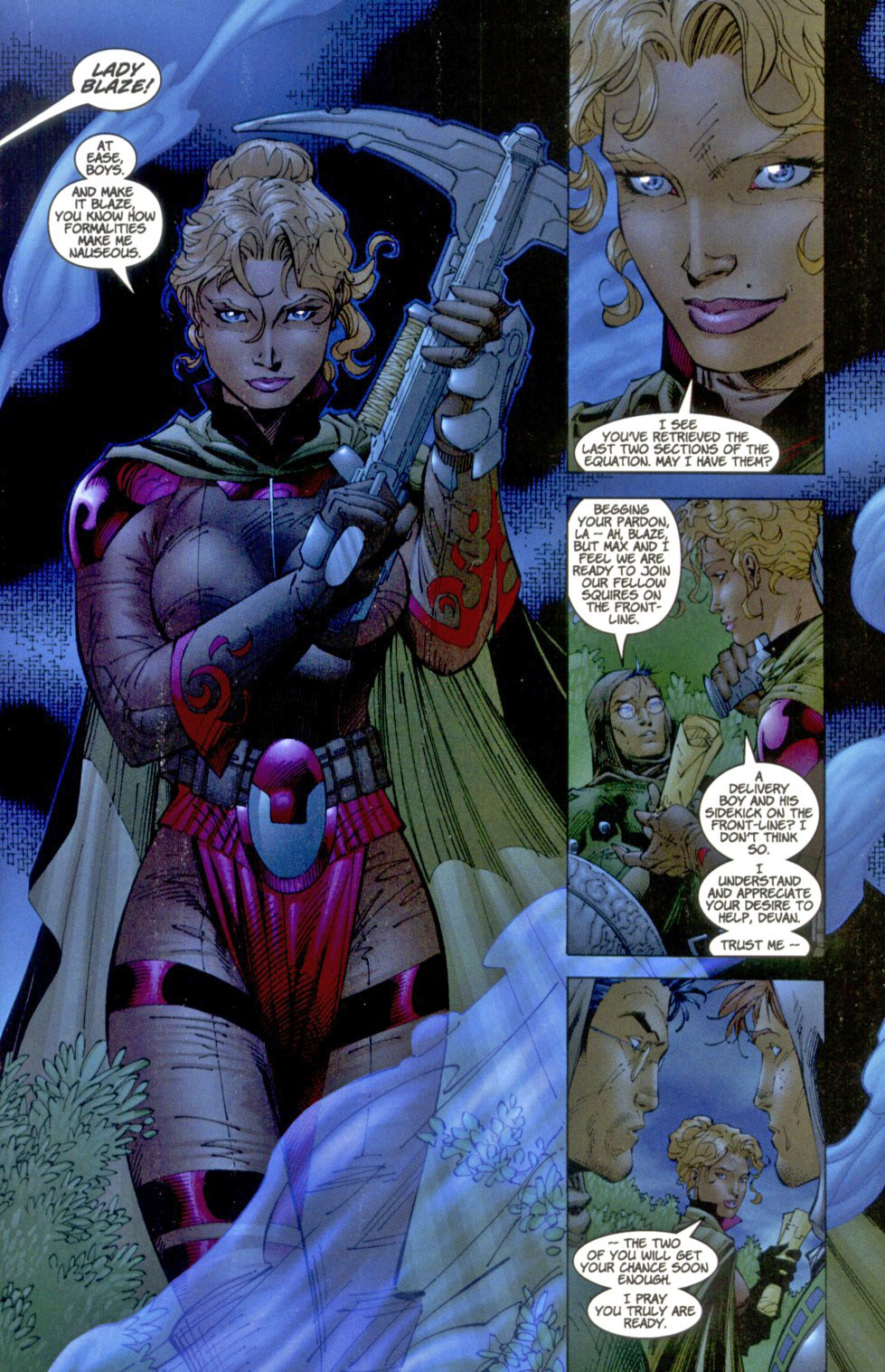
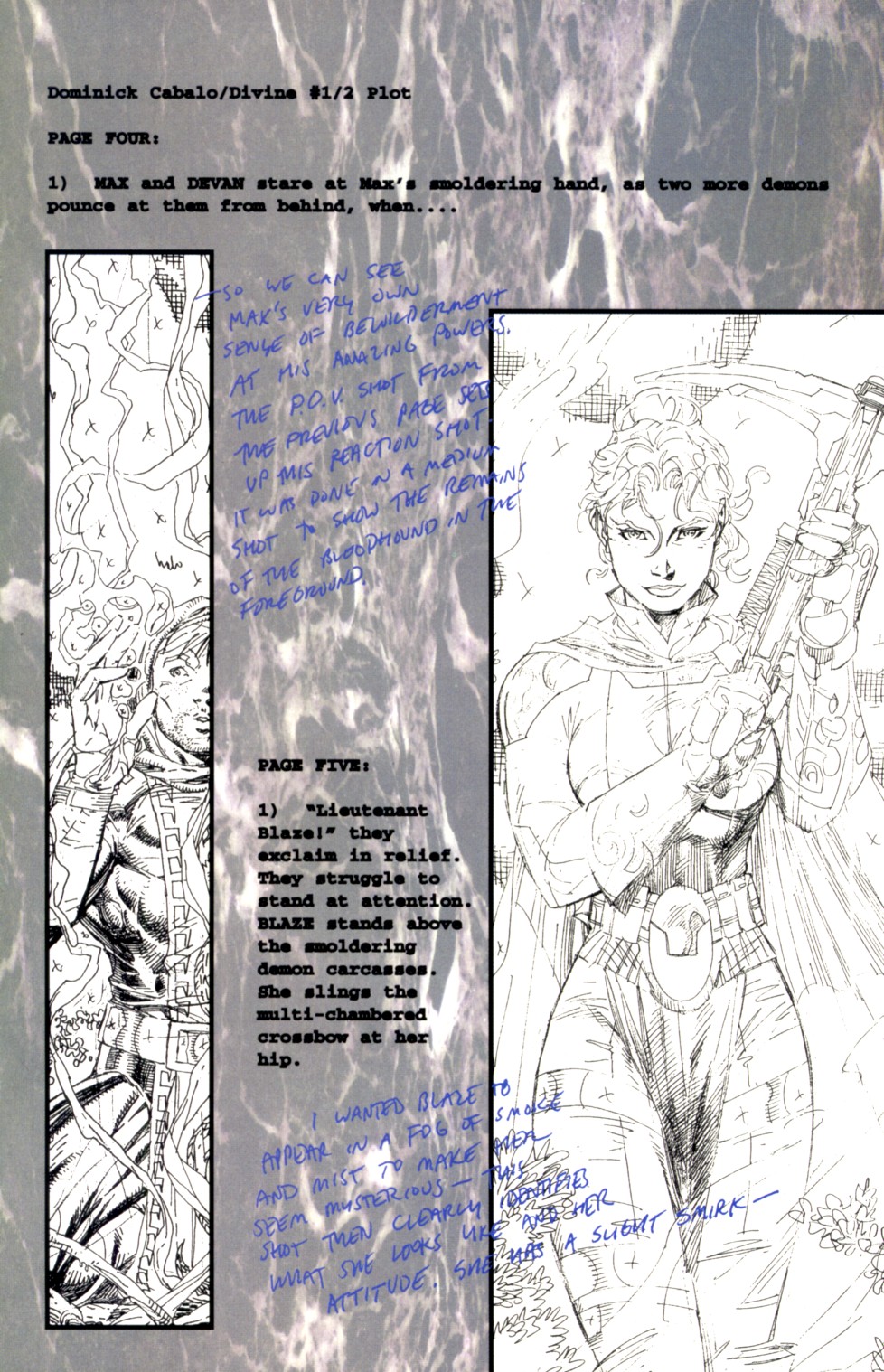
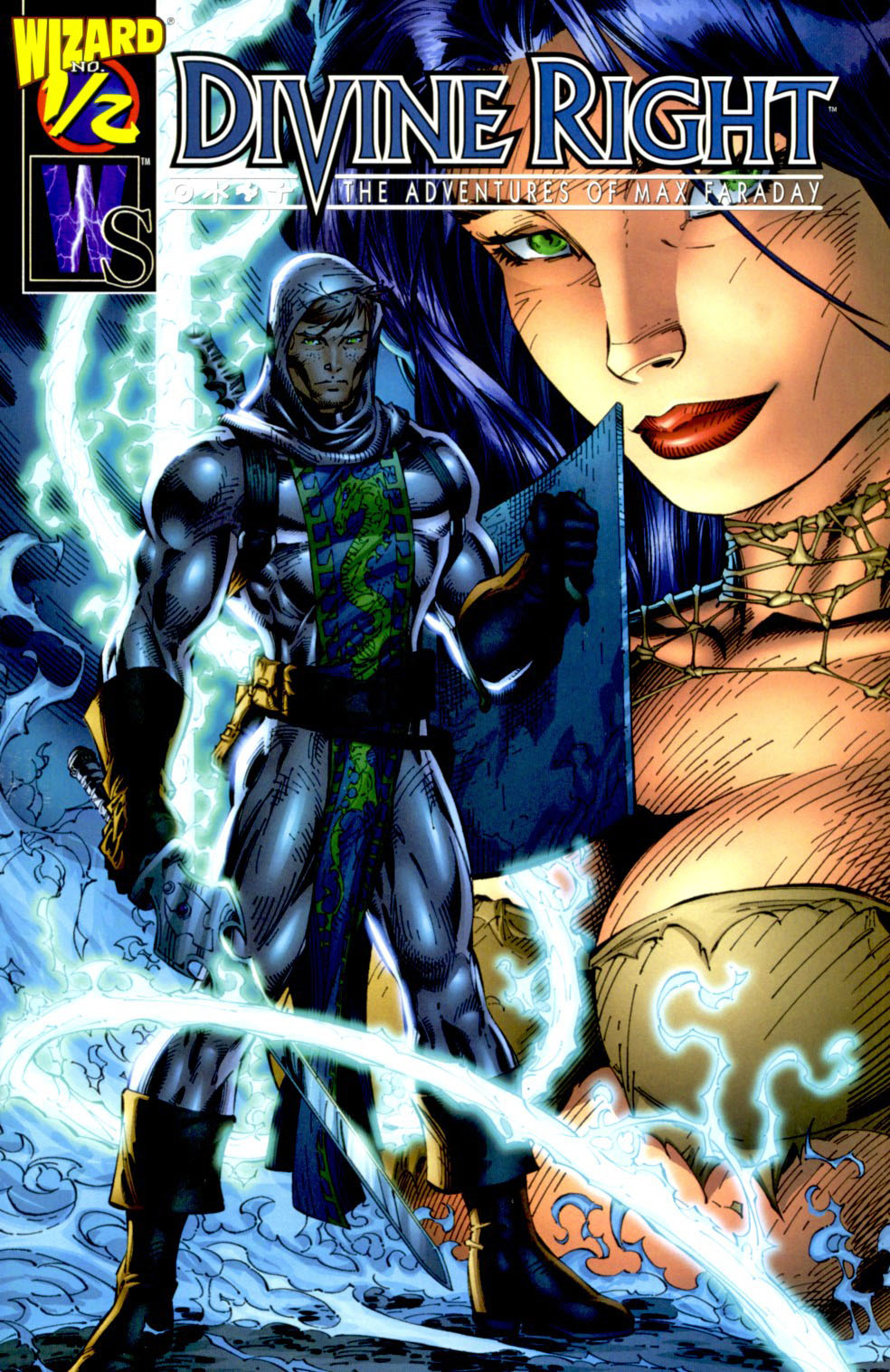
Divine Right, #1/2, July 1998

Divine Right: The Adventures of Max Faraday is Jim Lee’s final creator-owned project launched at WildStorm prior to DC Comics acquiring the company.

A number of fans called Jim a “sell-out” at the time, much in the same way they hollered when Jim and Rob Liefeld agreed to reboot some of Marvel’s classic superheroes a short while earlier. (Thank goodness contemporary social media hadn’t appeared yet, but let’s face it, trolls are still trolls.)
The Irony of that criticism? Being independent means making your own choices, on your own terms, whatever those might be.

And ultimately, the winnow swallowed the whale. DC became much more like WildStorm, rather than the other way around. And Jim of course became DC publisher.

As for Max Faraday? It was planned to be a mini-series, and has remained a “one and done” project with a complete collection finally appearing in 2014.

We continue with our month long celebration of the “Independents” — Independent creators and projects that continue to impact the comic book medium.  See you back here on Thursday.

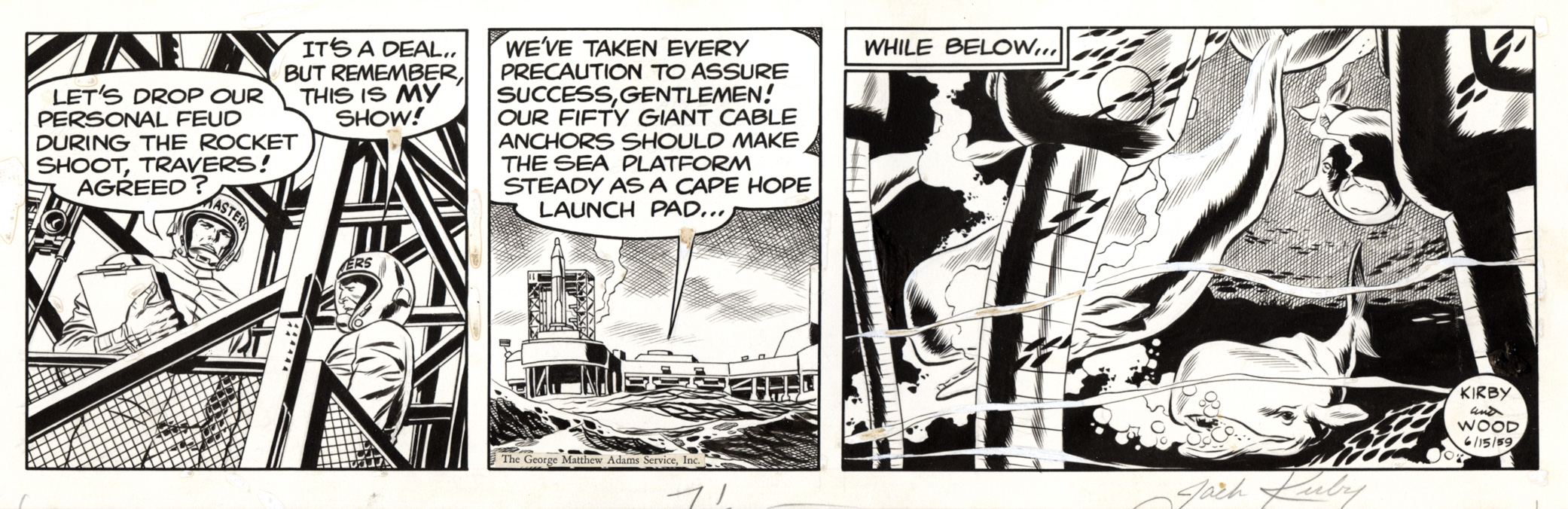
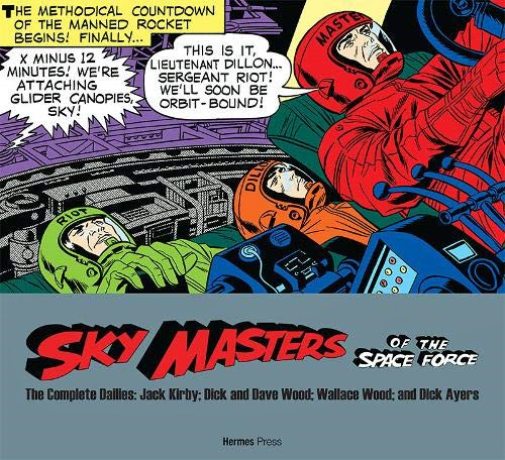
Jack Kirby & Wallace Wood — Blastoff

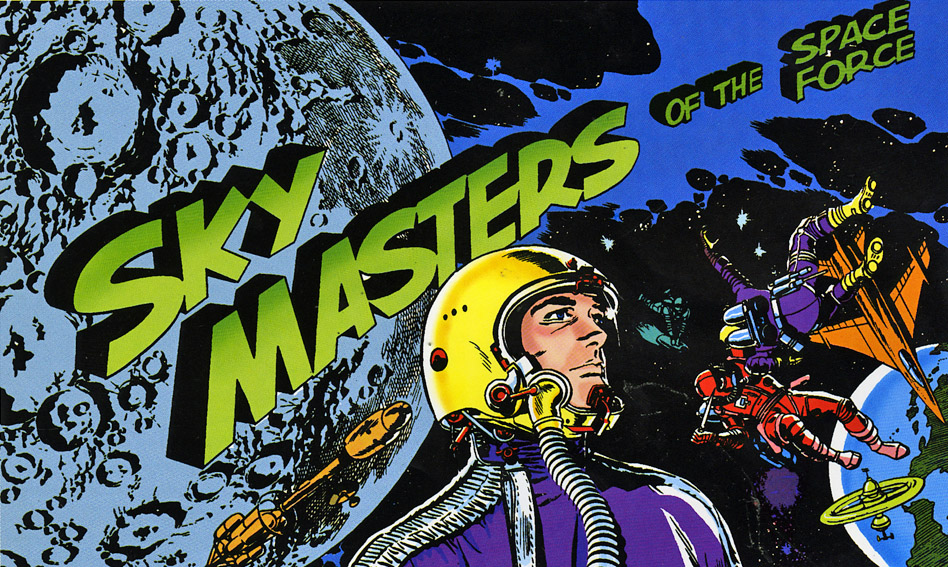
Sky Masters, Daily Strip, June 15, 1959

What if…

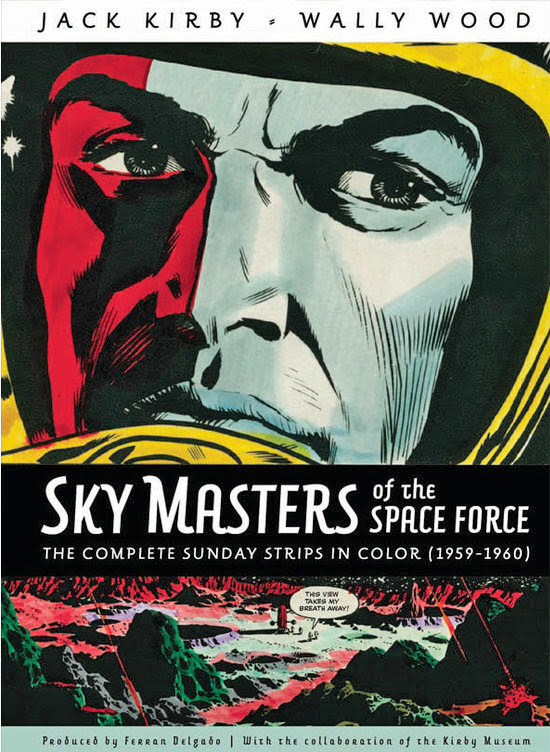
Jack Kirby’s 1958 Sky Masters newspaper comic strip — about the nascent space race — had turned into a giant hit for Jack, and partner Dave Wood.

What if…

Kirby had been able to easily solve any financial dispute with DC editor Jack Schiff about the strip’s royalty terms. (The News syndicate had originally approached Schiff about the creation of the strip, and Schiff appears to be the intermediary between the syndicate and writer Dave Wood.)
What if… 

Despite any financial acrimony over the strip, Schiff didn’t fire Kirby from Challengers of the Unknown… and all of DC comics.

You can see where this is going —

Jack continues to draw Sky Masters, fits in some DC comics work whenever possible, and never finds any time to return to Atlas/Marvel.

And “The Marvel Age of Comics” takes a completely different turn, if it even manages to leave the launching pad.

For those interested in the nitty gritty of dispute, Wikipedia has done a good job of assembling an overview (and sources) here.

Writer Jon B. Cooke provides an even more detailed summary, from the Jack Kirby Collector.

Fun fact: For many years, like most fans, I thought the “Wood” on Kirby/Wood signature referred to Wallace Wood as inker. It actually referred to Dave Wood and his brother Dick who co-wrote the strip. This, despite the fact that that Woody actually did ink the strip for about the first year, including the example above. (Dick Ayers eventually came on the strip as inker, and ultimately Jack inked it himself, likely with help of wife Roz.)

Continuing our month long celebration of the great adventure comic strips:
Week 1: Superheroes
Week 2: Detectives
Week 3: SF
Week 4: Comic Book Giants

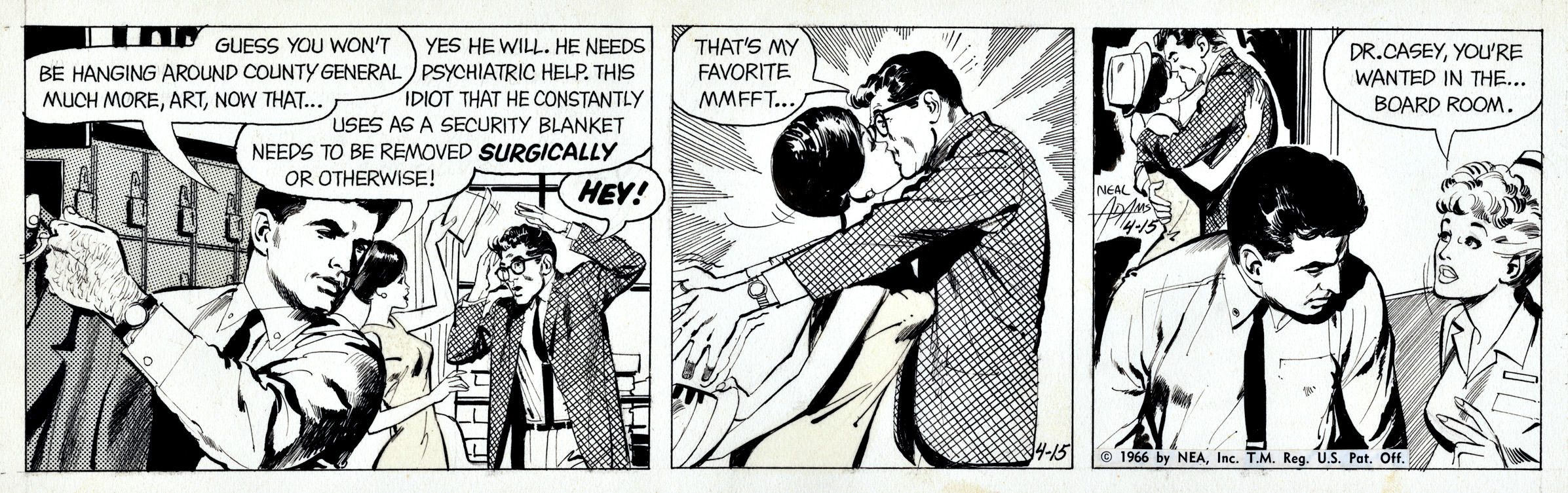
Neal Adams — Happy (Belated) Birthday

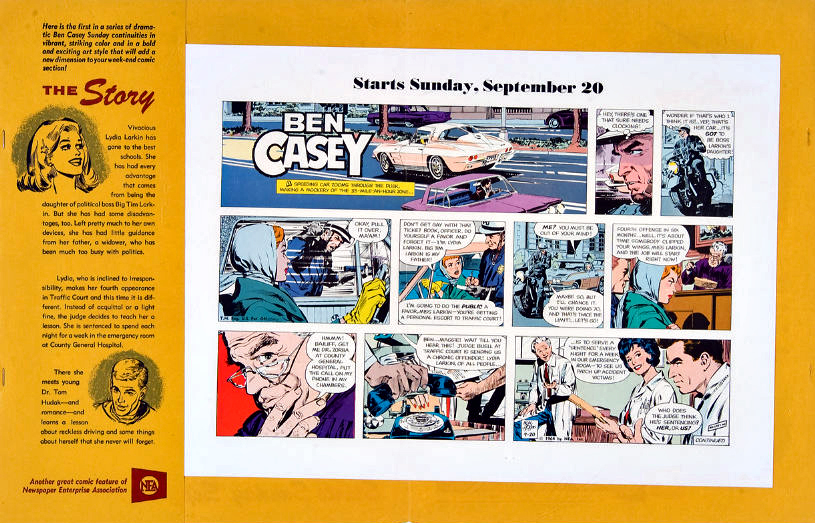
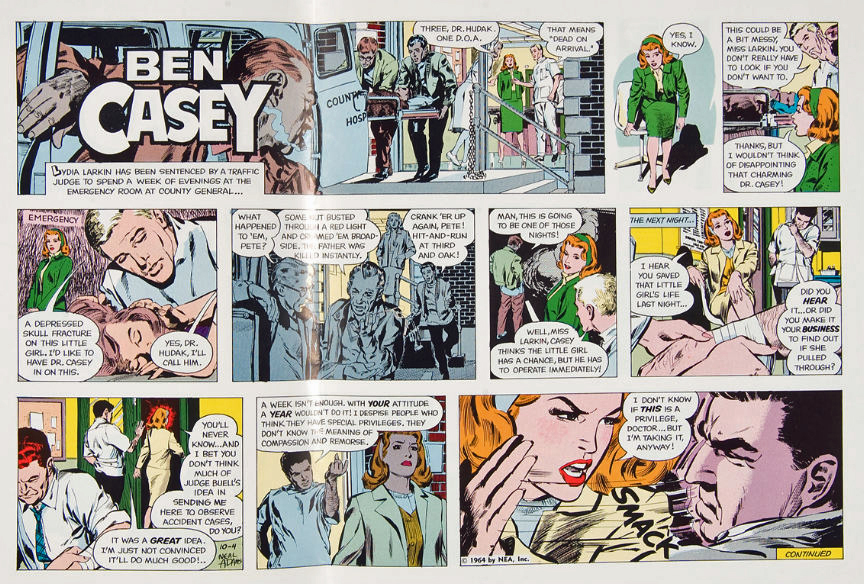
Ben Casey, Daily Strip, April 15,1966

Neal Adams turned 80-years old last Tuesday, June 15.

I’ve been planning for months to pay tribute to great strips, and great strip artists, in the month of June.

Had I been able to logically put two and together, this post would have run last week, not today.

In other words, I’m a week late… and a more than a dollar short. Ack.

As for Dr. Ben Casey? From Neal’s own website:

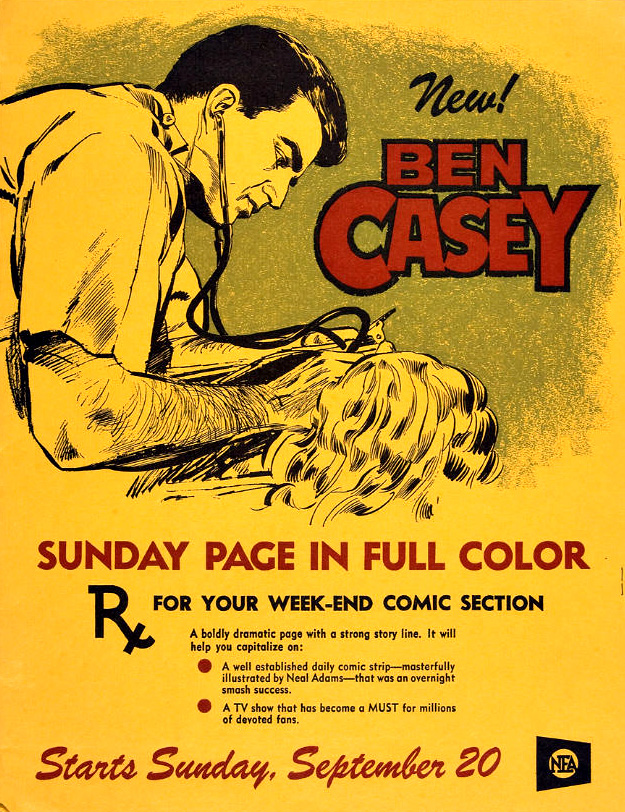
“When charming and talented Neal Adams was just 21, he was awarded the art chores of the comic strip based on the popular TV show Ben Casey staring Vince Edwards. One of the youngest, syndicated strip artists, Neal started his groundbreaking work on November 26, 1962 and the Sunday strip was added on September 20, 1964. Four years later, the strip ended as the television show did, but Neal’s career was just starting.”

I have a lot of “favorite” artists, but the one who had the most impact on me as a youngster was — you guessed it — Neal Adams

And the charming side of him can indeed be charming as hell.

Fun fact: A collection of all Neal’s Casey strips should be considered a holy grail of archival reprints. 

We tried. We really tried. 

Can’t win them all.

Continuing our month long celebration of the great adventure comic strips:
Week 1: Superheroes
Week 2: Detectives
Week 3: SF
Week 4: Comic Book Giants

Wayne Boring — Superman Powers Up

Superman Daily Strip, September 29, 1965

Classic Superman artist Wayne Boring provides us with an excellent and rare daily strip at the end of Superman’s 27-year newspaper run.

The excellence is obvious; Superman uses three different super powers in each of the three panels. 

Rare because, well, pretty much the same reason: Many, many strips from this period only feature Clark, Lois or other characters in “civilian” garb, with soap opera style plots and stories. In other words, there are many strips where Superman is nowhere to be found.

In fact, in the 80s, Boring would often Remarque those “plain” originals with a Superman figure to make them more desirable in the collectors market.

But of course, no need to add an “extra” Superman here. He’s doing just fine in this good-looking example.

We managed to collect most of the Superman strips at IDW and LOAC, but couldn’t find any collectors with complete runs from the earliest silver age period. (Late 50s.) That era of strips includes the introduction of a Brainiac prototype (“Romado”) drawn by the great Curt Swan.

Al Plastino — Batman’s Watery Doom!

Batman Daily Strip — July 8, 1969

Bat sheets. Bat soap. Bat pajamas. Bat-a-rangs…

As nearly any pop culture fan knows, (especially — ahem — older ones like myself) the hugely successful camp 1966 Batman TV show launched a plethora of bat merchandise.

So it’s no surprise that DC launched a revival of the Batman comic strip, which had a successful, but brief run in the Golden Age.

The daily strips initially mimicked the campiness of the TV show, but ultimately moved closer to more traditional DC superhero stories, as did the comics after the show was cancelled in early 1968.

Al Plastino handled the art chores for many of the strips, following Sheldon Moldoff and Joe Giella.

The strip managed to soldier on until early 1973. Finally managing to collect all of them — the dailies and Sundays — into a three-volume LOAC series was an archival highlight of mine at IDW. 

(It only took five years or so to convince DC to let us do it. Perseverance won the day.)

Butch Guice — Alternate Vision

Storming Paradise #5, July 2009

General Patton dramatically fires on… Japanese soldiers? 

In this alternate reality version of World War II, anything is possible. America’s atomic test goes horribly wrong in New Mexico, and the US is unable to produce a working A-Bomb. So the only way to attempt to defeat the Japanese forces is to invade.

Created by Chuck Dixon and Jackson “Butch” Guice the series ran into some scheduling and deadline challenges. At a minimum, there was a six-month gap between issues #4 and #5.

Hence, other artists were called in to help out. Some pages — like this one — look 100 percent Guice, and others, less so. Rich Burchett gets credits for pencils this issue but I’m guessing that many pages are rough breakdowns only.

But like I said, that’s a guess.

Guice ‘s art style has changed dramatically over the years. I enjoyed his early superhero work, but I find his contemporary “photo-realistic” style more appealing.

And perfect for a series that features the aforementioned General Patton, Harry Truman, George HW Bush and other recognizable historical figures.

Even if that history actually never happened.

Alex Toth — Illuminating

Weird War Tales #6, August 1972

One picture is worth a thousand words.  At least, that’s what they say. (“They” say a lot.)

In the case of this beautiful Alex Toth war page, I will eliminate 999 of them.

All we need to really say is: Astonishing.

Every single time I examine the page, I marvel at how Toth created those lighting effects using only India ink and negative space.

Every. Single. Time.

The art tricks the brain into seeing the illumination as three dimensional as if it were celluloid in a darkened theater. Hell, most cinematography fails to capture lighting as brilliantly as this.

Oh, and the storytelling and camera angles are terrific, too. And of course, the sound effects in the trademark Toth style, add to the drama.

Astonishing.

Dan Spiegle — The Last P.O.W.

Sgt. Rock #382, November 1983

We’ve used the phrase artist’s artist here a few times. Simply put, it’s an artist that other members of the craft more than admire and appreciate; they are often awestruck by the talent.

Dan Spiegle was one of those artists. 

Talented, speedy, and reliable. Did I say talented again?  It’s worth repeating.  He did a lot of terrific work for Gold Key (Space Family Robinson, Doctor Spector, Korak, etc.) and a ton of licensed material including a well-regarded run on Maverick (James Garner’s TV series), only occasionally finding time for DC and Marvel.

So I’m fortunate that he did manage a few DC war stories, including this one from 1983. It’s a typical example of Spiegle’s talents —creative storytelling and great spatial arrangements, inventive camera angles, and, of course, detailed and clean draftsmanship.

From a fan perspective, his lack of consistent work on “mainstream” titles often meant less recognition than he deserved: An underrated talent if there ever was one  — except by the people that knew his work.

John Severin — The Bloody Flag

Our Army At War #272, September 1974

The single greatest compliment I ever heard abut John Severin’s art — and there were many others — came from Jack Kirby, via Mark Evanier:

“Jack used to say that when he had to research some historical costume or weapon for a story, it was just as good to use a John Severin drawing as it was to find a photo of the real thing.”

Severin’s lavish attention to detail caught my eye early. The line-work was so precise and polished. It was amazing stuff, especially considering that those details needed to reproduce on cheap, pulpy newsprint running on industrial web presses.

As a kid, especially remember his pitch-perfect inking on Herb Trimpe’s pencils for The Incredible Hulk. I also loved John’s pairing with sister Marie Severin on some of the earliest issues of Kull. John’s had one weakness was that occasionally his realistic line work could come off as stiff and inking Marie’s more dynamic layouts solved that issue.

Severin was best known for three non-superhero genres:  Westerns, humor, and war. He was a pro at all three, and everything else he touched as well.

As Evanier wrote, “They don’t make ’em like that anymore.” 

Indeed they don’t.

(These two pages, along with others, were especially selected for the exhibit “War No More” at the Words & Pictures Museum in Northampton, Mass. in 1993.)